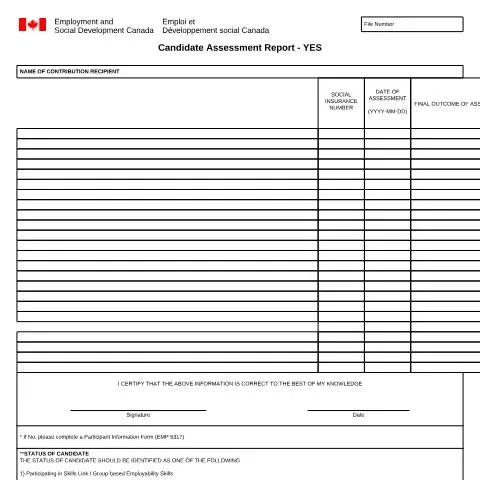
Understanding the Participant Assessment Report (Form EMP5318A)
The Participant Assessment Report, identified by the reference code EMP5318A, plays a crucial role in the landscape of employment initiatives managed by Employment and Social Development Canada (ESDC). This document is specifically designed for individuals engaged in various skills development programs. Its primary function is to evaluate a participant's progress and outcomes during their involvement in programs aimed at enhancing employability and skill sets.
Who Submits the Participant Assessment Report?
This report is typically submitted by program coordinators or designated officials from organizations that run employment training programs, such as Skills Link or other community-based initiatives. These individuals are responsible for compiling the necessary information about the participants' experiences, achievements, and challenges faced throughout the program duration.
Target Groups for the Report
- Youth Participants: Often between 15 and 30 years old, these individuals are directly engaged in skill-building programs.
- Community Organizations: Non-profits and educational institutions that facilitate training and employment programs.
- Government Bodies: Entities that monitor and evaluate the effectiveness of employment support programs.
Decoding the Structure of the EMP5318A
The form is structured in a way that ensures comprehensive assessment while maintaining clarity. Each section is essential for capturing vital participant data. The key areas include:
1. Participant Information
This section requires detailed information, including the participant's name, Social Insurance Number (SIN), and the date of assessment. Accurate entry is critical here, as errors could lead to delays or complications in processing.
2. Status of Candidate
Participants must be categorized under one of several statuses, which helps in understanding their level of engagement and the type of support they are receiving. Options include:
- Participating in Skills Link / Group-based Employability Skills
- Participating in Skills Link / Community Service
- Participating in Skills Link / Work Experience
- Participating in Skills Link / Individual Skills Enhancement
- Waiting for intervention
- Other / Unknown
It is essential to choose the correct status, as this categorization affects the follow-up and resources allocated to the participant.
3. Final Outcome of Assessment
This part of the form captures the overall assessment result. It's crucial to clearly state whether the participant successfully completed the program or if there were any setbacks that need to be documented.
Navigating Common Challenges with the EMP5318A
Filling out the Participant Assessment Report is not without its complexities. Participants and submitting organizations often encounter several challenges:
Identifying the Correct Reporting Status
Misclassifying the participant’s status can lead to incorrect outcomes and hinder future funding or support. Organizations should thoroughly train staff on the distinctions between each category to avoid errors.
Documentation and Evidence
- Gathering supporting documentation can be cumbersome. Ensure that all necessary evidence of participation and outcomes is compiled before submission.
- In cases where documentation is incomplete, the report may be rejected or delayed. Establish a checklist to ensure all required documents are included.
The Broader Context of Employment and Skills Development
The Participant Assessment Report does not exist in isolation. It is part of a larger framework of employment and skills development strategies set forth by the Canadian government. These initiatives aim to:
- Enhance employability among vulnerable populations, including youth and marginalized groups.
- Support organizations that provide crucial training and job placement services.
- Monitor the effectiveness of funded programs to ensure return on investment for taxpayers.
What Happens After Submission?
Once the Participant Assessment Report is submitted, several processes are triggered:
Processing Times and Follow-up
Typically, processing may take several weeks. Organizations should maintain records of their submissions and follow up if they do not receive confirmation within the expected time frame. Following are the steps to take:
- Document the submission date and personnel involved.
- Check in with the relevant ESDC contact for status updates after the processing window has closed.
- Be prepared to provide further information if requested.
Addressing Issues: When Things Don't Go as Planned
In instances where the assessment report may be rejected or flagged for errors, here’s how to navigate these challenges:
Common Reasons for Rejection
- Inaccurate or missing participant information.
- Improper selection of candidate status.
- Lack of supporting documentation.
Steps to Rectify Issues
If your submission is rejected:
- Review the feedback provided by ESDC meticulously.
- Make the necessary corrections to the report.
- Resubmit promptly to avoid delays in program assessments.
Regulatory Framework: The Legal Backdrop
The Participant Assessment Report operates under a specific regulatory framework that governs employment and training programs in Canada. The primary legal provisions include:
- The Canada Employment Insurance Act
- Various policies established by Employment and Social Development Canada
Understanding this legal backdrop helps organizations and individuals navigate the application process effectively, ensuring compliance and optimized outcomes.
Conclusion: The Importance of Accurate Reporting
In the intricate world of employment and social development, forms like the Participant Assessment Report serve as vital tools. The accuracy and timeliness of these reports can significantly impact funding, support, and the overall effectiveness of training initiatives. Engaging in thorough preparation and understanding the nuances of the EMP5318A will empower organizations and participants alike to succeed in their employment endeavors.
Understanding the Purpose of the Participant Assessment Report
The Participant Assessment Report (PAR) serves as a pivotal document within various social and employment programs in Canada. Initiated by Employment and Social Development Canada (ESDC), the PAR establishes a comprehensive profile of an individual's skills, work history, and educational background. The main objective of this report is to facilitate a streamlined process for eligibility assessments for programs such as Employment Insurance (EI), Canadian Pension Plan (CPP), and various social assistance initiatives.
When you apply for these programs, the PAR is crucial in determining your suitability and the level of support you may receive. This assessment involves a thorough evaluation of your capabilities and potential contribution to the workforce. It not only influences the benefits you may be entitled to but also provides insight into the support services necessary for your success, such as training programs, job placement services, and skill development opportunities.
Understanding your PAR is beneficial not just for immediate program applications but also for long-term career planning. By identifying your strengths and areas for improvement, you can better navigate your career path and consider further education or training that aligns with your aspirations and the job market's demands.
How to Request a Participant Assessment Report
If you find yourself needing a Participant Assessment Report, the process to obtain one is relatively straightforward, but it does have specific steps that you must follow. Here’s a detailed guide on how to go about it:
Determine Your Eligibility: Before you initiate the request, confirm that you are eligible for a PAR. Typically, the assessment is available to individuals seeking benefits under ESDC programs, including those who may be transitioning from social assistance to employment.
Gather Necessary Documentation: You will need to provide various documents to substantiate your application. Core documents often include proof of identity (your Social Insurance Number), educational qualifications, résumés, and any previous work references. If you have participated in training programs or workshops, gather those certificates, as they can enhance your profile.
Contact Your Local Service Canada Centre: To initiate the request, reach out to your nearest Service Canada Centre. You can do this either in person, through telephone, or, in some cases, through their online platform. Make sure you express your intent clearly: you want a Participant Assessment Report.
Complete Required Forms: During your interaction, you may be required to fill out specific forms. The most relevant form is the Service Canada General Application Form, which can usually be accessed online or at your local Service Canada Centre. Ensure all information is filled out accurately to avoid delays.
Submit Your Request: After completing the necessary forms and compiling your documentation, submit your request through the designated channels. Keep copies of everything for your records.
Follow Up: After submitting your request, be proactive in following up. Depending on the volume of requests, it may take some time to process. You can check the status of your assessment by contacting the Service Canada Centre where you submitted your application.
Understanding these steps can significantly ease the process of obtaining your Participant Assessment Report, ensuring you are prepared to access the benefits and resources available to you.
Common Challenges and Solutions in the PAR Process
Navigating the Participant Assessment Report process can sometimes be fraught with challenges. Here are some common obstacles you might encounter and practical solutions to address them:
Incomplete Documentation: One of the most frequent issues applicants face is the inability to provide all necessary documentation. This can delay the assessment process significantly. To mitigate this, it's wise to create a checklist of all required documents before starting your application. Consider reaching out to past employers or educational institutions ahead of time to gather the necessary paperwork.
Misunderstanding Eligibility Criteria: Some individuals may not fully grasp the eligibility requirements for obtaining a PAR. This misunderstanding can lead to wasted time and effort. To counter this, take advantage of resources provided by ESDC and Service Canada, including their official websites and customer service representatives. They can provide clarity on what qualifies and what does not.
Long Processing Times: Depending on the volume of applications, the processing time for your PAR can sometimes be lengthy. If you find yourself waiting longer than expected, don’t hesitate to reach out to Service Canada for updates. Being persistent can help expedite your application.
Language Barriers: For individuals whose first language is not English or French, communication can become a barrier during the application process. Service Canada provides services in both official languages, but if you need further assistance, consider bringing a bilingual friend or family member to help, or inquire about translation services that may be available through local community organizations.
Lack of Clarity on Next Steps: After receiving your PAR, you might feel uncertain about how to proceed, particularly if you face challenges in finding employment. It's beneficial to connect with local employment services or community organizations that offer workshops, mentorship programs, and job placement assistance tailored to your profile. This proactive approach can facilitate the transition from assessment to active job searching.
By being aware of these common challenges and preparing accordingly, you can navigate the Participant Assessment Report process with greater confidence and efficiency. Remember, the ultimate goal is to secure the support you need for your career advancement and overall well-being.