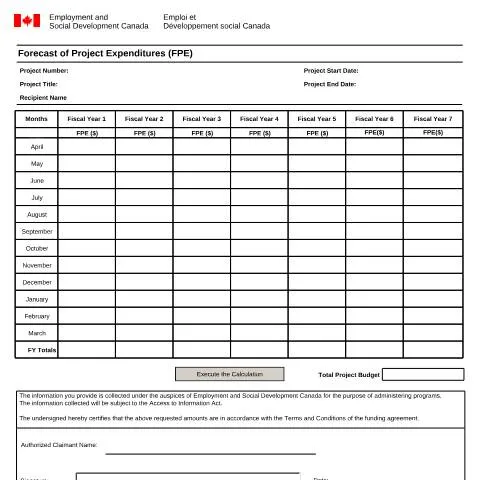
Understanding the Forecast of Project Expenditures (FPE) Form
When embarking on a project funded or supported by the Employment and Social Development Canada (ESDC), navigating the administrative landscape can be daunting. The Forecast of Project Expenditures (FPE) form (code EMP5538) stands as a critical document in this process, serving as a formal forecast of financial needs across various fiscal years. Understanding its role, requirements, and potential implications is essential for those responsible for project management within the Canadian funding framework.
Key Components of the FPE Form
The FPE form outlines a structured approach to predicting project expenditures, segmented by month and fiscal year. Let's break down its essential components:
- Project Details: The form requires the project number, title, start date, and end date. These details create a clear identity for the project, essential for tracking and accountability.
- Monthly Breakdown: Each month across up to seven fiscal years is listed, with space allocated for outlining the forecasted expenditures. This section is critical for providing a granular view of anticipated spending.
- Fiscal Year Totals: At the end of each yearly section, totals must be calculated and recorded, assisting in summarizing the financial forecast.
- Certification: The form concludes with a certification section where the authorized claimant signifies the accuracy of the information provided, reinforcing accountability.
The Importance of Accurate Forecasting
Accurate forecasting is not merely a procedural element; it directly influences funding decisions and project viability. A well-prepared FPE form ensures that:
- Financial needs are clearly communicated to ESDC, which can facilitate timely approval and disbursement of funds.
- Potential financial pitfalls are identified early, allowing for adjustments before project commencement.
- Accountability is maintained, as forecasting aligns expectations between stakeholders and funders.
Steps for Completing the FPE Form Effectively
Completing the FPE form can be streamlined by following a systematic approach. Here’s a detailed walkthrough of the process:
- Gather Relevant Data: Collect all necessary financial data regarding the project, including historical expenditures and anticipated costs.
- Fill in Project Information: Complete the top section of the form with accurate project details. Ensure that all entries are clear and succinct.
- Detail Monthly Expenditures: Carefully predict expenditures by month for each fiscal year. Consider consulting with project managers or accounting personnel to enhance accuracy.
- Calculate Yearly Totals: After entering monthly data, ensure that totals for each fiscal year are accurate to avoid discrepancies.
- Complete Certification: The authorized claimant must sign and date the form, asserting that all information is correct to the best of their knowledge.
Where to Submit the FPE Form
Once the FPE form is completed, it must be submitted to the appropriate ESDC contact point. The submission process generally includes:
- Email Submission: Many organizations may prefer electronic submission via email. Ensure the document is in an acceptable format (usually PDF) and confirm the email address before sending.
- Mail Submission: If required, the form can be mailed to the ESDC office. Use registered mail for tracking and to confirm receipt.
Monitoring Your Submission: Follow-Up Procedures
After submitting the FPE form, it’s crucial to monitor its status to ensure timely processing. Here are steps to facilitate effective follow-up:
- Document Submission: Keep copies of all submitted documents, including the FPE form and any correspondence with ESDC.
- Set Reminders: After a few weeks, set reminders to follow up with ESDC to check on the status of your submission.
- Contact ESDC: Reach out through official channels (phone or email) to inquire about the processing status. Be ready to provide your project details to expedite the process.
Handling Common Issues: What Happens If Your FPE is Rejected?
While submitting the FPE form, there might be instances where it is rejected or requires resubmission. Understanding how to navigate these challenges is imperative:
- Review Feedback: If your submission is rejected, carefully review the feedback provided by ESDC. Understanding the reasons for rejection is critical for making necessary adjustments.
- Correct Errors: Address any errors or omissions indicated in the feedback. This may involve revising expenditure estimates or providing additional documentation.
- Resubmit Timely: Once corrections are made, resubmit the FPE form as soon as possible to avoid project delays.
Clarifying Misconceptions: Distinguishing the FPE from Similar Forms
The FPE form may often be confused with other financial documents used within project funding frameworks. Here’s how it stands apart:
| Form Type | Purpose | Key Differences |
|---|---|---|
| FPE (EMP5538) | Project expenditure forecasting over multiple years. | Focuses specifically on projecting future costs; requires monthly breakdown. |
| Budget Proposal | Outlines proposed budget allocations for funding requests. | More comprehensive; generally includes justifications for costs. |
| Financial Report | Documents actual expenditures incurred during project execution. | Reflects historical data rather than future forecasts. |
The Implications of Inaccuracies in the FPE Form
Providing inaccurate information on the FPE form can have serious consequences:
- Funding Delays: Inaccuracies may lead to delays in funding approvals, impacting project timelines.
- Accountability Issues: Misreporting expenditures can raise concerns about financial integrity and accountability.
- Future Applications: A history of inaccuracies may complicate future funding applications or project approvals with ESDC.
Preparing Supporting Documents: A Checklist
In addition to the FPE form, several supporting documents may be required to strengthen your submission:
- Previous Financial Reports: Include past funding reports that showcase historical financial management.
- Detailed Project Plans: A comprehensive project plan can help clarify the context for your expenditure forecasts.
- Letters of Support: Endorsements from stakeholders can bolster your application and credibility.
In summary, the FPE form is a cornerstone of project funding within the ESDC framework. Understanding its nuances, accurately completing it, and being proactive in managing the submission process can significantly enhance the success of your project funding endeavours.
Understanding the Importance of Forecasting Project Expenditures
Forecasting project expenditures is a crucial practice in Canada, not only for private enterprises but also for public sector projects. Understanding the intricacies of expenditures allows organizations to allocate resources more efficiently, manage risks effectively, and enhance overall project success rates.
To begin with, project expenditures typically encompass direct costs such as materials and labor, as well as indirect costs like overhead and administration. Accurate forecasting can aid in identifying variances between budgeted and actual costs early in the project lifecycle, which is paramount for decision-making and executing timely corrective actions.
The methodology behind forecasting varies widely depending on the type of project and its sector—be it construction, IT development, or community services. For instance, in the construction sector, tools like historical data analysis and expert judgment are often employed to predict future costs based on past project scopes. In contrast, IT projects may rely more on iterative approaches like Agile budgeting, where expenditures are reassessed at the conclusion of each sprint.
Moreover, various factors can influence project expenditures, including economic conditions, regulatory changes, and technological advancements. For example, a sudden increase in material costs due to supply chain disruptions can significantly impact a project's financial forecast. Therefore, incorporating a flexible forecasting model that can adapt to market changes is vital.
In Canadian governance, effective forecasting also plays a role in transparency and accountability. Public agencies are often audited, and well-documented project expenditure forecasts bolster public trust and help ensure that taxpayer dollars are spent responsibly.
Key Methodologies in Expenditure Forecasting
Different methodologies exist for forecasting project expenditures, each with its own advantages and contexts of use. Understanding these methodologies can help you choose the most appropriate one for your specific project requirements.
Top-Down Estimation: This method begins with an overall project budget derived from similar past projects. You can break down the total into individual components or tasks. While this approach is quick and can provide a broad overview, its accuracy may be compromised if historical data is not relevant to the current project.
Bottom-Up Estimation: This technique involves estimating the costs of individual tasks or components and then aggregating them to obtain a project-wide forecast. This approach typically yields higher accuracy but requires extensive detail and a deep understanding of every aspect of the project.
Expert Judgment: Leveraging the experience of experts in the field can lead to valuable insights that numbers alone might not reveal. This approach can be beneficial in volatile or niche sectors where historical data may not be as dependable. However, it is essential to weigh expert opinions against quantitative data to minimize bias.
Parametric Estimating: This method uses statistical relationships between historical data and other variables to develop cost estimates. For example, if data indicates that project costs per square foot have increased over the years, this information can be used to project costs for a new construction project accordingly.
Three-Point Estimation: This technique provides a more comprehensive forecast by considering three scenarios: the best-case, worst-case, and most likely costs. By analyzing these scenarios, you can create a range of possible outcomes and take a more informed approach to risk management.
Each methodology has its unique applicability; therefore, understanding the project's context and the available data is key to successful forecasting.
Integrating Forecasting with Project Management Tools
In today's digital age, integrating forecasting practices with project management tools can significantly enhance your ability to track and manage expenditures effectively. Such integration allows for real-time updates, dynamic adjustments, and comprehensive reporting capabilities.
Many project management software solutions include features for budgeting and expenditure tracking, enabling you to input your forecasts and compare them against actual expenditures continuously. This functionality can help you identify variances and make data-driven decisions rapidly.
Furthermore, cloud-based solutions allow for seamless collaboration among project stakeholders. Everyone involved in the project can access up-to-date financial information, ensuring that all parties are aligned, which is crucial for transparency in public projects funded by taxpayer money.
Another advantage of integrating forecasting with project management tools is the ability to leverage advanced analytics. Many platforms offer predictive analytics capabilities that can highlight potential risks and cost overruns before they materialize. By setting up alerts for when expenditures deviate from forecasts by a certain percentage, project managers can take proactive measures rather than reactive ones.
In addition, tools that incorporate Earned Value Management (EVM) enable you to assess the project's performance by comparing the planned value, earned value, and actual costs. This methodology adds another layer of insight, helping you determine not just what you have spent but also what you have accomplished relative to the budget.
When selecting a project management tool for expenditure forecasting, consider functionalities that allow for customizable reports, visual dashboards, and integration capabilities with other financial systems like accounting software. This comprehensive approach will help you achieve a holistic view of expenditures, paving the way for better decision-making and project outcomes.