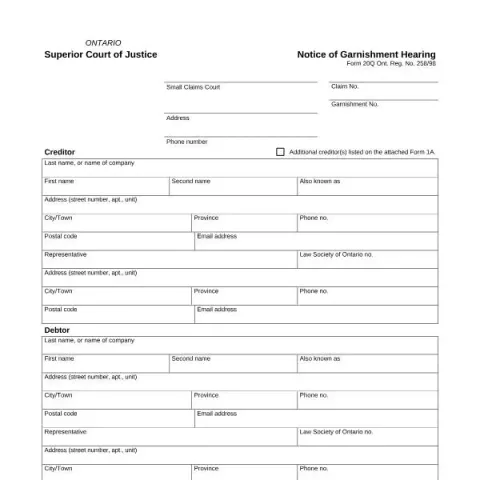
Understanding the Ontario Superior Court of Justice Notice of Garnishment Hearing (Form 20Q)
If you are involved in a legal proceeding related to debt collection in Ontario, you may encounter the Notice of Garnishment Hearing (Form 20Q). This official court document is used to inform relevant parties about an upcoming hearing concerning wage or asset garnishment. Knowing how to interpret and prepare for this notice is essential for creditors, debtors, and other interested parties.
Purpose and Scope of the Form
The primary objective of the Notice of Garnishment Hearing is to schedule a court hearing where parties involved in a garnishment case can present their arguments. The hearing aims to determine whether the garnishment order should be enforced or modified. It is a formal step in the legal process that ensures all parties have the opportunity to be heard before a court makes a binding decision.
This form is applicable in cases where a creditor seeks to garnish wages or assets from a debtor, or when other interested persons challenge or support the garnishment. It is designed to facilitate transparent communication and proper scheduling of the hearing.
Preparing Your Case and Completing the Form
Gathering Necessary Information
- Claim and Garnishment Numbers: Ensure you have the correct claim number and garnishment number assigned to your case.
- Parties Involved: Accurately identify all parties, including the creditor, debtor, garnishee (the employer or asset holder), co-owners of the debt, and any other interested persons. Complete their full names, addresses, phone numbers, and email addresses.
- Legal Representation: If any party is represented by a lawyer, include the Law Society of Ontario registration number and contact details.
Filling Out the Form
The form requires detailed information about each party involved. It also specifies the date, time, and location of the hearing, which can be in person or via videoconference. When completing the form:
- Indicate the reason for the hearing by checking the appropriate box (e.g., creditor, debtor, garnishee).
- Provide a clear, numbered statement of the dispute or issue at hand, including the specific orders or relief sought.
- Attach additional pages if necessary to fully detail your case.
Serving the Notice and Ensuring Compliance
Once completed, the Notice of Garnishment Hearing must be served on all relevant parties. This includes the creditor, debtor, garnishee, co-owners of the debt, and any other interested persons. Service must be carried out by the person requesting the hearing, following the rules set out in the Rules of Civil Procedure (R. 8.01(9)).
Failure to serve the notice properly or to attend the scheduled hearing could result in the court making orders in your absence or enforcing garnishment actions without your input. Therefore, timely service and attendance are crucial.
Scheduling and Attending the Hearing
The court clerk or the party requesting the hearing must contact the court to select an appropriate date and time. The hearing can be held in person at the designated courthouse or via videoconference, depending on the circumstances and court availability.
Parties should prepare all relevant documentation and be ready to present their case. If you are the debtor, for example, you might want to bring proof of income or assets, while creditors should have supporting documentation of the debt and garnishment request.
Fill in your form directly online
No printing: type your details into the boxes of the official form, tick, then download the PDF ready to send.
- 1Type into the form boxes
- 2Tick in one click
- 3Save and download the PDF
Additional Resources and Contacts
For questions about accessibility or court services, parties can contact the court at the provided phone numbers or TTY services. It is advisable to review the official court forms available online for the latest versions and detailed instructions.
Understanding the process and preparing adequately can help ensure your rights are protected during the garnishment hearing. Always consider consulting with a legal professional if you have specific questions or complex issues related to your case.