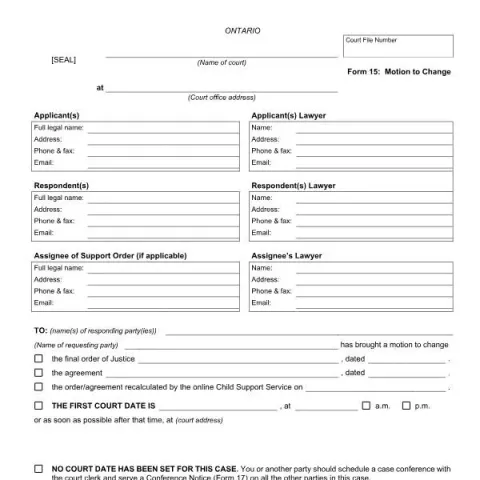
Understanding the Ontario Courts Form 15: Motion to Change
If you are involved in a family law case in Ontario and need to request a modification to an existing court order or agreement, you will likely need to complete and submit Form 15: Motion to Change. This official document is used to formally ask the court to alter decisions related to child support, parenting arrangements, spousal support, or decision-making responsibilities. Understanding how to properly fill out and submit this form is essential for ensuring your case proceeds smoothly and that your concerns are clearly communicated to the court.
Purpose and Scope of Form 15
Form 15 is designed to provide the Ontario courts with detailed information about your request for a change to a previous order or agreement. This form is applicable in cases involving:
- Child support adjustments
- Changes to parenting time or decision-making responsibilities
- Modifications to spousal support
- Alterations to contact arrangements or other related issues
It is a critical step for parties seeking to update or modify existing court orders based on changed circumstances, such as income variations, relocation, or evolving needs of children.
How to Prepare Your Motion to Change
Gathering Necessary Information
Before completing Form 15, you should collect relevant details, including:
- Dates of key events such as when the parties started living together, married, or separated
- Full legal names, addresses, and contact details of all parties involved, including legal representatives if applicable
- Information about the children involved, including their full names, birthdates, current living arrangements, and who they are living with
- Income details for the requesting and responding parties over the past three years to support your case for a change
Specifying the Changes Requested
On the form, you will need to clearly indicate which aspects of the existing order or agreement you wish to change. This can include:
- Child support amounts, whether to increase, decrease, or modify specific expenses
- Parenting time or decision-making responsibilities
- Spousal support arrangements
- Contact or communication arrangements
- Other specific terms outlined in the original court order or agreement
Additionally, you may specify the exact paragraph numbers of the current order or agreement that you want to amend, along with the proposed new wording.
Filing and Responding to the Motion
Submission Process
Once completed, Form 15 must be filed with the appropriate Ontario court. The court will then schedule a first court date, which could be as soon as possible after the filing. If no court date has been set, the parties are responsible for scheduling a case conference by serving a Conference Notice (Form 17) on all involved parties.
Response Timeline
Responding parties generally have 30 days to reply to the Motion to Change. If served outside of Canada or the United States, this period extends to 60 days. Failing to respond within this timeframe may result in the case proceeding without your input, and the court may issue orders against you based on the available information.
Fill in your form directly online
No printing: type your details into the boxes of the official form, tick, then download the PDF ready to send.
- 1Type into the form boxes
- 2Tick in one click
- 3Save and download the PDF
Legal and Dispute Resolution Considerations
Under the Divorce Act and Children’s Law Reform Act, parties are encouraged to:
- Act in the best interests of the child in decision-making and parenting time
- Minimize conflict and protect the child's well-being
- Attempt out-of-court dispute resolution methods, such as mediation, where appropriate
- Provide complete and accurate information to the court
- Comply with any court orders issued in the case
Both parties or their legal representatives must certify awareness of these duties when submitting the form.
Conclusion
Completing and submitting Form 15 is a fundamental step if you seek to change an existing court order or agreement in Ontario family law cases. Proper preparation, timely filing, and understanding of your responsibilities can significantly influence the outcome of your motion. If you are unsure about the process or need guidance, consulting with a family law professional or legal advisor is recommended to ensure your rights and interests are adequately represented.