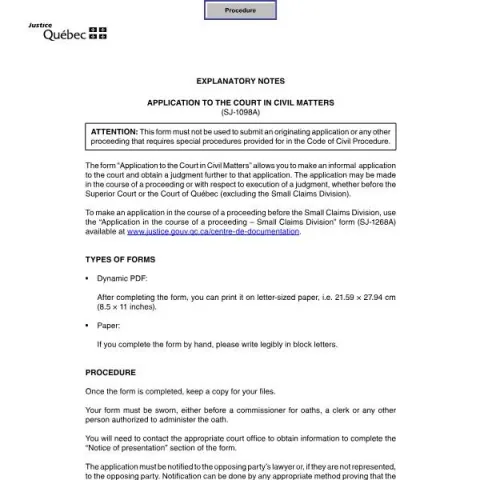
Understanding the Application to the Court in Civil Matters Form (SJ-1098A) in Quebec
The Application to the Court in Civil Matters form, identified by the code SJ-1098A, is a crucial document used within the Quebec civil justice system. Issued by the Ministère de la Justice, this form allows individuals or parties involved in civil proceedings to submit informal applications to the court, outside of the standard procedures for originating applications or other specific legal processes. This article provides a comprehensive overview of how to understand, fill out, and properly submit this form.
What Is the Purpose of the SJ-1098A Form?
The primary purpose of the SJ-1098A form is to facilitate informal applications to the court. This can include requests for access to court documents, extensions of deadlines, or other procedural matters that do not require initiating a formal legal proceeding. It is important to note that this form is not suitable for submitting an originating application or any proceeding that requires special procedures under the Code of Civil Procedure.
The form can be used in the context of ongoing proceedings or with respect to the enforcement of a judgment, whether before the Superior Court or the Court of Québec, but explicitly excludes the Small Claims Division. For applications related to Small Claims Court, a different form is used.
Who Should Fill Out This Form?
This form is intended for individuals or parties involved in civil matters who need to make an informal application to the court. This could include litigants, lawyers, or other authorized representatives. The person filling out the form must have relevant details about the case, such as the court district, file number, and the identities of the parties involved.
Step-by-Step Guide to Filling Out the Form
1. Complete the Header
Start by entering the details of the court district, locality, and the specific file number associated with your case. This information ensures your application is directed to the correct court and case file.
2. Identify the Parties
Provide the full names and addresses of all parties involved, matching the information already on record in the court case. Accurate identification helps prevent delays or misfiling.
3. Specify the Nature of Your Application
In the section titled "Title of Application," briefly describe the purpose of your request. For example, "Request for Access to Court Records" or "Extension of Deadline for Filing Evidence." Use the dropdown menus to select the appropriate category, or manually specify if necessary.
4. Describe the Content of Your Application
In the main body, clearly state the object of your application in the first paragraph. Follow with a detailed explanation of the grounds or reasons supporting your request. Be concise but precise, including relevant facts or legal considerations.
5. State Your Conclusions
Specify what you are asking the court to do. This could include ordering a specific action, declaring a fact, or granting an extension. Clearly state your desired outcome in this section.
6. Sign and Swear the Declaration
At the end of the form, you must sign the document in the presence of an authorized person, such as a clerk or commissioner for oaths. Include your full name and address. This sworn statement affirms the truthfulness of your application.
Fill in your form directly online
No printing: type your details into the boxes of the official form, tick, then download the PDF ready to send.
- 1Type into the form boxes
- 2Tick in one click
- 3Save and download the PDF
Filing and Notification Procedures
Once completed and sworn, you should keep a copy for your records. The form must then be filed with the appropriate court office, which can be done physically or via the Digital Court Office of Québec. Be aware that court fees may apply, and you should verify the current rates and payment methods on the official website of the Ministère de la Justice.
Notification of your application to the opposing party is a critical step. This can be done through registered mail, bailiff service, or any method that provides proof of delivery. Proper notification ensures that the other party is aware of your application and has an opportunity to respond.
Additional Tips and Common Errors to Avoid
- Ensure accuracy: Double-check all personal and case details to avoid delays.
- Use legible handwriting: If filling out by hand, write clearly in block letters.
- Attach relevant documents: Include any supporting evidence or documentation that substantiates your application.
- Follow proper sworn statement procedures: Sign the form in front of an authorized person to validate it.
- Notify correctly: Use a method that provides proof of delivery to the opposing party.
By following these guidelines, you can effectively utilize the SJ-1098A form to make informal applications to the Quebec courts, ensuring your requests are properly submitted and considered.