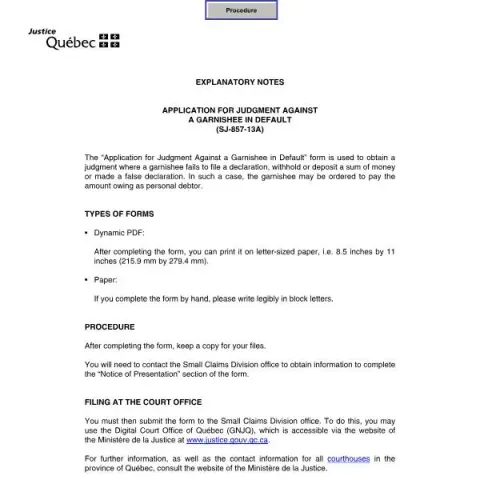
Understanding the Application for Judgment Against a Garnishee in Default (Form SJ-857-13A)
The Application for Judgment Against a Garnishee in Default (form SJ-857-13A) is an official legal document used within the judicial system of the Province of Quebec, specifically in the Small Claims Division of the Canada Court of Québec. This form serves a crucial role in enforcing court orders related to garnishment when a garnishee fails to fulfill their legal obligations. Whether you are a plaintiff seeking to recover owed funds or a legal professional guiding a client, understanding the purpose and proper use of this form is essential.
Purpose and Scope of the Form
This form is primarily used when a garnishee—someone who has been legally ordered to withhold or deposit a certain amount of money—fails to file the required declaration, withholds or deposits the money, or makes a false declaration. In such cases, the court can issue a judgment against the garnishee, effectively making the garnishee personally liable for the amount owed.
It is important to note that this form does not initiate a garnishment but rather addresses non-compliance with garnishment obligations. It is a procedural step in the enforcement process, ensuring that the court can impose a judgment on the garnishee who neglects their duties.
Who Can Use This Form?
- Plaintiffs or creditors who have previously obtained a garnishment order and are seeking to enforce it when the garnishee defaults.
- Legal representatives acting on behalf of the creditor or plaintiff.
- Parties involved in small claims cases within the jurisdiction of the Quebec Court of Québec.
Procedure for Filling Out the Form
Proper completion of the Application for Judgment Against a Garnishee in Default is vital for the effective processing of your case. Here are the key steps:
- Gather information: Obtain details about the garnishee, including their identity and the amount owed.
- Complete the form digitally or by hand: You can fill out the dynamic PDF version or write legibly in block letters if completing by hand. Ensure all sections are filled accurately.
- Specify the circumstances: Clearly indicate whether the garnishee failed to file a declaration, withheld or deposited funds, or made a false declaration.
- Include the date and location: Provide the date and court location where the application is filed.
After completing the form, keep a copy for your records. You will also need to contact the Small Claims Division office to obtain information necessary for completing the “Notice of Presentation” section of the form.
Filing the Application with the Court
The completed form must be submitted to the Small Claims Division office of the Quebec Court of Québec. This can be done via the Digital Court Office of Québec (GNJQ), accessible through the Ministère de la Justice’s website (www.justice.gouv.qc.ca).
When submitting, ensure that:
- You have included all relevant documentation and supporting evidence.
- Copies of the application are retained for your records.
- You follow any specific instructions provided by the court or the Digital Court Office for electronic submission.
Notice of Presentation and Court Hearing
Once the application is filed, a Notice of Presentation will be issued, indicating the date, time, and location of the court hearing. It is essential to attend this hearing to present your case and seek the court’s judgment against the garnishee.
Fill in your form directly online
No printing: type your details into the boxes of the official form, tick, then download the PDF ready to send.
- 1Type into the form boxes
- 2Tick in one click
- 3Save and download the PDF
The notice will specify the courthouse, room number, and scheduled time, allowing you to prepare accordingly. Missing the hearing could delay the enforcement process or weaken your case.
Post-Submission Considerations
If the court grants judgment against the garnishee, the next steps involve enforcing the judgment, which may include additional procedures such as seizure or further garnishment. It is advisable to consult with a legal professional or the court clerk for guidance on subsequent actions.
Remember, strict adherence to procedural rules and deadlines is crucial in legal proceedings. If you have questions about completing the form or the process, contact the Small Claims Division office or visit the official website of the Ministère de la Justice for detailed instructions and resources.