Understanding the Application for Setting Down for Trial and Judgment in Canada
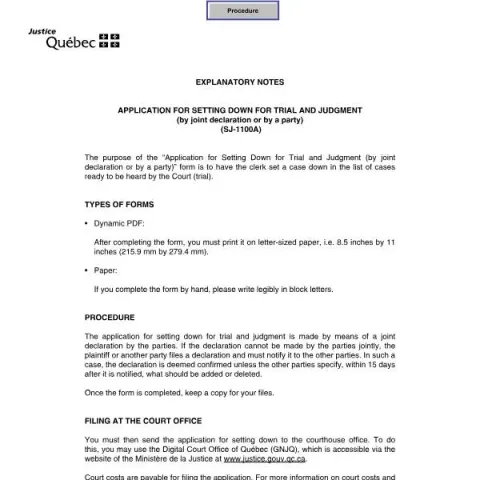
If you are involved in a civil legal case within the Province of Quebec, you may encounter the need to formally request that your case be scheduled for trial and judgment. This process is governed by the Application for Setting Down for Trial and Judgment (by joint declaration or by a party), identified by the code SJ-1100A, issued by the Canada Court of Quebec, Ministère de la Justice. This article aims to clarify the purpose of this form, when and how to use it, and key points to consider during its completion and submission.
What is the Purpose of the Form?
The primary function of the Application for Setting Down for Trial and Judgment is to inform the court that all parties agree the case is ready for trial. Once submitted, the court clerk will place the case on the trial list, facilitating the scheduling of proceedings. This form can be completed either through a joint declaration by all parties or by a single party if the others cannot jointly agree.
When Should You Use This Form?
This form is typically used after the discovery process, when parties believe that the case has gathered sufficient evidence and facts to proceed to trial. It is essential that the case is indeed ready for trial, as the court relies on the information provided in the application to confirm this status. The form is applicable in civil disputes under the Civil Code of Quebec, specifically under article 174 C.C.P.
How to Complete the Application
Preliminary Information
- Initiative: Indicate whether the application is made jointly by all parties or by a single party (e.g., plaintiff).
- Reason for non-joint declaration: If not joint, provide an explanation.
Parties and Legal Representation
Provide detailed contact information for all parties involved, including their legal representatives. This includes names, addresses, telephone numbers, fax numbers, and email addresses. Accurate and complete information ensures proper notification and processing of the application.
Details of the Dispute
- Main Application: Describe the nature of the dispute and the value of the subject matter.
- Additional Claims: Indicate if there are cross-claims, warranty recourses, or interventions, and specify the issues in dispute.
- Evidence and Facts: List facts admitted by the parties and issues requiring expert analysis.
Evidence and Exhibits
Both plaintiff and defendant must declare which documents and evidence they are submitting for the trial. This includes:
- Exhibits and their complete list
- Affidavits in lieu of testimony
- Transcripts of examinations (oral or written)
- Expert reports with details of the specialist and date
Filing and Submission Process
Once the form is completed, you should keep a copy for your records. The next step is to submit the application to the court office, either physically or via the Digital Court Office of Québec (GNJQ), accessible through the Ministère de la Justice website. Be aware that court costs are payable upon filing, and the fees vary depending on the specific case and court location.
Points of Attention and Practical Tips
When filling out the SJ-1100A form, ensure that all information is accurate and legible, especially if completed by hand. Double-check the completeness of the evidence list and confirm that all relevant documents are properly filed. Remember that the application confirms the case's readiness for trial; therefore, it should only be submitted once all procedural steps, including discovery and evidence collection, are finalized.
Fill in your form directly online
No printing: type your details into the boxes of the official form, tick, then download the PDF ready to send.
- 1Type into the form boxes
- 2Tick in one click
- 3Save and download the PDF
Finally, keep in mind that if the application is not made jointly, other parties have 15 days to review and suggest additions or deletions after notification. This period is crucial for ensuring that all parties agree on the case’s readiness, avoiding delays or disputes during scheduling.
Conclusion
The Application for Setting Down for Trial and Judgment is an essential procedural step in civil litigation within Quebec. Proper completion and timely submission can facilitate an efficient trial process, ensuring that your case proceeds without unnecessary delays. For detailed legal advice or assistance with filling out the form, consulting a qualified legal professional or your lawyer is recommended.