Understanding the Affidavit of Documents (Individual) Form under the Courts of Justice Act
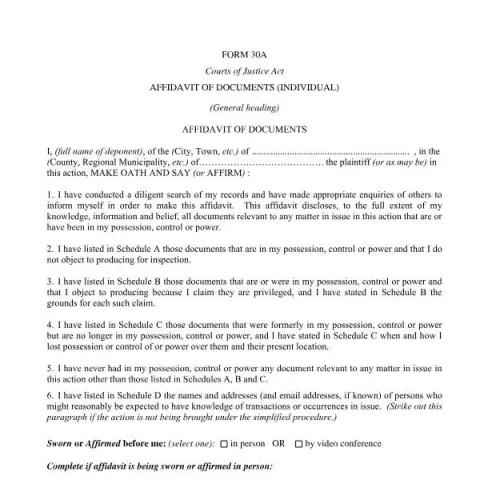
The Affidavit of Documents (Individual) form, designated as RCP Form 30A, is a legal document used within the framework of the Courts of Justice Act. This form plays a crucial role in civil litigation, especially during the discovery process, by requiring individuals involved in a legal action to disclose relevant documents.
Purpose and Significance of the Form
This affidavit serves to establish a comprehensive record of all documents pertinent to the case that are or have been in the possession, control, or power of the deponent (the individual making the affidavit). Its primary goal is to facilitate transparency and fairness in legal proceedings by ensuring that all relevant evidence is disclosed, subject to certain privilege claims.
In essence, the form guides the deponent to systematically list and categorize documents, thereby aiding the court and opposing parties in understanding the scope of available evidence. It helps prevent surprises during litigation and promotes efficient case management.
Who Must Complete the Form?
The form is typically completed by an individual involved in a legal action—often the plaintiff or defendant—who possesses relevant documents. The deponent must be an adult individual capable of making sworn statements. The form is especially relevant in civil cases where document disclosure is a key component of the discovery process.
How to Fill Out the Affidavit of Documents
Step 1: Conduct a Diligent Search
The deponent must thoroughly search their records and make appropriate inquiries of others to identify all relevant documents. This step ensures that the affidavit reflects a complete and honest disclosure.
Step 2: Categorize the Documents
The documents are to be organized into four categories:
- Schedule A: Documents in possession, control, or power that are to be produced for inspection.
- Schedule B: Documents claimed to be privileged, with grounds for privilege specified.
- Schedule C: Documents formerly in possession but no longer held, with details on how and when they were lost and their current location.
- Schedule D: Names and addresses of persons likely to have knowledge relevant to the case (applicable under simplified procedures).
Step 3: Complete the Schedules
Each schedule requires detailed entries, including descriptions, dates, and other identifying information for each document. For privileged documents, the grounds for privilege must be clearly stated.
Step 4: Swear or Affirm the Affidavit
The affidavit must be sworn or affirmed before a commissioner for taking affidavits. This can be done in person or via video conference, following the applicable regulations. The deponent signs the document in the presence of the commissioner, who also signs and stamps the affidavit.
Fill in your form directly online
No printing: type your details into the boxes of the official form, tick, then download the PDF ready to send.
- 1Type into the form boxes
- 2Tick in one click
- 3Save and download the PDF
Supporting Documents and Certification
Along with the affidavit, a lawyer's certificate is often included to confirm that the deponent has been advised on the importance of full disclosure and the relevance of the documents listed. This ensures legal compliance and reinforces the integrity of the disclosure process.
Where and How to Submit the Form
The completed RCP Form 30A should be filed with the court handling the case. Submission methods may vary depending on local court rules, but generally, the affidavit is submitted as part of the discovery process or during pre-trial procedures. It is essential to keep copies and ensure that all schedules are properly attached and signed.
Common Errors to Avoid
- Incomplete searches: Failing to conduct a diligent search can lead to sanctions or adverse inferences.
- Omitting relevant documents: Overlooking documents that are relevant to the case can compromise your position.
- Incorrect categorization: Misclassifying documents or failing to specify privilege grounds may result in delays or disputes.
- Failure to swear or affirm properly: Not following proper procedures for swearing or affirming can invalidate the affidavit.
Understanding and correctly completing the Affidavit of Documents (Individual) form is vital for a transparent and efficient legal process. If you are unsure about any aspect of this form, consulting a legal professional is strongly recommended to ensure compliance with court requirements.