Understanding the "Request for Consent to Sublet a Manufactured Home Site" Form in British Columbia
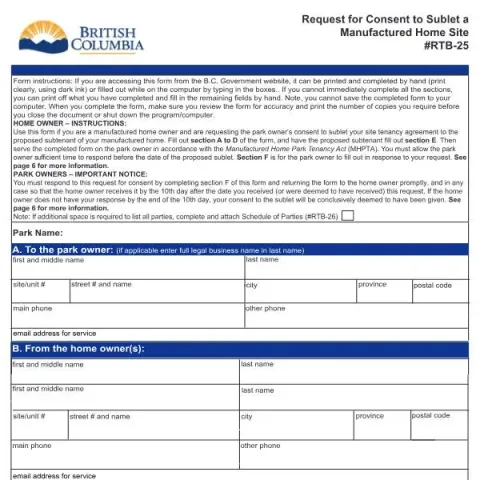
If you own a manufactured home and wish to sublet your designated site within a park, you will need to complete the official RTB-25 form, titled Request for Consent to Sublet a Manufactured Home Site. This form, issued by the Residential Tenancy Branch under the Office of Housing and Construction Standards, is a mandatory step in the process of legally assigning your site tenancy to a proposed subtenant.
Purpose of the Form
The primary objective of this form is to obtain the park owner’s formal approval for the proposed subletting arrangement. As a home owner, you are responsible for ensuring that the subtenant meets the park’s criteria and that all relevant legal and contractual obligations are met. The form facilitates transparent communication between the owner, the park management, and the prospective subtenant, ensuring compliance with the Manufactured Home Park Tenancy Act.
Preparing Your Application
Before completing the form, gather all necessary information, including details about yourself as the owner, the proposed subtenant, and any additional occupants. You will need:
- Identification details such as your Social Insurance Number (SIN), full name, and contact information.
- Details of the site or unit to be sublet, including address, park name, and site/unit number.
- Proposed subtenant’s personal information, including full name, current and previous addresses, and contact details.
- References from the proposed subtenant, such as personal references and proof of age if applicable.
It is also advisable to review your existing tenancy agreement and the park’s policies to ensure the subletting complies with all contractual obligations.
Filling Out the Form
Section A: To the Park Owner
Enter the park’s full legal name and your contact details. Clearly specify the site or unit number and the park’s address. This section initiates the request for approval.
Section B: Home Owner Details
Provide your name, address of the site to be sublet, and contact information. This confirms your ownership and intent to sublet.
Section C: Request for Consent
Complete this section by listing the proposed subtenant’s full name and the effective date of the sublet. Sign and date the form to formalize your request.
Section D: Home Owner’s Statement
By signing, you acknowledge that you remain responsible for rent payments and adherence to the tenancy agreement during the sublet period. You also confirm that the subtenant has been informed of relevant rules and that the sublease terms do not conflict with your existing agreement.
Section E: Proposed Subtenant Information
This section must be completed by the proposed subtenant, including personal details, current and previous addresses, references, and proof of age if required. Additional occupants should also be listed.
Submitting the Application
Once completed, the form must be served to the park owner, respecting the timeline outlined in the Manufactured Home Park Tenancy Act. The park owner has 10 days to respond—if no response is received within this period, consent is deemed granted.
Fill in your form directly online
No printing: type your details into the boxes of the official form, tick, then download the PDF ready to send.
- 1Type into the form boxes
- 2Tick in one click
- 3Save and download the PDF
Follow-Up and Record-Keeping
It is essential to keep copies of the completed form and any supporting documentation for your records. If the park owner approves the sublet, ensure that any additional agreements are in writing and aligned with your original tenancy terms.
Contact Information for Assistance
If you have questions about filling out the form or the subletting process, contact the Residential Tenancy Branch at the numbers provided on their official website or consult with a legal advisor familiar with BC tenancy laws.
Remember, completing and submitting the RTB-25 form correctly is crucial to legally subletting your manufactured home site and avoiding potential disputes or legal issues in the future.