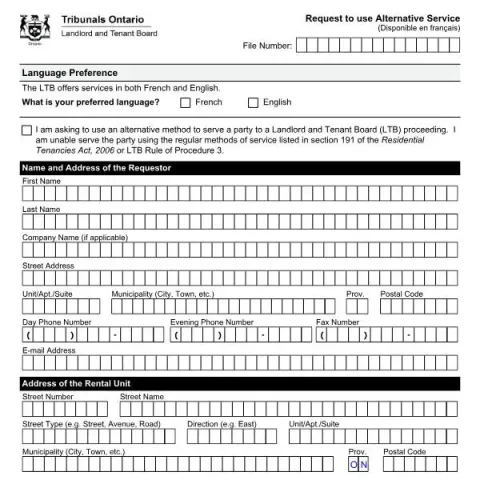
Understanding the "Request to Use Alternative Service" Form at the Landlord and Tenant Board, Ontario
If you are involved in a landlord-tenant dispute in Ontario and need to serve legal documents to a party who cannot be reached using standard methods, the "Request to Use Alternative Service" form is an essential tool. This official form, managed by the Landlord and Tenant Board (LTB) under Tribunals Ontario, allows landlords, tenants, or their representatives to seek permission to serve documents through a different method when traditional service options are not feasible.
Purpose of the Form
The primary goal of this form is to obtain approval from the LTB for an alternative method of service when the usual procedures—such as personal delivery, mail, or courier—are impractical or impossible. This situation often arises when the party to be served is unlocatable, avoids service, or resides in a manner that complicates traditional service methods. By submitting this request, you demonstrate to the tribunal that you have exhausted standard options and need an alternative approach to ensure the party receives the necessary legal documents.
Preparing Your Application
Documenting Previous Service Attempts
Before requesting alternative service, you must provide evidence of your efforts to serve the party using standard methods. This includes details on how you attempted to deliver the documents, such as personal service, registered mail, or other accepted procedures under section 191 of the Residential Tenancies Act, 2006, or LTB Rule of Procedure 3. Attach additional sheets if needed to thoroughly explain your attempts and demonstrate your diligence.
Proposing an Alternative Method
In your application, specify the alternative service method you propose—such as email, posting on the rental unit door, or publication in a newspaper—and explain why you believe this method will effectively reach the party. For example, if requesting email service, include reasons why the party is likely to check and receive emails at the provided address. Your explanation should establish a reasonable expectation that the documents will be received through this alternative approach.
Filing and Submission Details
The form must be completed and submitted to the LTB at least 40 days before the scheduled hearing. This advance notice allows the tribunal sufficient time to review your request and make a decision. The form includes spaces for your contact information, details about the rental property, and your explanation of previous service attempts and proposed alternative methods.
Signatures and Authorization
The form requires the signature of the applicant—whether a landlord, tenant, or their representative—and their contact information. If someone is acting on behalf of a party, their details, including their license number (LSO #), must also be provided. The tribunal will review your request and decide whether to grant or deny the proposed alternative service method.
Tribunal Decision and Follow-up
After submission, the LTB will evaluate your application and inform you of their decision. If approved, they will specify the method to be used and the deadline for completing service. If denied, reasons will be provided, and you may need to attempt traditional service methods again or explore other options.
Fill in your form directly online
No printing: type your details into the boxes of the official form, tick, then download the PDF ready to send.
- 1Type into the form boxes
- 2Tick in one click
- 3Save and download the PDF
Confidentiality and Public Records
It’s important to note that the information provided in this form may become part of the tribunal’s public records, in accordance with Tribunals Ontario policies. Parties seeking confidentiality must request a confidentiality order from the adjudicator. For questions about records or confidentiality, contact details are provided by the tribunal for further assistance.
Summary
The "Request to Use Alternative Service" form is a vital document in Ontario landlord-tenant proceedings, ensuring that even when conventional service methods are ineffective, legal notices and documents can still be delivered to the relevant parties. Properly completing and submitting this form helps maintain the integrity of the legal process and supports the fair resolution of disputes.