Understanding the One Month Notice to End Tenancy For Cause or End of Employment
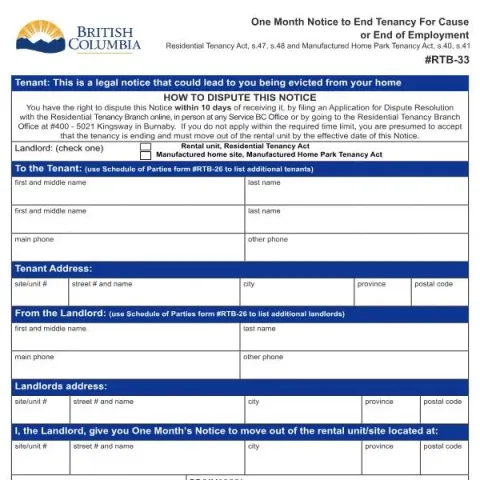
If you are a tenant or a landlord in British Columbia, the Residential Tenancy Branch provides a standardized form known as the RTB-33: One Month Notice to End Tenancy For Cause or End of Employment. This official document is used to formally notify a tenant that their tenancy will be ending, either due to specific causes related to the tenancy or because the tenant’s employment has concluded. It is essential to understand when and how this form should be used, what information it requires, and the steps to dispute or respond to such notices.
When to Use the RTB-33 Notice
This form is applicable in situations where a landlord needs to end a tenancy for a valid cause or due to employment-related reasons. Common circumstances include:
- Repeated late rent payments or failure to pay rent
- Unauthorized subletting or assignment of the rental unit
- Significant damage or illegal activities on the property
- Failure to comply with government orders affecting the property
- Employment ending, where the rental unit was provided as part of employment arrangements
In all cases, the landlord must provide a clear and detailed explanation of the cause for ending the tenancy, as this form serves as a formal legal notice under the Residential Tenancy Act.
Key Information Required on the Form
The RTB-33 form gathers essential details to ensure clarity and legal compliance:
- Tenant details: Full names, contact information, and address of the rental unit.
- Landlord details: Names, contact information, and address of the property owner or agent.
- Effective move-out date: The date by which the tenant must vacate the premises, which must be at least one full month from the date of notice.
- Reason for termination: Check all applicable causes, such as breach of tenancy agreement, illegal activity, or employment ending.
- Details of cause: A detailed description including dates, times, and specific incidents supporting the reason for termination.
This detailed information is crucial because an arbitrator may cancel the notice if causes are not adequately documented.
How to Serve and Submit the Notice
The landlord must serve the RTB-33 notice in person or through other approved methods such as mailing or posting at the property. The effective date of the notice is the date by which the tenant must vacate, which must align with the last day of a rental period (e.g., the last day of a month if rent is paid monthly).
If the tenant wishes to dispute the notice, they have 10 days from receipt to file an Application for Dispute Resolution with the Residential Tenancy Branch. This can be done online, in person at a Service BC Office, or at the Branch’s office in Burnaby. Failure to respond within this timeframe is presumed to accept the termination, and the tenant must vacate by the specified date.
Fill in your form directly online
No printing: type your details into the boxes of the official form, tick, then download the PDF ready to send.
- 1Type into the form boxes
- 2Tick in one click
- 3Save and download the PDF
Important Points for Landlords and Tenants
Both parties should be aware of the legal obligations associated with this notice:
- Landlords must provide at least one full month’s notice, with the effective date set at the end of a rental period.
- Tenants have the right to dispute the notice within 10 days, which can delay or prevent eviction if successful.
- The notice must clearly specify the cause, as vague or incomplete descriptions may lead to cancellation or dispute.
- Any additional tenants or landlords involved should be listed using the Schedule of Parties form (#RTB-26).
Conclusion
The RTB-33 form is a critical legal document used in British Columbia’s rental housing framework. Proper completion and timely serving of this notice ensure compliance with provincial laws and protect the rights of both landlords and tenants. Whether you are issuing or responding to this notice, understanding its requirements and procedures is essential to navigating tenancy terminations lawfully and effectively.