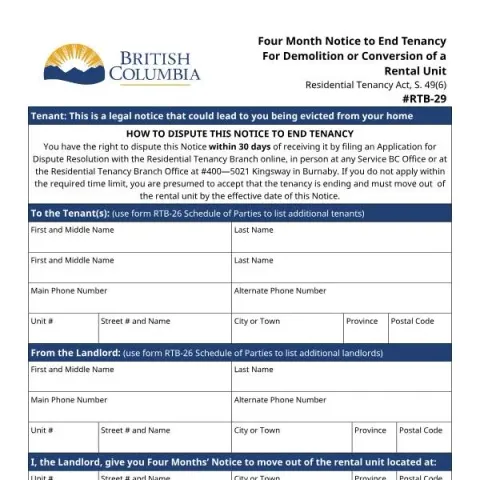
Understanding the Four-Month Notice to End Tenancy for Demolition or Conversion
If you are a tenant in British Columbia and receive a Four Month Notice to End Tenancy for Demolition or Conversion of a Rental Unit (form RTB-29), it is important to understand your rights, the reasons behind this notice, and the steps you can take to respond or dispute it. This official form, issued by the Residential Tenancy Branch, serves as a legal communication from your landlord informing you that your tenancy will end due to planned demolition, conversion, or other specified reasons.
Purpose of the RTB-29 Form
The RTB-29 form is used by landlords to legally notify tenants that they intend to end the tenancy for specific reasons, including:
- Demolition of the rental unit
- Conversion of the property into strata lots under the Strata Property Act
- Conversion into a not-for-profit housing cooperative under the Cooperative Association Act
- Conversion to a non-residential use
This notice provides tenants with a minimum of four months’ advance warning to vacate the rental unit, aligning with legal requirements to ensure fair notice and adequate time for tenants to plan their move.
How the Notice Is Issued and Served
Landlords must serve this notice following specific procedures to ensure legal validity. The notice can be delivered by:
- Registered mail to the tenant’s address
- Leaving a copy in a mailbox or mail slot at the rental unit
- Attaching a copy to the door or another conspicuous place
- Fax or email, if the tenant has provided these contact details
- As ordered by the Director of the Residential Tenancy Branch, such as through a Substituted Service Order
It is recommended that landlords complete the Proof of Service Notice to End Tenancy (form RTB-34) to document the delivery process, which can be important if the tenant disputes the notice.
Important Legal Requirements and Conditions
Good Faith and Permits
The landlord must act in good faith, genuinely intending to carry out the demolition or conversion. They must also have obtained all necessary permits and approvals from municipal or provincial authorities before issuing the notice. These permits may include demolition, building, electrical, or zoning approvals, depending on the project.
Effective Date and Compensation
The effective date of the notice is the date by which tenants must vacate. This date cannot be earlier than four months from the date the notice is issued and must fall on the last day of a rental period (e.g., the last day of the month for month-to-month tenants). The landlord is required to compensate tenants with an amount equal to one month’s rent, payable before the move-out date, unless the tenant chooses to withhold their last month’s rent.
Early Move-Out and Additional Compensation
Tenants on a periodic tenancy (such as month-to-month) may choose to move out earlier by providing at least 10 days’ written notice and paying rent up to the new move-out date. If the landlord does not proceed with the demolition or conversion within a reasonable period after the notice, tenants may be entitled to additional compensation equivalent to 12 months’ rent, subject to application and approval by the Residential Tenancy Branch.
Fill in your form directly online
No printing: type your details into the boxes of the official form, tick, then download the PDF ready to send.
- 1Type into the form boxes
- 2Tick in one click
- 3Save and download the PDF
Responding to the Notice and Dispute Resolution
If you believe the notice was issued improperly or the landlord did not meet legal requirements, you have the right to dispute it. You must file an Application for Dispute Resolution within 30 days of receiving the notice. This application can be submitted online via the Residential Tenancy Branch’s platform, in person at a Service BC Office, or at the Branch’s Burnaby office. Failing to apply within this period results in the presumption that you accept the notice and must vacate by the specified date.
Conclusion
Receiving a RTB-29 notice can be stressful, but understanding your rights and the legal procedures involved is crucial. Whether you choose to dispute the notice or prepare for your move, it is advisable to keep detailed records of all communications and ensure that the landlord complies with legal obligations. For further assistance, contact the Residential Tenancy Branch or seek legal advice to explore your options.