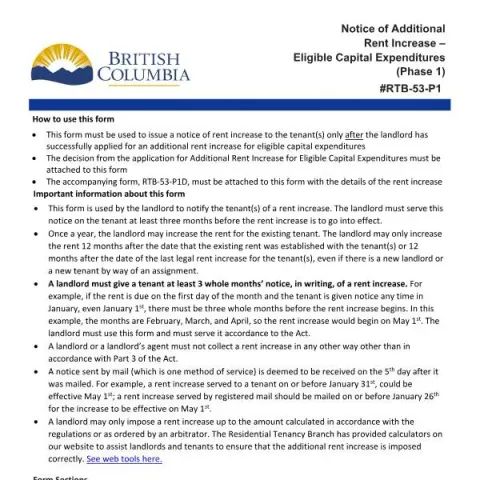
Understanding the Notice of Additional Rent Increase – Eligible Capital Expenditures (Phase 1)
The Notice of Additional Rent Increase – Eligible Capital Expenditures (Phase 1) is an official form used by landlords in British Columbia to inform tenants of a rent increase related to eligible capital expenditures. This form, designated as RTB-53-P1, is part of the regulatory framework established by the Residential Tenancy Branch Office of Housing and Construction Standards. It ensures transparency and compliance with the Residential Tenancy Act when landlords seek to pass certain capital costs onto tenants.
Purpose and When to Use This Form
This form must be completed and served to tenants only after the landlord has successfully applied and received approval for an additional rent increase specifically attributable to eligible capital expenditures. These expenditures typically involve significant investments in the property, such as major repairs or upgrades, that enhance the property's value or safety.
It is important to note that the application for this increase must be approved prior to issuing the notice. The decision, along with details of the approved increase, must be attached to this form. The purpose of the form is to notify tenants formally about the upcoming rent change, in accordance with legal requirements.
Key Conditions and Eligibility
- The landlord must have obtained approval for the rent increase related to eligible capital expenditures before issuing this notice.
- The rent increase can only be applied once per year, and at least 12 months must have passed since the last rent increase or the rent was established.
- The landlord must serve the notice at least three full months before the increase is to take effect. For example, a notice served in January can only take effect starting from May 1st.
- The increase must be within the limits calculated according to regulations or as ordered by an arbitrator.
These conditions are designed to ensure fairness and prevent excessive rent hikes, maintaining a balanced relationship between landlords and tenants.
Step-by-Step Procedure for Completing the Form
1. Tenant Information
Fill out the section with the tenant’s details, including their name, address, email, and contact number. If there are multiple tenants or additional parties, use Form RTB-26 to include their information.
2. Landlord Information
Provide your details as the landlord or authorized agent, including your name, mailing address, email, and phone number. If applicable, include the business name.
3. Notice of Rent Increase
Complete the section with the current rent, the date of the last rent increase or the rent establishment date, and the new rent amount. Specify the date when the new rent will commence, ensuring it is at least three months from the date of service.
4. Attachments and Declarations
Attach the decision document from the application for the rent increase and the accompanying form RTB-53-P1D, which details the rent increase specifics. The landlord or authorized agent must sign and date the form, certifying the accuracy of the information provided.
Important Deadlines and Service Methods
The notice must be served in writing and at least three full months before the rent increase is scheduled to begin. Service methods include personal delivery or mailing. If served by mail, the notice is deemed received five days after mailing.
Fill in your form directly online
No printing: type your details into the boxes of the official form, tick, then download the PDF ready to send.
- 1Type into the form boxes
- 2Tick in one click
- 3Save and download the PDF
For example, if a landlord serves the notice on January 1st, the increase can take effect no earlier than April 1st. To ensure timely implementation, the notice should be mailed or delivered well in advance, considering the five-day deemed receipt if mailed.
After Serving the Notice
Once the notice is served, tenants have the right to review the details and, if necessary, dispute the increase through the Residential Tenancy Branch. It is essential that landlords adhere strictly to the notice period and service methods to avoid legal complications.
For further guidance, landlords and tenants can consult the official resources provided by the Residential Tenancy Branch or contact their support lines.