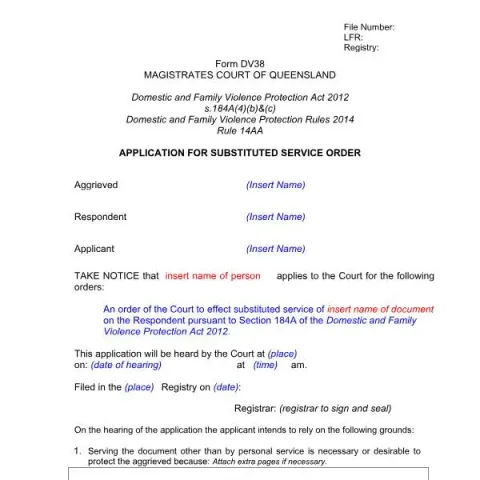
Understanding the Application for Substituted Service Order (Form DV38) in Queensland
The Application for Substituted Service Order (Form DV38) is a legal document used within the Queensland Magistrates Court to request an order that allows for alternative methods of serving legal documents in domestic violence cases. This form is essential when personal service on the respondent (the person against whom the order is sought) is not feasible or safe, and the applicant needs the court’s approval to use other methods of notification.
Who Should Fill Out This Form?
This form must be completed by the applicant who is seeking to serve a document on the respondent under the Domestic and Family Violence Protection Act 2012. Typically, this includes individuals who are involved in domestic violence protection proceedings and require the court’s assistance to ensure the respondent receives legal notices or documents, such as applications for protection orders or related court documents.
The applicant can be an individual, a legal representative, or an authorized person acting on behalf of the applicant. It is crucial that the person filling out the form provides accurate information to ensure the court can process the request efficiently.
How to Complete the Form
Step 1: Fill in the Court Details
- Insert the name of the aggrieved, respondent, and applicant.
- Specify the court location where the application will be heard, along with the date and time of the hearing.
- Record the date of filing the application and the registry where it was lodged.
Step 2: State the Grounds for Substituted Service
In the section titled "On the hearing of the application the applicant intends to rely on the following grounds," the applicant must clearly outline why personal service is not possible or appropriate. This might include safety concerns, respondent evasion, or other circumstances preventing direct service.
Step 3: Provide Evidence of Efforts to Serve
The applicant must attach an affidavit of attempted personal service (Form DV39) and a draft order (Form DV40). These documents support the application by demonstrating that reasonable efforts to serve the respondent personally have been made.
Step 4: Sign the Statutory Declaration
The applicant must sign a statutory declaration confirming the truthfulness of the information provided. This declaration must be witnessed by an authorized person such as a Justice of the Peace, a solicitor, or a Commissioner for Declarations. If the applicant is a member of the Queensland Police Service, additional details such as rank and registration number are required.
Supporting Documents and Attachments
Along with the completed form, the applicant should attach:
Fill in your form directly online
No printing: type your details into the boxes of the official form, tick, then download the PDF ready to send.
- 1Type into the form boxes
- 2Tick in one click
- 3Save and download the PDF
- An affidavit of attempted personal service (Form DV39).
- A draft order (Form DV40) for the substituted service.
- Any additional evidence or documentation relevant to demonstrating the necessity for substituted service.
Where and How to Lodge the Application
The completed Form DV38 must be filed with the appropriate registry of the Queensland Magistrates Court where the matter is being heard. This can often be done in person at the registry or through electronic lodgment if available. It is advisable to retain copies of all documents submitted for your records.
Common Mistakes to Avoid
- Failing to attach the required affidavits and draft orders.
- Providing incomplete or inaccurate information, especially regarding the grounds for substituted service.
- Not signing the statutory declaration in the presence of an authorized witness.
- Missing the court hearing date or providing incorrect details about the hearing location or time.
Conclusion
The Application for Substituted Service Order (Form DV38) is a vital legal tool for ensuring that respondents in domestic violence cases are properly notified when personal service is not possible. Accurate completion of the form, along with supporting affidavits and documents, is essential for the court to grant the order and facilitate the legal process. If you are unsure about how to complete this form or the process involved, seeking legal advice or assistance from the court registry is recommended to ensure compliance with all legal requirements.