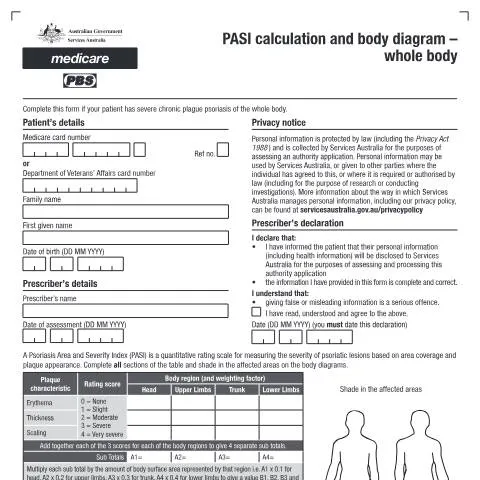
Understanding the PASI Calculation and Body Diagram - Whole Body Form (PB115)
In the realm of health assessments in Australia, the PASI Calculation and Body Diagram - Whole Body Form (PB115) serves a crucial role in evaluating skin conditions. This document is particularly pertinent for health professionals who are tasked with determining the severity of a patient's skin disease, generally for the purpose of applying for assistance or treatment options from Services Australia.
Historical Context and Regulatory Framework
The inception of the PB115 form can be traced back to an increasing demand for standardised assessments in dermatological conditions, notably those related to psoriasis. Over the years, as skin diseases have gained more recognition in healthcare discussions, the necessity for a comprehensive tool to quantify their impact has become evident. The Administrative Decisions (Judicial Review) Act 1977 (Cth) provides the legal framework for the operation of Services Australia by ensuring fair decision-making processes for those seeking assistance. The PB115 is a manifestation of this ethos, designed to facilitate consistent evaluations by health professionals.
A Pivotal Component of Health Assessments
The process of filling out the PB115 is typically initiated when a clinician identifies the need for a thorough assessment of a patient's skin condition. This document not only supports the patient’s claim for medical assistance but also plays a pivotal role in gathering quantitative data that can influence treatment pathways.
- Who Typically Uses the Form: Dermatologists, general practitioners, and other qualified health professionals.
- Why It’s Important: Accurate completion can significantly affect the type of financial support or treatment options a patient may access.
Key Steps in Completing the PB115
Completing the PB115 accurately is vital for ensuring that the health condition is well represented. The form requires input from health professionals, hence understanding its structure is essential. Key components often include:
| Section | Description |
|---|---|
| Patient Information | Basic details such as name, date of birth, and contact information. |
| Clinical Assessment | Details regarding the patient’s diagnosed condition and previous treatments. |
| PASI Calculation | Quantitative measures of the severity of the patient's skin condition. |
| Body Diagram | A visual representation of the affected areas on the body. |
Each section must be completed in detail, ensuring data accuracy and relevance. Misrepresentations or incomplete sections can lead to delays or rejections of claims, which can be detrimental to patient care.
Submission Channels: Navigating Options for PB115
Once the PB115 has been meticulously filled out, it can be submitted through several channels. Understanding these options is vital to ensure that the process runs smoothly. Here are the primary methods for submission:
- Online Submission: Many health professionals opt to submit the form through the myGov platform, which streamlines the process and ensures timely receipt.
- Paper Submission: Alternatively, the form can be printed and mailed directly to Services Australia. It's important to ensure the correct postal address is used for timely processing.
- In-Person Submission: For those preferring face-to-face interactions, submitting the form at a Services Australia service centre is an option, although it may require prior appointment scheduling.
Each of these channels has its own advantages, and the choice often depends on the urgency of the situation and the preference of the health professional involved.
Handling Complications: Error Management and Missing Documents
In the event of a submission that lacks required information or contains errors, it's crucial to act swiftly. Common issues include missing signatures, inaccurate patient details, or incomplete PASI calculations. The following steps should be taken:
- Review the Submission: Double-check the submitted form against the requirements set by Services Australia.
- Contact Services Australia: If discrepancies are identified, reach out to Services Australia for clarification on how to rectify the issues.
- Resubmit if Necessary: Should the document need to be resubmitted, ensure that all corrections are made and verified before sending it back.
It's worth noting that prompt actions can significantly mitigate potential delays in patient treatment or funding approvals.
Comparative Analysis: Distinguishing PB115 from Similar Forms
The PB115 is often confused with other forms used in health assessments or claims, such as those related to chronic care or specialist referrals. Understanding the distinct purposes and requirements of the PB115 compared to its counterparts is essential for health professionals:
| Form | Purpose | Key Differences |
|---|---|---|
| PB115 | PASI Calculation & Body Assessment | Focuses specifically on skin conditions and their severity. |
| Other Health Assessment Forms | Various health conditions | May cover broader health issues without the focus on dermatological assessments. |
Recognising these differences can aid healthcare providers in selecting the appropriate documentation for their patients, ensuring they receive the right support without unnecessary complications.
Unique Circumstances: Special Cases and Exceptions
While the PB115 is generally straightforward in its use, there are special cases that health professionals should be aware of:
- Minors: When assessing skin conditions in patients under 18 years, parental or guardian consent is typically required.
- Complex Cases: Situations involving multiple comorbidities may necessitate additional documentation to fully support the patient's condition.
- Urgent Cases: In emergencies, bypassing standard procedures may be necessary to expedite care. Communicating directly with Services Australia can provide clarity on how to proceed.
Addressing these unique circumstances with care can help ensure that patients receive appropriate attention and resources in a timely manner.
The Future of PB115 and Ongoing Changes in Health Documentation
As healthcare practices continue to evolve, the PB115 form is likely to undergo revisions to adapt to new treatments and assessment methods. Keeping abreast of these changes is important for health professionals, as staying informed ensures optimal patient care and compliance with regulatory standards.
For updates and modifications regarding the PB115, health professionals should regularly consult with Services Australia and engage in professional development opportunities that encompass changes in health documentation and patient assessments.
Final Insights on Effective Use of PB115
In navigating the complexities of health assessments, the PB115 form stands out as an essential tool for health professionals addressing skin conditions. By understanding its role, completing it accurately, and submitting it through appropriate channels, healthcare providers can significantly influence the quality of care their patients receive.
Ultimately, the effective use of the PB115 not only aids in securing necessary support for patients but also enhances the quality of healthcare delivery across Australia. As healthcare continues to adapt, the framework established by forms like PB115 will be critical in shaping future practices.
Understanding the PASI Calculation Methodology
The Psoriasis Area and Severity Index (PASI) is a standardized tool used to measure the severity and extent of psoriasis. Understanding how to accurately calculate the PASI score is crucial for both healthcare professionals and patients to evaluate the severity of their condition and monitor treatment effectiveness.
The PASI score takes into account two primary factors: the area of skin affected by psoriasis and the severity of psoriatic lesions. The calculation involves assessing various body regions, assigning a score based on the percentage of the body affected, and evaluating the severity of lesions based on redness, thickness, and scaling.
To begin the PASI calculation, you must divide the body into four regions: the head, upper limbs, trunk, and lower limbs. Each region is then evaluated based on the percentage of surface area affected by psoriasis using the following approach:
- Head: Assess the severity of psoriatic lesions in the scalp and face.
- Upper Limbs: Evaluate both arms and hands.
- Trunk: Analyze the torso area, including the back and chest.
- Lower Limbs: Consider the thighs, legs, and feet.
Each of these regions is assigned a score from 0 to 6 based on the severity of the lesions, which considers the redness, thickness, and scaling of the plaques. Once all regions have been assessed, a formula is applied to calculate the total PASI score, which can range from 0 (no psoriasis) to 72 (extremely severe psoriasis).
It is essential to keep in mind that several factors can influence the PASI calculation. Age, gender, and skin type might affect lesion appearance and response to treatment. Furthermore, the PASI score should be interpreted alongside clinical judgment and patient-reported outcomes for comprehensive management of psoriasis.
Using the Whole Body Form (PB115) for Accurate Reporting
The Whole Body Form (PB115) is a critical tool that complements the PASI calculation by providing a structured approach for reporting psoriasis and the associated symptoms across the entire body. This form enables healthcare providers to record the severity, distribution, and impact of psoriasis on the patient’s life more effectively.
This comprehensive form includes detailed diagrams of the human body, allowing healthcare providers to mark the specific areas where psoriasis is present. The use of the PB115 form can significantly enhance the accuracy of the PASI score by ensuring that all affected areas are documented and assessed consistently.
To use the Whole Body Form effectively, follow these steps:
- Identify Affected Areas: Begin by having the patient mark their affected areas on the body diagrams provided in the PB115 form. This visual representation helps in quickly identifying and quantifying the psoriasis extent.
- Assess Severity: Once the areas are marked, evaluate the severity of lesions in each area. Use the PASI severity criteria (redness, thickness, and scaling) to assign appropriate scores.
- Document Findings: Record the findings in the PB115 form. Ensure clear annotations regarding the severity and extent of psoriasis to facilitate effective communication with other healthcare providers.
- Review and Update: The PB115 form should be reviewed regularly during follow-up appointments to track changes over time and assess treatment responses. Updates to the chart can help in refining treatment strategies and improving patient outcomes.
Utilizing the Whole Body Form alongside the PASI calculation provides a holistic view of a patient’s condition, improving treatment planning and enhancing communication between patients and healthcare providers. This approach is especially valuable in chronic conditions such as psoriasis, where variations can occur, and effective management is paramount.
Factors Influencing the PASI Score and Treatment Implications
When calculating the PASI score, it is essential to consider various factors that may influence the outcomes significantly. These factors can help in tailoring individual treatment plans and guiding clinical decisions.
1. Patient Demographics: Age and gender can impact psoriasis presentation. Older patients might have different lesion characteristics compared to younger patients, while hormonal changes in women can influence flare-ups. Understanding these demographic factors can aid in anticipating treatment response.
2. Comorbidities: Patients with psoriasis often present with comorbid conditions such as psoriatic arthritis, cardiovascular disease, or metabolic syndrome. These comorbidities can exacerbate psoriasis and influence the overall management strategy. A higher PASI score may indicate greater systemic involvement, necessitating a more aggressive treatment approach.
3. Skin Type and Ethnicity: Research suggests that skin types and ethnic backgrounds may affect the severity and visibility of psoriatic lesions. Some patients may have less obvious symptoms, leading to an underestimation of their PASI scores if not assessed appropriately.
4. Psychological Impact: The psychological burden of psoriasis can influence treatment adherence and outcomes. Patients experiencing anxiety or depression may struggle with self-care and managing their condition. Recognizing these aspects is vital when interpreting the PASI scores as they can affect overall quality of life and treatment efficacy.
5. Response to Treatment: Patients may respond differently to various treatments based on their PASI score and other individual factors. Regularly monitoring changes in the PASI score can help clinicians adjust treatments and optimize management strategies. A significant decrease in the PASI score may indicate a positive response to therapy, while a stagnant or worsening score may necessitate reconsideration of the treatment plan.
In conclusion, the PASI score calculation is not just a number; it reflects a multifaceted view of a patient’s condition. By considering these influential factors, healthcare providers can better tailor treatment approaches that address the unique needs of each patient, ultimately improving outcomes and enhancing the quality of life for those living with psoriasis.