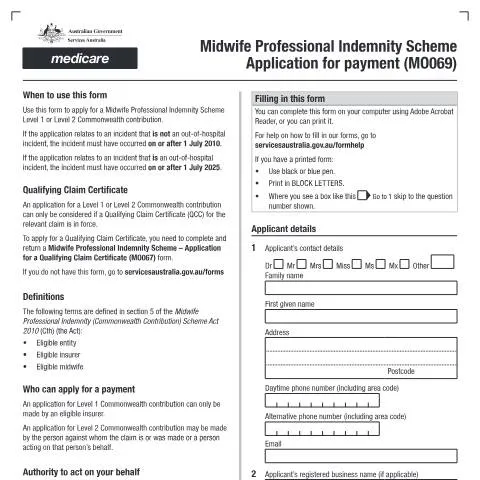
Understanding the Midwife Professional Indemnity Scheme
The Midwife Professional Indemnity Scheme is a crucial safety net designed specifically for midwives in Australia. This scheme addresses the professional liability concerns that midwives may face in their practice. By ensuring financial protection against claims, it fosters a more secure environment for midwives to provide essential services to mothers and families. Understanding this scheme and the associated application process, particularly the Application for payment form (MO069), is integral for midwives to access the financial support they are entitled to.
Who is Required to Submit Form MO069?
Any midwife registered with the Australian Health Practitioner Regulation Agency (AHPRA) who is seeking indemnity payments under the Midwife Professional Indemnity Scheme must complete and submit the MO069 form. This applies to both self-employed midwives and those employed by healthcare institutions. As midwives navigate their professional responsibilities, the need for indemnity coverage becomes paramount, making this form a vital element in securing their rights and responsibilities in a legally compliant framework.
Decoding the Application for Payment Form (MO069)
Form MO069 is not just a simple document; it comprises various sections that require careful attention and precision to complete. Each section serves a distinct purpose and contributes to the overall coherence of the application. Below is a breakdown of key sections within the form:
- Personal Information: This section gathers essential details such as your name, contact information, and registration number with AHPRA.
- Details of Indemnity Cover: Applicants must specify the nature of their indemnity cover, including the insurer’s name and policy number.
- Claim Information: Here, midwives must detail the claims for which they are seeking payment, including date of occurrence and nature of the claim.
- Declaration: By signing this section, the applicant confirms the accuracy of the information provided and acknowledges the terms of the indemnity scheme.
It’s imperative to cross-check each entry against the supporting documentation to ensure accuracy. Any discrepancies may lead to delays or refusals.
Gathering the Necessary Supporting Documentation
Completing the application isn't just about filling out the form; it also requires gathering specific documentation to substantiate your claims. Depending on your situation, the necessary documents can vary. Here’s a list of commonly required items:
- Proof of Registration: AHPRA registration certificate to validate your status as a practicing midwife.
- Indemnity Insurance Certificate: A copy of your current indemnity insurance policy.
- Claim Documentation: Any relevant documents that detail the claims being made, including letters or corresponding emails.
- Financial Records: Receipts or invoices supporting the claim amount, as applicable.
Ensuring that you have all the required documents prepared in advance will facilitate a smoother application process.
The Timeline: When to Apply and What Happens Next
Timing is a critical factor when it comes to submitting Form MO069. Midwives should be aware of the timelines associated with making an application, as well as the subsequent steps in the process:
| Action | Timeline |
|---|---|
| Application Submission | As soon as a claim arises; there may be deadlines specific to different circumstances. |
| Processing Period | Typically a few weeks, but can vary based on complexity. |
| Notification of Decision | Midwives will receive written communication regarding the outcome of their application. |
Being proactive in your application process can significantly impact the speed and efficiency with which you receive feedback and payments.
Navigating Potential Challenges: What to Do in Case of Issues
While the process is designed to be straightforward, challenges can arise. Here’s how to handle common issues that may occur:
- Incomplete Applications: If additional information is required, Services Australia will contact you. Respond promptly to avoid delays.
- Claim Denial: If your application is denied, you have the right to request a review. This can often be done by contacting Services Australia directly.
- Missing Documentation: Should any documentation be missing, it’s crucial to provide this as soon as possible, as incomplete submissions can stall the process.
Preparedness and rapid response to notifications can help mitigate complications and ensure that your application proceeds smoothly.
Merging Insurance Coverage with the Indemnity Scheme
A unique aspect of the Midwife Professional Indemnity Scheme is the relationship between personal indemnity insurance and scheme coverage. Understanding this interplay is essential:
- Primary Coverage: Personal indemnity insurance is often the first line of defense. The scheme acts as supplementary indemnity coverage, enhancing overall protection.
- Compliance Verification: The application process requires verification of existing indemnity insurance to ensure compliance with regulatory standards.
- Coverage Gaps: Midwives should assess their personal coverage to identify any gaps that the scheme may fill, ensuring comprehensive protection.
By aligning personal insurance with the indemnity scheme, midwives can ensure they are adequately protected against potential claims.
Final Considerations: Staying Informed and Prepared
Being well-informed about the Midwife Professional Indemnity Scheme and the application process for Form MO069 can significantly impact a midwife's professional peace of mind. Regularly reviewing your insurance, understanding your rights under the scheme, and staying abreast of any legislative changes are all critical to ensuring compliance and protection. Moreover, seeking advice from professional associations can provide additional support and guidance in navigating these waters.
In summary, the Midwife Professional Indemnity Scheme – Application for payment form (MO069) is an essential document that plays a critical role in ensuring midwives are financially protected in their professional pursuits. By understanding its components, preparing thoroughly, and responding proactively to any challenges, midwives can navigate the application process effectively, securing the support they need to continue their invaluable work.
Understanding the Midwife Professional Indemnity Scheme
The Midwife Professional Indemnity Scheme (MPIS) is designed to provide professional indemnity insurance to registered midwives in Australia. Given the unique nature of midwifery practice, the Scheme plays a vital role in safeguarding the interests of both midwives and their clients. The MPIS covers claims arising from civil liability for negligence, meaning that if a client alleges that a midwife acted negligently and this results in a legal claim, the Scheme can provide financial support for legal costs and any damages awarded.
It's important to note that the MPIS is available to eligible midwives who are registered with the Australian Health Practitioner Regulation Agency (AHPRA). Midwives must be providing care in accordance with the standards set out by the Nursing and Midwifery Board of Australia (NMBA). This professional coverage is essential for midwives who operate in various settings, including hospitals, private practices, and community environments.
Eligibility Criteria for the Midwife Professional Indemnity Scheme
To qualify for the MPIS, midwives must meet several key eligibility criteria. Firstly, applicants need to possess a valid registration with AHPRA. Additionally, midwives must demonstrate that they are engaged in midwifery practice, meaning they provide care to women during pregnancy, childbirth, and the postpartum period.
It’s also crucial for midwives to maintain compliance with relevant professional standards and guidelines. This includes adherence to the NMBA’s Code of Conduct and the Midwife Standards for Practice. Midwives who are employed in settings where indemnity insurance is provided by their employer may not need to apply, as their coverage may already be secured through their employment arrangement. However, independent practitioners must ensure that they have sufficient personal indemnity insurance to qualify for the Scheme.
Midwives wishing to access the MPIS should gather necessary documentation, including proof of AHPRA registration and evidence of employment in midwifery practice. This ensures a smooth application process and reduces the risk of delays in receiving support from the Scheme.
Application Process for the Midwife Professional Indemnity Scheme Payment Form (MO069)
The application process for the MPIS payment form (MO069) is vital for midwives seeking financial assistance. The process begins with filling out the MO069 form accurately. This form can typically be accessed online through the relevant government portals, such as Services Australia. Midwives must provide their personal details, including their Tax File Number (TFN), registration number with AHPRA, and details of the claim or payment request they are submitting.
Once the form is completed, midwives need to submit it along with any supporting documentation, such as evidence of claims or legal correspondence. Depending on the nature of the claim, additional documents may be required, such as medical records or witness statements. It’s crucial to ensure that all documents are legible and accurately reflect the case at hand to avoid any complications during the processing of the application.
After submission, midwives can track the status of their application through the myGov portal if they have linked their account to Services Australia. This provides transparency and allows midwives to stay updated on any requests for further information or clarification that may arise during the review process.
Common Challenges and How to Overcome Them When Applying
Many midwives encounter challenges when applying for payments through the MPIS. One common issue is incomplete or inaccurate information on the application form, which can lead to delays or refusals. To mitigate this, midwives should meticulously review their application and ensure that all fields are filled out correctly. Keeping copies of all submitted documents is also advisable for reference in case clarification is needed later.
Another challenge can arise from the need for supporting evidence. Gathering documentation to substantiate claims can be time-consuming and may require the cooperation of third parties, such as clients or other healthcare providers. Early communication with these parties can help streamline this process. It is also beneficial for midwives to maintain detailed records of their practice, as this can facilitate easier documentation collection when needed.
Midwives should also be aware of the timelines involved in the application process. Delays can occur due to various factors, including high volumes of applications or missing documentation. To avoid potential delays, submitting applications as early as possible and ensuring all required materials are included can significantly enhance the chances of a timely resolution.
Post-Application: What to Expect After Submission
Once the application for the MPIS payment form (MO069) has been submitted, midwives may receive a confirmation of receipt. The processing time can vary, but it typically takes several weeks. During this period, the application will be reviewed by the relevant authorities, who may reach out for additional information or clarification if needed.
Midwives should be prepared for the possibility of receiving a request for more information. If this occurs, it’s essential to respond promptly and thoroughly to avoid further delays. Once the review is complete, midwives will be notified of the outcome via their preferred communication method, which can include email or postal mail.
If the application is approved, midwives will receive details on how payments will be made, including timelines and payment methods. In the case of a denial, the notification will explain the reasons for the decision, and midwives will have the right to appeal this decision through the Administrative Appeals Tribunal (AAT) under the Administrative Decisions (Judicial Review) Act 1977 (Cth).