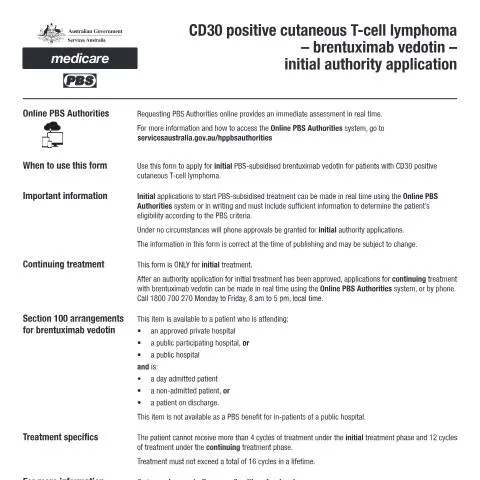
Understanding the Cutaneous T-cell Lymphoma (CTCL) Initial Authority Application Form (PB268)
In the complex landscape of healthcare management in Australia, forms play a pivotal role in enabling patients to access vital treatments. The Cutaneous T-cell lymphoma (CTCL) initial authority application form (PB268) is a specific document that healthcare professionals, particularly prescribers, engage with to facilitate access to brentuximab vedotin for their patients. This treatment is critical for individuals diagnosed with CTCL, representing a substantial step in their healthcare journey.
The Significance of the PB268 Form in Patient Care
This form is integral to the process of obtaining approval for the prescription of brentuximab vedotin, a monoclonal antibody that targets CD30, used in treating certain types of lymphomas. Without this form, healthcare practitioners cannot initiate the prescribing process, making it an essential component of patient care for those suffering from CTCL.
Who Needs to Submit the PB268 Form?
- Prescribing Doctors: Typically, oncologists or dermatologists who are managing the patient's lymphoma.
- Specialist Clinics: Facilities specializing in hematology or oncology where the treatment is being administered.
It is important to note that the authority application must be submitted by a registered healthcare professional on behalf of the patient. Patients themselves are not permitted to submit this form, reinforcing the role of medical expertise in treatment decisions.
Steps to Complete the PB268 Form
Completing the PB268 form requires careful attention to detail. Each section of the form is designed to capture critical information that will impact the approval process.
Detailed Breakdown of the Form Sections
- Patient Information: This section asks for the patient’s personal details, including their Medicare number, which is essential for identification and billing.
- Clinical Information: Here, the prescriber must detail the patient's diagnosis, treatment history, and any other relevant medical information that justifies the need for brentuximab vedotin.
- Rationale for Treatment: This critical section requires the clinician to provide a comprehensive explanation of why this specific treatment is necessary. It may involve citing previous treatments and their outcomes.
- Signatures: Finally, the prescriber must sign the form, confirming that all information provided is accurate and that they are authorized to prescribe this treatment.
Submitting the PB268 Form: What Happens Next?
Once the PB268 form is completed, it must be submitted to Services Australia for review. Submission can typically be done electronically through myGov or via traditional mail, although electronic submission is encouraged for efficiency.
What to Expect After Submission
After submission, healthcare providers can expect to receive a decision regarding the authority request. Approval will allow the prescriber to initiate treatment with brentuximab vedotin, while a denial may require further action.
- Approval: If approved, the prescriber will receive instructions on how to proceed with the treatment.
- Denial: Should the application be denied, the provider will typically receive feedback or a rationale detailing why the treatment is not authorized, which may include a request for additional information.
Understanding the Context: When PB268 Intersects with Other Forms
Healthcare professionals often navigate a myriad of forms within the Australian health system. Understanding how the PB268 form uniquely fits into this landscape can prevent confusion and streamline the process for patients.
Distinguishing PB268 from Other Applications
| Form | Purpose | Applicable Treatments |
|---|---|---|
| PB268 | Initial authority for brentuximab vedotin in CTCL | Brentuximab vedotin |
| Other Authority Forms | Varied treatments depending on specific conditions | Other medications like chemotherapy agents |
This table illustrates how the PB268 form is specifically tailored for CTCL treatments and should not be confused with other authority forms that may serve entirely different purposes.
Unique Circumstances: Special Cases in Submission
There are various scenarios where patients or healthcare professionals may face additional complexities when submitting the PB268 form. Understanding these situations can help navigate the process more smoothly.
Complex Medical Situations
- Patients with Multiple Conditions: If a patient is dealing with CTCL alongside other chronic conditions, the prescriber must ensure that the treatment plan is cohesive and addresses all health aspects, which should be articulated in the rationale section of the form.
- Pediatric Patients: For minors, the process may involve additional legal considerations, such as obtaining consent from guardians and ensuring that all information is represented accurately.
Emergency Situations
In urgent cases where the patient’s condition may worsen without immediate treatment, healthcare providers should indicate this urgency in their submission. While the regular approval process is in place, there may be provisions for expedited assessments.
The Responsibilities of Healthcare Providers
Filling out and submitting the PB268 form entails certain responsibilities for healthcare providers. These professionals are not only tasked with ensuring accuracy, but they must also understand the legal implications of their submissions.
Ethical Considerations
- Honesty and Transparency: The information provided in the form must reflect the patient's actual condition and treatment history without exaggeration or omission.
- Patient Confidentiality: As with any medical documentation, preserving patient confidentiality is paramount. Only the necessary details related to the treatment should be included.
Consequences of Incomplete or Incorrect Submissions
Neglecting to complete the PB268 form properly can lead to significant delays in treatment or even outright denial of the authority request. Understanding the ramifications of errors or omissions is crucial for healthcare providers.
Implications for Patients
- Delayed access to essential therapies can lead to deterioration in the patient’s health status.
- Financial repercussions may arise from the need for alternative treatments that may not be covered under the same authority.
Conclusion: Navigating the Future with the PB268 Form
In navigating the complexities of healthcare applications, the PB268 form represents just one part of a larger puzzle. Healthcare professionals must approach each submission with diligence and clarity, ensuring that patients receive the timely and effective care they deserve. As the landscape of medical treatments evolves, so too will the requirements and processes surrounding authority applications, making it imperative for practitioners to stay informed and prepared.
Understanding Brentuximab Vedotin: Mechanism and Indications
Brentuximab vedotin is an antibody-drug conjugate specifically indicated for the treatment of certain types of cutaneous T-cell lymphoma (CTCL), among other malignancies. The drug works by targeting a protein called CD30, which is present on the surface of some cancerous cells. Once Brentuximab binds to CD30, it delivers a cytotoxic agent, effectively killing the cancer cells while sparing normal cells. This selective action not only enhances efficacy but also helps in reducing the side effects typically associated with conventional chemotherapy. In the context of CTCL, Brentuximab is usually considered for patients who have received prior systemic therapy and whose disease has either progressed or has not responded adequately to treatment.
Criteria for Initial Authority Application: Eligibility and Documentation
When applying for initial authority to prescribe Brentuximab vedotin for CTCL, healthcare providers must carefully consider and document the eligibility criteria set forth by the Pharmaceutical Benefits Scheme (PBS). Key criteria include: 1) Confirmation of diagnosis through histological examination, indicating that the patient has a subtype of CTCL suitable for this treatment. 2) Evidence of prior systemic therapy, which may include chemotherapy or other targeted agents. 3) Documentation of disease progression or ineffectiveness of previous treatments. It's essential to provide comprehensive clinical notes and relevant test results with the Initial Authority Application Form (PB268) to substantiate the request. Incomplete applications or insufficient evidence may lead to delays or rejections.
Patient Support Programs and Navigating the PBS
For patients initiating treatment with Brentuximab vedotin, it’s critical to be aware of available support programs that can facilitate access and provide ongoing assistance. The PBS outlines the framework for subsidised medications, but there may be additional resources available through hospitals or community health services that offer financial counselling or assistance. Patients are encouraged to engage with their healthcare teams to discuss potential financial burdens, as some pharmaceutical companies also provide patient support programs designed to help with medication costs or navigation through the PBS application process. Furthermore, understanding the role of myGov in managing health entitlements can improve efficiency in accessing subsidised treatments and maintaining eligibility for ongoing care.