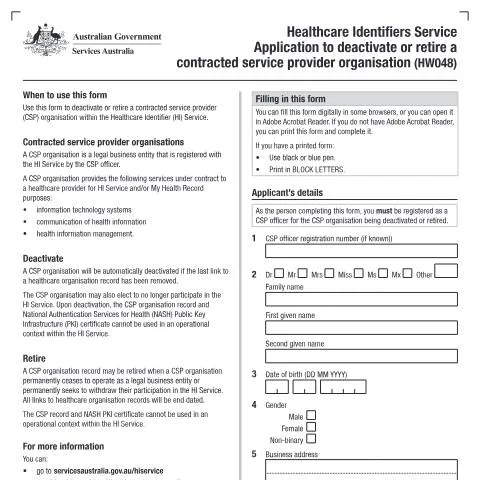
Understanding the Context of the HW048 Form in Healthcare
The Healthcare Identifiers Service application to deactivate or retire a contracted service provider organisation form, commonly referred to as HW048, plays a crucial role within Australia’s health sector. Its importance cannot be understated in the context of maintaining accurate and up-to-date records of healthcare service providers. This document is used primarily by organisations that have been contracted to deliver health services but may no longer require their identifiers due to various circumstances. Understanding its function, requirements, and implications is essential for health professionals and administrators alike.
A Historical Perspective: Regulation and Evolution of Healthcare Identifiers
The establishment of the Healthcare Identifiers Service (HIS) was a significant advancement in Australia's healthcare system. Introduced to facilitate better record-keeping and ensure the security of patient information, the HIS is governed under specific legislation aimed at improving the interoperability of health services. This legislative framework enables healthcare providers to easily share patient information while maintaining privacy standards. Over the years, the HIS has evolved to accommodate the changing needs of healthcare delivery, prompting the necessity for forms such as HW048. This form serves as a mechanism through which entities can formally request the deactivation of their identifiers, ensuring that the healthcare database remains accurate and relevant.
The Importance of Accurate Healthcare Identifiers
Accurate healthcare identifiers are paramount in preventing confusion, ensuring patient safety, and maintaining the integrity of Australia's healthcare system. With various health professionals and organisations involved in patient care, having a reliable way to identify and deactivate services is crucial. The HW048 form is instrumental in managing these identifiers when an organisation ceases operations or no longer requires a particular identifier.
Who Needs to Submit the HW048 Form?
The HW048 form is specifically designed for contracted service provider organisations within Australia. This includes a range of entities such as hospitals, clinics, and specialist practices. These organisations must complete the form when they decide to retire or deactivate their healthcare identifiers for any number of reasons, including:
- Business closure or merger
- Changes in service provision
- Transition to a different care model
Each case is unique, and the implications of deactivating a healthcare identifier can extend beyond administrative processes, potentially affecting patient care and continuity.
Exceptional Cases Requiring Special Attention
While the HW048 form typically applies to contracted organisations, there are exceptional cases where unique circumstances might arise. For instance, foreign organisations operating in Australia or those that are part of larger networks may have specific requirements when submitting this form. Additionally, organisations that serve vulnerable populations or those with specific health needs may need to navigate additional protocols, ensuring that patient care remains a priority during the identifier deactivation process.
A Step-by-Step Guide to Completing the HW048 Form
Completing the HW048 form requires careful attention to detail to avoid complications. Here is a structured approach to tackling it:
- Gather Required Information: Before starting, ensure you have all necessary details at hand, including your healthcare identifier, organisation details, and reasons for deactivation.
- Accessing the Form: The HW048 form can be found through the Services Australia portal. Ensure you have a myGov account to access the digital version.
- Completing the Form: Fill out all relevant fields accurately. Take particular care with sections related to contact information and reasons for deactivation.
- Review for Accuracy: Double-check all information for clarity and accuracy. Incomplete or incorrect submissions can lead to delays.
- Submission: Once reviewed, submit the form electronically via the Services Australia online portal.
Common Pitfalls and Considerations
While completing the HW048, certain common pitfalls may arise:
- Incomplete Information: Failing to provide complete information can result in processing delays.
- Inaccurate Contact Details: Ensure that the contact details provided are current to facilitate any follow-up communications from Services Australia.
- Submission Errors: Electronic submissions should be confirmed to ensure they have been received.
Timeline: From Submission to Deactivation
Once the HW048 form is submitted, a timeline of events is triggered. Here’s what typically happens:
| Step | Description | Expected Duration |
|---|---|---|
| Verification Process | Services Australia reviews the submitted form for accuracy and completeness. | Typically within 10 business days |
| Decision Notification | Notification sent to the submitting organisation regarding the status of their application. | Varies, typically 5-15 business days after verification |
| Deactivation of Identifier | Upon approval, the healthcare identifier is officially deactivated. | Immediate upon confirmation |
The clarity of this process is designed to support organisations in managing their healthcare identifiers efficiently.
The Role of the HW048 Form in Broader Healthcare Administration
The HW048 form is not an isolated document; instead, it plays a vital role within the overarching framework of healthcare administration in Australia. It interacts with other forms and processes that address the registration, updating, and deactivation of healthcare identifiers. This holistic approach ensures that patient safety and data integrity are maintained across the health system. Understanding this interconnectedness can help organisations better navigate their obligations and responsibilities within the healthcare landscape.
Distinguishing the HW048 from Similar Forms
It's essential to differentiate the HW048 form from other related documents used in the healthcare sector. For example, the Healthcare Identifiers Service application for new organisations focuses on registration, while the HW048 centers on deactivation. Misunderstanding these distinctions can lead to administrative errors and potential disruptions in service delivery. Being aware of these differences ensures that healthcare organisations can choose the correct form for their needs.
Final Thoughts: Navigating the Healthcare Landscape with Confidence
As healthcare providers and organisations navigate the complexities of maintaining accurate records, understanding the use of the HW048 form becomes paramount. It not only facilitates compliance with regulatory standards but also enhances the quality of service provided to patients. The emphasis on accuracy, clarity, and timely communication throughout the deactivation process ultimately supports the integrity of Australia’s healthcare system. By leveraging the HW048 form effectively, organisations can manage their identifiers responsibly, ensuring a focus on patient care and safety remains at the forefront.
Understanding Healthcare Identifiers in Australia
The Healthcare Identifiers (HI) Service in Australia is a crucial framework designed to streamline the identification of healthcare providers and patients across the healthcare system. By having a unique identifier for each healthcare provider, it aids in ensuring that patients receive proper care without the complications of misidentification. This is particularly important in a country like Australia, where the healthcare system is multifaceted and involves various stakeholders including public and private healthcare providers.
The HI Service assigns unique identifiers to individuals and organisations involved in the healthcare sector. For organisations, the HI number can be essential for billing, coordination of care, and communication between different healthcare providers. Understanding the implications of the HI numbers can help organisations ensure that they maintain compliance with both national standards and their contractual obligations to health services.
Deactivation Process: Step-by-Step Guide
The process of deactivating or retiring a contracted service provider organisation is defined with clarity in the HW048 form. It is essential that organisations follow the established procedures to maintain compliance with the HI Service requirements. Here’s a detailed overview of the steps involved in the deactivation process:
- Gather Necessary Information: Before starting the application, ensure that you have all relevant information at hand, including the unique HI number assigned to your organisation, the reason for deactivation, and any correspondence with the HI Service or related authorities.
- Complete the HW048 Form: This form is critical and must be filled out comprehensively. It includes sections that require detailed explanations for the deactivation, such as the effective date of deactivation and a declaration of the authority signing the application. Ensure accuracy to avoid delays.
- Submit the Application: Once the form is completed, it should be submitted through the designated channels. Depending on whether you are using myGov or another platform, follow the specific instructions provided on the submission portal.
- Await Confirmation: After submission, allow some processing time. The HI Service will review your application and may reach out for further information if needed. Confirmation of deactivation will be communicated to your registered email address or through your myGov account.
Following these steps is crucial to ensure the smooth and compliant deactivation of a service provider organisation within the HI framework.
Common Issues Encountered During Deactivation
While the process to deactivate a service provider organisation is relatively straightforward, certain issues can arise that complicate the procedure. Below are some common pitfalls and how to navigate them:
- Incomplete or Incorrect Information: One of the most frequent issues is submitting an application with missing or incorrect information. Prior to submission, double-check all entries against your records to ensure accuracy.
- Delay in Response: Sometimes, the HI Service may take longer than expected to process applications. If you haven’t received confirmation after a reasonable time, follow up through the appropriate contact channels to inquire about the status of your application.
- Understanding Impacts on Patient Care: Deactivating an organisation can have implications on patients. It is essential to inform the affected patients about changes that may occur, to ensure they are directed to alternative services when necessary. Providing clear communication can mitigate confusion.
By being proactive and aware of these common issues, organisations can better manage the deactivation process and maintain compliance with the HI Service regulations.