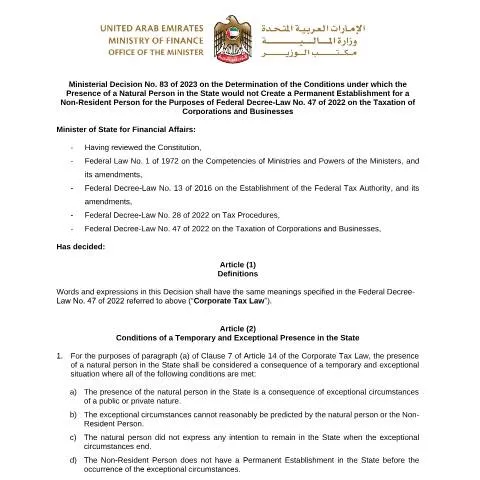
Understanding Ministerial Decision No (83) of 2023 on Taxation and Non-Resident Presence in the UAE
The United Arab Emirates continues to refine its tax regulations to ensure clarity and fairness for both resident and non-resident entities operating within its borders. A significant development in this regard is the issuance of Ministerial Decision No (83) of 2023, which delineates specific conditions under which the physical presence of an individual in the UAE does not constitute a permanent establishment for tax purposes. This guide aims to clarify the scope, implications, and practical application of this decision for businesses and individuals engaged in cross-border activities.
Scope and Purpose of the Decision
The primary objective of Ministerial Decision No (83) of 2023 is to provide clear criteria that distinguish between activities that create a taxable presence and those that do not, thereby preventing inadvertent tax obligations for non-resident persons. This aligns with the broader legal framework established by Federal Decree-Law No (47) of 2022 on the taxation of corporations and businesses, ensuring that the definition of a permanent establishment (PE) remains precise and applicable to the evolving economic landscape.
This decision is particularly relevant for foreign individuals and businesses that operate in the UAE without establishing a formal physical or economic presence, such as representatives, consultants, or contractors who might occasionally visit or work temporarily within the country.
Main Provisions and Conditions
The decision sets forth specific conditions under which the presence of a natural person in the UAE will not be deemed to create a PE. These conditions include, but are not limited to:
- Duration of Stay: The individual's stay in the UAE must be limited to a certain period, typically not exceeding the threshold set by the legislation, which is intended to prevent long-term or permanent activities.
- Nature of Activities: The activities conducted should be preparatory or auxiliary, such as attending meetings, training sessions, or occasional site visits, and should not involve core business operations or decision-making authority.
- Absence of Fixed Place of Business: The individual should not use or maintain a dedicated office, branch, or other fixed place of business within the UAE for conducting the activities.
- Limited Physical Presence: The presence should be incidental and not indicative of a substantial or ongoing physical footprint that could be construed as establishing a PE.
It is important to note that these conditions are designed to be interpreted in a manner consistent with international standards, ensuring that the UAE remains an attractive destination for international business while maintaining compliance with global tax principles.
Implications for Non-Residents and Businesses
For non-resident individuals and entities, this decision offers clarity on when their activities in the UAE will not trigger a tax obligation related to permanent establishment. This is particularly beneficial for companies engaging in consulting, auditing, or advisory services, where personnel may visit the country intermittently.
Businesses should review their operational models and ensure that their activities align with the criteria outlined in the decision to avoid unintended tax liabilities. Proper documentation and adherence to the specified conditions are essential for demonstrating compliance if questioned by tax authorities.
Practical Guidance and Compliance
While the decision provides a framework, it is advisable for companies and individuals to consult with qualified tax advisors or legal experts familiar with UAE tax legislation to interpret the provisions accurately and implement best practices. Maintaining detailed records of visits, activities conducted, and the duration of stay can be instrumental in establishing that the conditions for exclusion from PE status are met.
Moreover, entities should stay informed about updates or clarifications issued by the Federal Tax Authority (FTA) and other relevant authorities to ensure ongoing compliance and to adapt to any legislative or procedural changes.
Conclusion
Ministerial Decision No (83) of 2023 marks a significant step towards clarifying the tax treatment of non-resident persons in the UAE. By defining clear conditions under which a person's presence does not constitute a permanent establishment, the UAE aims to foster a transparent and business-friendly environment. Stakeholders engaged in cross-border activities should review this decision carefully and align their operational practices accordingly to ensure compliance and optimize their tax position within the framework of UAE law.