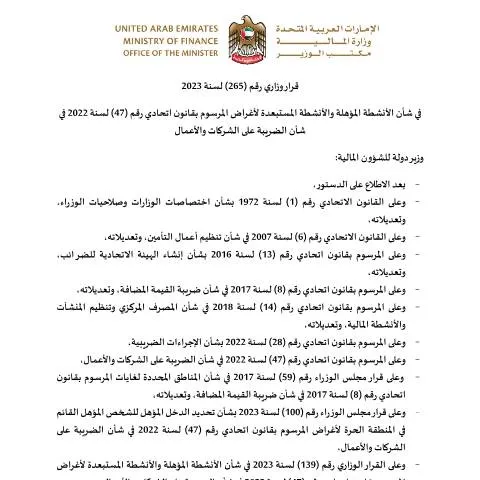
Overview of Ministerial Decision No. 265 of 2023 on Qualifying and Excluded Activities for Corporate Taxation in the UAE
The United Arab Emirates has issued Ministerial Decision No. 265 of 2023, which provides detailed guidance on the classification of activities as either qualifying or excluded under the provisions of Federal Decree-Law No. 47 of 2022 concerning Corporate Tax. This decision aims to clarify the scope of taxable activities and streamline compliance for businesses operating within the UAE’s evolving tax framework.
Objectives and Scope of the Decision
The primary objective of this ministerial decision is to delineate the activities that are considered eligible (qualifying) for the purposes of corporate taxation, as well as those that are explicitly excluded. It serves as an official interpretative guideline to assist businesses, tax authorities, and other stakeholders in understanding the application of the federal corporate tax law.
Specifically, the decision applies to all entities subject to corporate tax under the federal law, regardless of their size or sector. It emphasizes the importance of compliance with the legal definitions and classifications to ensure correct tax treatment and reporting.
Main Provisions and Classifications
Qualifying Activities
The decision identifies certain activities as qualifying, meaning they are considered legitimate sources of income that will be subject to corporate tax. These typically include:
- Commercial trading activities conducted within or outside the UAE, provided they meet the criteria set forth in the law.
- Manufacturing and industrial activities that contribute to the local economy.
- Services that are directly related to the core business operations of the entity.
It is important for businesses to verify whether their activities fall under these categories to determine their tax obligations accurately.
Excluded Activities
Conversely, the decision explicitly lists activities that are excluded from the scope of corporate tax. These include, but are not limited to:
- Activities related to government or public authority functions.
- Educational, scientific, or cultural activities conducted by recognized institutions.
- Activities carried out within free zones, subject to specific conditions and exemptions.
These exclusions aim to support sectors that are considered vital for social development and economic diversification, aligning with the UAE’s strategic objectives.
Implications for Businesses and Tax Compliance
Businesses operating in the UAE must carefully assess their activities against the classifications provided in Ministerial Decision No. 265 of 2023. Proper identification of qualifying versus excluded activities is essential for accurate tax reporting and compliance with federal regulations.
Entities engaged in activities that are classified as qualifying should ensure they maintain detailed records and documentation to substantiate their classification during audits or reviews by the Federal Tax Authority (FTA).
For activities deemed excluded, businesses should verify if any specific conditions or exemptions apply, especially when operating within free zones or under special economic zones that might have separate tax regimes.
Role of the Federal Tax Authority and Future Guidance
The Federal Tax Authority (FTA) remains the primary body responsible for the enforcement and interpretation of these classifications. It is expected to issue further guidance and clarifications to assist taxpayers in implementing the provisions of Ministerial Decision No. 265 of 2023 effectively.
Businesses are encouraged to stay informed through official channels and consult with tax professionals to ensure ongoing compliance and to adapt their operations as needed based on evolving legal interpretations.
Conclusion
Ministerial Decision No. 265 of 2023 represents a significant step in clarifying the scope of corporate taxation in the UAE. By explicitly defining qualifying and excluded activities, it provides a clearer framework for businesses to align their operations with federal tax laws, fostering transparency and compliance within the national economic strategy.