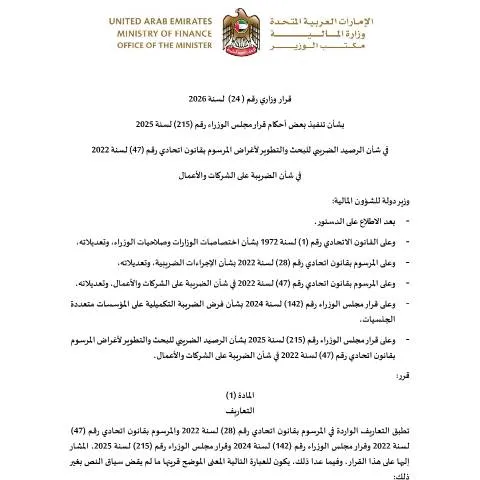
Understanding the Ministerial Decision No. 24 of 2026: A Guide to Tax Credits for R&D
The Ministerial Decision No. 24 of 2026 represents a pivotal moment in the tax landscape of the United Arab Emirates (UAE), particularly concerning the implementation of tax credits for research and development (R&D) activities. This document, issued by the Ministry of Finance, outlines provisions for tax credits which serve to incentivize innovation and technological advancements within the UAE’s corporate sector.
The Purpose of the Ministerial Decision
The primary role of this decision is to specify the details surrounding the eligibility and application of tax credits for R&D, as stipulated in Cabinet Decision No. 215 of 2025. It establishes the criteria, conditions, and parameters for calculating the R&D tax credit, providing clarity to businesses aiming to engage in or expand their R&D efforts within the UAE.
Who Needs to File and Under What Conditions?
Entities eligible to file under this decision include companies engaged in qualifying R&D activities. This encompasses both local and foreign firms operating in the UAE, provided they meet specific criteria outlined in the decision. Key factors for eligibility include:
- The organization must have incurred qualifying R&D expenditures as defined by the Federal Decree-Law No. 47 of 2022.
- Companies must demonstrate compliance with the requirements set forth in the Cabinet Decision No. 215 of 2025.
- Entities can either apply individually or as part of a tax group, enabling collaboration among different companies for shared R&D initiatives.
Details of the R&D Tax Credit Calculation
Understanding how to calculate the R&D tax credit is crucial for organizations looking to benefit from this provision. The tax credit is determined based on a tiered structure that considers the amount of R&D expenditures and the average number of qualified R&D employees:
| R&D Expenditure Range | Average R&D Employees | Tax Credit Percentage |
|---|---|---|
| Up to AED 1 million | 2 | 15% |
| Over AED 1 million to AED 2 million | 6 | 35% |
| Over AED 2 million to AED 5 million | 14 | 50% |
This tiered approach ensures that the benefits of the tax credit are scaled according to the investment in research and the capacity of the workforce dedicated to these activities.
Completing the Application Process
The application process for the R&D tax credit involves several steps that must be meticulously followed to ensure compliance and maximize the claim:
- Preparation of Documentation: Companies must gather all relevant financial records related to R&D expenses, including invoices, contracts, and payroll records for employees engaged in R&D activities.
- Submission of Application: The application for the tax credit must be submitted electronically to the Federal Tax Authority (FTA) through the designated online platform, ensuring that all supporting documentation is attached.
- Review Process: Upon submission, the FTA will review the application. This process may involve requests for additional information or clarification regarding the R&D activities conducted.
- Approval and Credit Application: Once approved, the tax credit will be applied against the entity’s corporate tax obligations. It is essential to monitor compliance with ongoing reporting requirements to maintain eligibility for future claims.
The Importance of Timely Submission
Timeliness is crucial when submitting applications for the R&D tax credit. Organizations must be aware of specific deadlines for submission following the end of the financial year, as outlined in the Cabinet Decision No. 215 of 2025. Late submissions may result in penalties or a denial of the tax credit, making adherence to deadlines a top priority for all involved.
Implications of the Tax Credit for Businesses
Successfully navigating the tax credit application process can yield significant benefits for businesses engaged in R&D. These advantages include:
- Financial Relief: The tax credit can substantially reduce the overall tax liabilities of a company, freeing up resources for further investment in R&D or other business activities.
- Encouragement for Innovation: With financial incentives in place, companies are more likely to invest in innovative projects, thereby fostering an environment conducive to technological advancements and economic growth within the UAE.
- Enhanced Competitive Advantage: Leveraging the tax credit can improve a company's market position, making it more appealing to investors and partners interested in innovative ventures.
Adapting to Unique Situations: Special Cases and Exceptions
There are particular scenarios that businesses should be aware of, especially when navigating the complexities of the tax credit system:
- Foreign Entities: Foreign companies operating in the UAE must ensure that they are compliant with local regulations and the specific provisions applicable to their organizational structure.
- Startups and Small Enterprises: Smaller companies with limited R&D expenditures should evaluate their eligibility to maximize the potential benefits from the tax credit, even if their scale of operations is relatively modest.
- Joint Ventures: Companies forming joint ventures for R&D projects need to understand how to allocate expenditures and employee counts appropriately to ensure all participating entities benefit from the tax credit.
Historical Context: The Legislative Framework Behind the Decision
The issuance of Ministerial Decision No. 24 of 2026 is rooted in a broader legislative context aimed at strengthening the UAE’s position as a global hub for innovation. The decision builds upon previous laws and decrees, including:
- The Federal Decree-Law No. 47 of 2022 concerning corporate tax obligations.
- The Federal Decree-Law No. 28 of 2022 related to tax procedures.
- The Cabinet Decision No. 142 of 2024 regarding supplementary taxes on multinational enterprises.
Each of these legal frameworks contributes to a comprehensive approach designed to stimulate economic growth through enhanced corporate activity, particularly in the realm of research and development.
Conclusion: Navigating the Future of R&D Tax Credits
In summary, the Ministerial Decision No. 24 of 2026 represents a vital opportunity for businesses in the UAE to leverage tax credits for their R&D initiatives. By understanding the requirements and diligently following the application process, organizations can position themselves to benefit significantly from this framework. As the UAE continues to evolve as a leader in innovation, staying informed about such tax provisions will be essential for companies aiming to thrive in an increasingly competitive global market.
Understanding Ministerial Resolution No. (24) of 2026: Implications for Research and Development Tax Credit
The Ministerial Resolution No. (24) of 2026 serves as a pivotal development in the UAE's approach to incentivizing research and development (R&D) within the private sector. This resolution builds upon the Cabinet Decision No. (215) of 2025, which laid the groundwork for the tax credit system aimed at enhancing the technological and innovative capabilities of local businesses. Understanding the nuances of this ministerial decree is essential for stakeholders intending to capitalize on the tax benefits associated with R&D efforts.
Firstly, the resolution delineates the qualifying criteria for entities seeking to benefit from the tax credits. Companies must demonstrate a minimum threshold of R&D expenditures, which should not only be justifiable through financial documentation but also align with the broader objectives of technological advancement set forth by the tax authorities. This includes innovation in processes, products, or services that offer a competitive edge in both local and international markets.
Moreover, a distinctive feature of this resolution is its emphasis on sustainability and environmentally friendly technologies. Companies engaging in R&D should consider how their projects align with the UAE’s vision for sustainable development, as those meeting these criteria may qualify for enhanced tax incentives. This can be particularly beneficial for firms in the renewable energy sector, which is actively promoted by the Emirati government.
For businesses looking to navigate this landscape, it is crucial to maintain meticulous records of R&D activities and expenditures. The Federal Tax Authority (FTA) has outlined specific documentation requirements, including detailed project descriptions and financial justifications. Failure to comply with these regulations may result in disqualification from receiving the tax benefits. Thus, a strategic approach to record-keeping cannot be overstated.
Tax Compliance and Reporting Mechanisms under the New Resolution
Compliance with the stipulations of Ministerial Resolution No. (24) of 2026 is not merely a formality; it is an integral part of the strategic framework that businesses must adopt to leverage tax credits effectively. The resolution demands a robust reporting mechanism that allows for the transparent monitoring of R&D expenditures. Companies are required to submit periodic reports to the FTA detailing their R&D activities, alongside the associated costs incurred within the eligible financial year.
To facilitate this process, the FTA has provided a structured online submission platform, which enables businesses to upload their R&D reports along with supporting documentation. It is advisable for companies to familiarize themselves with this digital interface, as it is designed to enhance efficiency and reduce the administrative burden on businesses. The online system also includes features that allow for real-time tracking of submissions, ensuring that companies can monitor their compliance status at any given time.
An additional layer of compliance comes from the potential for audits by the FTA. Random audits may be conducted to verify the validity of claims made under the tax credit system. Companies must be prepared for this eventuality by ensuring their records are not only comprehensive but also easily accessible. Clear categorization of expenses related to R&D initiatives and maintaining a well-organized digital folder system can simplify the audit process.
Moreover, engaging with tax professionals who specialize in R&D tax credits can provide invaluable insights into optimizing claims. They can assist in navigating the complexities of the resolution and ensuring adherence to all legal requirements, thus maximizing potential benefits while mitigating risks associated with non-compliance.
Future Trends and Considerations for R&D Tax Policies in the UAE
The enactment of Ministerial Resolution No. (24) of 2026 signals a broader shift in the UAE's fiscal policy towards fostering innovation through tax incentives. Observers anticipate several emerging trends that may influence future R&D tax policies in the country. First, there is a growing recognition of the need to tailor tax incentives to the rapidly evolving technological landscape. As new technologies emerge, such as artificial intelligence and blockchain, the government may adjust qualifying criteria to encompass a wider array of R&D activities that align with these advancements.
Furthermore, the UAE's commitment to diversifying its economy away from oil dependency is likely to shape the evolution of R&D tax policies. Increased emphasis on sectors such as healthcare, renewable energy, and information technology suggests that future regulations may focus more on incentivizing innovation in these areas. Businesses engaged in these disciplines should actively monitor policy announcements and be prepared to adapt their R&D strategies accordingly.
Another trend to watch is the potential collaboration between the government and the private sector in areas of research and development. Joint ventures and public-private partnerships could become more prevalent, providing companies with access to additional resources and funding opportunities. Such collaborations might be encouraged through enhanced tax incentives, ultimately fostering a more robust innovation ecosystem in the UAE.
Lastly, as the global economy continues to recover from recent disruptions, international competitiveness will be a focal point for the UAE's R&D tax policies. The government may implement measures aimed at attracting foreign direct investment in R&D by offering competitive tax incentives, thereby positioning the UAE as a hub for innovation in the Middle East. Companies considering expansion or investment in R&D within the UAE should stay abreast of these potential developments to align their strategies accordingly.