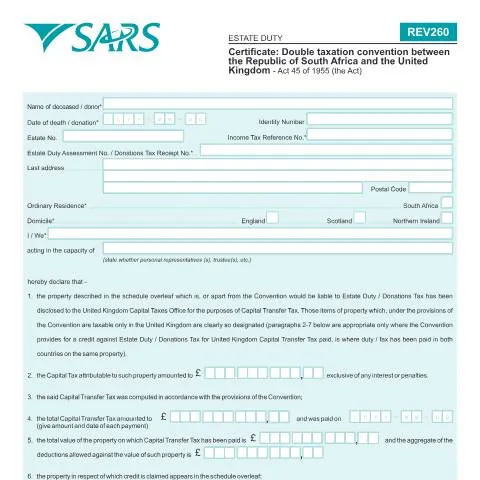
Navigating the REV260 Certificate: A Vital Document in Cross-Border Taxation
The REV260 Certificate is an essential document for individuals and entities engaging in transactions between the Republic of South Africa (RSA) and the United Kingdom (UK). As globalization leads to more cross-border investments and financial interactions, understanding the nuances of tax treaties becomes pivotal. The REV260 Certificate serves as proof of compliance with the Double Taxation Convention established between these two nations, ensuring that individuals are not double-taxed on the same income or assets.
Eligibility Criteria for Obtaining the REV260 Certificate
Not everyone can apply for the REV260 Certificate; specific eligibility criteria must be met. This document is designed for individuals or entities who have connections to both South Africa and the UK and are involved in financial transactions that may attract estate duty or donations tax. Here are the main eligibility conditions:
- Tax Residency: The applicant must be a tax resident of South Africa or the UK. This usually requires demonstrating a permanent home or principal place of business in one of the countries.
- Connection to the Estate: The application is typically made by executors or administrators of an estate concerning a deceased individual, or by donors in the case of gifts.
- Payment of Relevant Taxes: The applicant must provide proof that applicable taxes have been paid to either party, which may involve submitting tax returns or payment receipts.
The Detailed Process for Application
Obtaining the REV260 Certificate involves several distinct steps. The process can seem complicated, but with careful attention to detail, it can be navigated smoothly. Here is a step-by-step guide:
- Gather Required Documentation: Collect all necessary documents, which may include the death certificate (for estates), proof of identity, and any financial documentation related to the property in question.
- Complete the REV260 Form: This form can be accessed as a downloadable PDF from the official government site. Ensure that all sections of the form are accurately filled out, including details about the deceased or donor and the property involved.
- Submit to Relevant Authorities: The completed form needs to be submitted in triplicate to the appropriate office. This includes the South African Revenue Service (SARS) and the Capital Taxes Office in the UK.
- Follow Up: After submission, maintain communication with SARS to ensure that your application is processed and to check if any additional information is required.
Understanding the Legal Implications of the REV260 Certificate
The REV260 Certificate is not just a piece of paper; it holds significant legal weight in tax matters. It certifies that:
- The tax liability concerning the property has been assessed and recorded accurately.
- Any relevant tax credits or exemptions have been applied per the Double Taxation Convention.
- It acts as a safeguard against the possibility of double taxation on the same income or assets, thereby protecting the financial interests of the applicant.
Moreover, the certificate provides a clear audit trail for tax authorities, which helps in maintaining transparency and accountability in cross-border transactions.
Practical Usages of the REV260 Certificate
Understanding the practical applications of the REV260 Certificate is crucial for individuals and businesses. Here are some typical scenarios where this document is essential:
- Estate Settlements: Executors of estates must have this certificate to facilitate the distribution of assets without double taxation.
- Gift Transactions: Donors may need the REV260 when transferring significant assets to beneficiaries in the UK, ensuring tax compliance.
- Tax Filings: This certificate often forms part of the documentation required when filing tax returns in either jurisdiction.
Organizations like the South African Revenue Service (SARS) and the UK Capital Taxes Office specifically require this document to process estate duty and donations tax matters efficiently.
Managing Errors or Disputes Related to the REV260 Certificate
Mistakes can happen, and when they do, it’s important to know how to rectify them. Whether it’s a typing error on the certificate or a dispute about the valuation of an estate, here are the steps to take:
- Identify the Error: Carefully review the certificate and relevant documents to ascertain the nature of the mistake.
- Notify the Relevant Authorities: Contact SARS and the UK Capital Taxes Office as soon as possible to report the error. Documentation may be required to support your claim.
- Submit Corrective Actions: Depending on the nature of the error, you may need to complete an amended REV260 form or provide additional information to clarify your situation.
- Keep Records: Maintain a detailed record of all correspondence and documentation submitted. This is crucial in case of further disputes or investigations.
Validity and Renewal of the REV260 Certificate
The REV260 Certificate typically remains valid as long as the underlying tax obligations remain unchanged. However, several factors may necessitate a renewal or re-assessment of the certificate:
- Changes in Tax Law: If either South Africa or the UK amends its tax policies, the terms of the REV260 may need to be reassessed.
- Revised Valuation of Assets: If the market value of the estate changes significantly, a new certificate may be required to reflect the current tax obligations.
- Disputes Resolved: In cases of successful appeals or disputes, a new certificate might be necessary to officially document the resolution.
Conclusion: The Importance of Awareness and Preparedness
In an increasingly globalized world, understanding the importance of the REV260 Certificate and its implications cannot be overstated. Whether you’re an individual planning your estate or a business involved in cross-border transactions, being informed about this vital document will facilitate smoother processes and ensure compliance with tax regulations. By staying proactive and aware of the requirements surrounding the REV260 Certificate, individuals can effectively navigate the complexities of international taxation and safeguard their financial interests.
Understanding the REV260 Form: Purpose and Importance
The REV260 form, officially known as the Certificate for Double Taxation Convention between the Republic of South Africa (RSA) and the United Kingdom (UK), serves a crucial role for individuals and entities involved in cross-border transactions between these two countries. Its primary purpose is to prevent double taxation on income, ensuring that taxpayers do not pay tax on the same income in both jurisdictions. This aligns with the provisions of the double taxation agreement (DTA) established between RSA and the UK, aimed at enhancing economic cooperation and reducing the tax burden on residents of both nations.
The form is particularly relevant for South African residents earning income from the UK or UK residents deriving income from South Africa. By obtaining the REV260 certificate, applicants can claim relief from withholding tax on certain types of income—such as dividends, interest, and royalties—typically subjected to tax in the source country. This not only facilitates smoother business operations but also encourages foreign investment and trade, fostering economic growth.
It is essential for applicants to understand that the REV260 form must be completed accurately and submitted to the South African Revenue Service (SARS) for assessment. The information provided must reflect the applicant’s tax residency status, the nature of the income, and the relevant articles of the DTA that apply to the specific case. An incomplete or incorrect submission may lead to delays, result in penalties, or ultimately deny the relief sought.
Step-by-Step Guide to Completing the REV260 Form
Filling out the REV260 form can seem daunting, but breaking it down into manageable steps can simplify the process. Here’s a detailed walkthrough to ensure applicants can complete the form correctly:
- Gather Required Information: Before starting with the form, gather all necessary documents including proof of tax residency, identification documents (such as a Smart ID card or passport), and any previous tax returns or assessments related to the income in question. Having this information on hand will streamline the process.
- Access the Form: The REV260 form is available on the SARS website, and can be downloaded as a PDF. It is crucial to ensure you have the latest version of the form as regulations may change. Look for the interactive eForm option if preferred.
- Complete Applicant Details: In the first section of the REV260 form, fill in personal details accurately. This includes the 13-digit ID number (in YYMMDDSSSSCAZ format) for South African residents, or relevant UK tax identification details for foreign applicants.
- Describe the Income: Clearly specify the type of income you are claiming relief for. Be specific whether it is dividends, interest, royalties, or any other type of income referenced in the double taxation treaty.
- Tax Residency Certification: Indicate your status as a tax resident. For South African applicants, this involves confirming your physical presence in South Africa for a stipulated duration or indicating your permanent residency. Ensure you understand the criteria of tax residency as defined by the South African Revenue Service.
- Reference Relevant Articles of the DTA: You must refer to the specific articles within the DTA that pertain to your income type. This may require reviewing the DTA text to ascertain which article applies. Knowledge of these articles is crucial in substantiating your claim.
- Review and Submit: Once completed, thoroughly review all entries for accuracy. Any discrepancies could lead to rejection. Submit the form to SARS either digitally (if using the eForm) or physically at the designated SARS office. Ensure to keep copies of the submitted form and any accompanying documents for your records.
Common Challenges and Solutions When Applying for REV260
While the REV260 form is designed to assist taxpayers, applicants often encounter challenges during the application process. Here are some prevalent issues along with potential solutions:
- Incomplete Documentation: One of the most common reasons for application delays or rejection is the lack of supporting documents. To mitigate this, create a checklist of required documents before starting the application process. This should include proof of tax residency and any previous tax documents.
- Incorrect Tax Residency Status: Applicants may mistakenly assume their residency status which can lead to incorrect submissions. It's advisable to consult the guidelines provided by SARS regarding tax residency. If in doubt, consider seeking professional tax advice to accurately determine your status.
- Misunderstanding of the DTA Articles: Misinterpreting the DTA can lead to incorrect claims. It is vital to have a clear understanding of the treaty provisions. Taxpayers can access SARS or a tax professional for help in interpreting these articles correctly.
- Processing Delays: Applicants sometimes face long waiting times for their applications to be processed. To address this, ensure that your application is complete and submitted via the appropriate channels. In case of delays, utilize the SARS online services to track your application status.
- Non-Compliance Risks: Failure to comply with the provisions of the DTA or misrepresentation in the application can lead to penalties. Always ensure that all information is accurate and aligns with the tax laws to avoid any legal repercussions.
By being aware of these challenges and preparing accordingly, applicants can enhance their experience in submitting the REV260 form and improve their chances of receiving the tax relief available under the DTA.