Navigating the DA 180 01B 1 Form: A Key Component in Environmental Compliance
Compliance with environmental regulations is crucial for businesses in the oil and natural gas sectors in South Africa. One of the significant documents they must navigate is the DA 180 01B 1 form, related to the Environmental Levy Account for Carbon Tax. This form serves as a declaration of fugitive emissions, enabling the South African tax authorities to assess and collect carbon tax accordingly.
The Importance of Accurate Submissions
Submitting the DA 180 01B 1 form is more than a mere administrative task; it is a regulatory necessity that can affect a company's financial liabilities and environmental responsibilities. Failure to submit this form correctly can result in penalties, additional taxes, or even legal consequences.
In this context, understanding the intricacies of this form is vital. The submission informs the authorities about a company's emissions, thus facilitating compliance with the Carbon Tax Act of 2019.
Who Needs to Submit the DA 180 01B 1 Form?
The requirement to fill out the DA 180 01B 1 form generally falls under the responsibility of licensees engaged in activities that lead to fugitive emissions from oil and natural gas operations. This includes:
- Operators of oil and gas extraction sites.
- Companies involved in the transportation and storage of oil and gas.
- Businesses that process or refine fossil fuels.
These entities must ensure they are registered with the South African Revenue Service (SARS) and have the necessary licenses to report their emissions under the carbon tax framework.
Decoding the DA 180 01B 1 Form: A Section-by-Section Breakdown
Completing the form accurately is crucial for compliance. Below is a detailed look at the sections of the DA 180 01B 1 form:
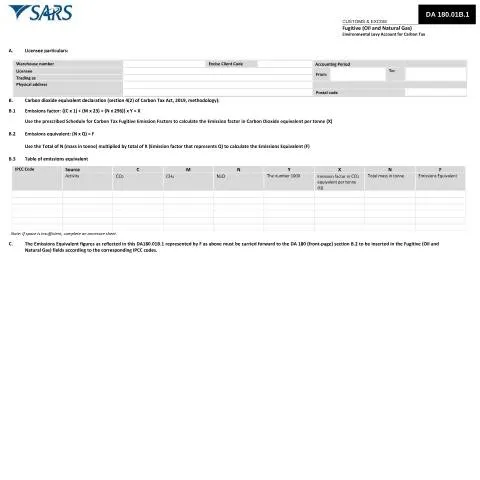
A. Licensee Particulars
The first section requires the licensee's details. This includes:
- Warehouse number
- Excise client code
- Accounting period (indicating the timeframe for which emissions are reported)
This information links the submitted data to the correct business entity, ensuring accountability.
B. Carbon Dioxide Equivalent Declaration
This section is divided into three components where complex calculations come into play:
- Emissions Factor: The formula provided is paramount for calculating the emissions factor in carbon dioxide equivalent per tonne. The formula is structured as follows: {(C x 1) + (M x 23) + (N x 296)} x Y = X. Here, each variable represents different greenhouse gases (e.g., C for CO2, M for CH4, N for N2O).
- Emissions Equivalent: This is where you calculate the total emissions equivalent. The formula (N x Q) = F shows how the mass in tonnes is multiplied by the emissions factor derived from the previous step.
- Table of Emissions Equivalent: This table systematically organizes the calculations and must be filled out accordingly, detailing emissions from various activities and their corresponding IPCC codes.
C. Carrying Figures Forward
It is essential to transfer the Emissions Equivalent figures calculated in section B to the front page of the DA 180 form, specifically to section B.2. This ensures that all emissions are accounted for in the broader carbon tax declaration process, facilitating the accuracy of tax assessments.
Common Pitfalls When Completing the DA 180 01B 1 Form
When filling out the DA 180 01B 1 form, applicants should be vigilant to avoid several common pitfalls:
- Incomplete Data: Each section must be filled out completely. Missing information can lead to delays, fines, or even legal repercussions.
- Calculation Errors: Given that the form involves calculations, double-checking the math is crucial. Errors can misrepresent emissions and lead to financial penalties.
- Incorrect IPCC Codes: Properly identifying and reporting the emissions sources with corresponding IPCC codes will ensure compliance and accurate tax rates.
Understanding these pitfalls can dramatically improve the chances of a successful and smooth submission process.
What to Do in Case of Submission Issues
If there are issues upon submission, such as a refusal or if additional information is required:
- Addressing Refusals: If your submission is rejected, the authorities will provide feedback. It is crucial to carefully read the feedback and rectify the identified issues as soon as possible.
- Correcting Errors: In instances where an error has been identified post-submission, it is advisable to promptly notify the relevant authority and submit a corrected form. Documentation of the original submission may be required for accurate processing.
- Missing Documentation: If any required documents were omitted, gather the necessary paperwork and provide it to the relevant authority without delay.
Submitting the DA 180 01B 1 Form: Channels Available
There are various channels for submitting the DA 180 01B 1 form, each with its pros and cons:
| Submission Method | Pros | Cons |
|---|---|---|
| Online Submission | Fast processing, immediate confirmation | Technical issues may arise; requires internet access |
| Paper Submission | Accessible for all; can be filled manually | Longer processing time; potential for lost mail |
| In-person Submission | Direct interaction with officials; immediate feedback | Time-consuming; may require travel |
Choosing the right method will depend on business needs, accessibility, and the urgency of the submission.
Final Considerations for Successful Filing
Understanding the nuances of the DA 180 01B 1 form is integral for compliance with South Africa’s carbon tax regulations. Constant vigilance in record-keeping, accurate calculations, and timely submissions will protect your organization from potential penalties. Regularly updating knowledge on changes to the regulatory framework and seeking assistance from environmental compliance experts could also enhance your filing success.
Keep in mind that environmental responsibility extends beyond mere compliance; it plays a critical role in shaping the future of our planet.
Understanding the DA 180 01B 1 Form for Environmental Levy Account
The DA 180 01B 1 form pertains specifically to the Environmental Levy Account for the Carbon Tax, a pivotal instrument in South Africa's efforts to mitigate climate change effects. This form is crucial for entities involved in the oil and natural gas sectors, focusing on their compliance with the carbon tax legislation introduced by the South African government.
To fill out this form accurately, businesses must first understand their obligations under the Carbon Tax Act (Act No. 15 of 2019). It is essential to determine the correct tax liability based on the emissions released during the financial year, which typically aligns with the South African tax year ending in February or March. Failure to comply can lead to substantial penalties, thus prioritizing careful completion of the DA 180 01B 1 form is essential.
Moreover, the Department of Environmental Affairs and other relevant stakeholders have stipulated that companies must maintain meticulous records of their greenhouse gas emissions. These records should be prepared for submission alongside the DA 180 01B 1 form to support any claimed deductions or adjustments related to the environmental levy. It is advisable to consult with environmental compliance specialists to ensure compliance with both tax obligations and environmental regulations.
Common Pitfalls and How to Avoid Them When Completing the DA 180 01B 1 Form
Completing the DA 180 01B 1 form can be a daunting task, especially for those less familiar with the nuances of South African tax regulations. One of the most common pitfalls occurs in the calculations of carbon emissions, which can lead to inaccuracies in the reporting of tax liability. To avoid this, businesses should implement a robust emissions tracking system that integrates data collection with financial reporting processes. This might include the use of software dedicated to carbon accounting or consulting with experts in environmental reporting.
Another frequent issue arises from incomplete documentation. The South African Revenue Service (SARS) requires all supporting documentation to be submitted alongside the DA 180 01B 1 form. This includes evidence of emissions calculations, historical data, and any other relevant paperwork that can substantiate the claims made in the submission. Companies are advised to create a checklist of required documentation to ensure nothing is overlooked during the application process.
Moreover, waiting until the last minute to submit the DA 180 01B 1 form can be detrimental. Businesses should aim to complete the form well ahead of the deadline to allow for potential issues that may arise. The submission typically requires careful review and, if necessary, revisions based on feedback from compliance officers. Engaging with a tax advisor early in the process will enhance the quality of submissions and reduce the likelihood of errors.
Future Developments and Impact on the DA 180 01B 1 Reporting Requirements
As the global focus on climate change intensifies, South Africa's approach to carbon taxation and environmental compliance is expected to evolve. Future developments may include more stringent reporting requirements or new forms introduced by the Department of Environmental Affairs to reflect changes in emissions metrics or sectoral obligations. It is crucial for businesses to stay updated on any announcements from the Department of Environmental Affairs or the South African Revenue Service regarding changes to the DA 180 01B 1 requirements.
Additionally, as the government seeks to enhance the efficiency of carbon tax collection, the introduction of digital platforms for form submission could streamline the process. With the strong push for online services, entities are encouraged to familiarize themselves with electronic submission processes and potential new digital tools that may simplify reporting and compliance.
Lastly, businesses should consider their role within the broader context of global climate initiatives. Engagement in carbon tax mechanisms not only reflects compliance with local laws but also aligns with international standards, potentially enhancing the company’s reputation among environmentally conscious consumers and investors. Continued dialogue with industry groups and government bodies can provide insights into anticipated changes that may affect the DA 180 01B 1 form and its related obligations.