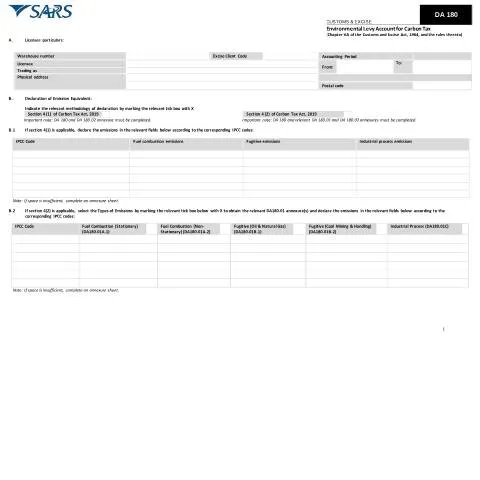
Understanding the Environmental Levy Account for Carbon Tax: DA 180
The DA 180 form is a pivotal document in the landscape of South Africa's environmental regulations, particularly concerning the Carbon Tax initiative. This form is not just a bureaucratic requirement; it plays a crucial role in the management of carbon emissions and environmental levies that companies must adhere to under the Carbon Tax Act of 2019. Engaging with this document is essential for licensees who are mandated to report and manage their emissions effectively.
The Stakeholders Behind the DA 180 Submission
The primary users of the DA 180 are businesses that fall under the Carbon Tax Act regulations. These include manufacturers, energy producers, and any entities that have a significant carbon footprint due to their operational activities. Typically, those required to submit this form are:
- Companies operating licensed warehouses that handle excise goods.
- Businesses that generate emissions from fuel combustion, industrial processes, or fugitive emissions.
- Entities participating in carbon offset and allowance programs.
Each stakeholder must ensure they are familiar with the specific requirements outlined in the Carbon Tax Act, especially regarding declaration methodologies. Understanding the implications of non-compliance can have financial repercussions, including penalties or increased levies.
A Chronological Guide to the DA 180 Submission Process
Understanding how to navigate the DA 180 submission process involves following well-defined steps. Here’s a step-by-step overview:
- Preparation: Gather all relevant data regarding emissions and the operational activities of your business for the applicable accounting period, which runs from January 1 to December 31 each year.
- Complete the Form: Fill out the DA 180 accurately, ensuring that all sections, especially the declaration of emission equivalent, are completed with the correct methodologies as defined by the Carbon Tax Act.
- Review and Attach Supporting Documents: Ensure all necessary annexures (such as DA 180.01 and DA 180.02) are filled out and attached to the DA 180 for submission.
- Submission: Submit the completed DA 180 and its annexures through the South African Revenue Service (SARS) eFiling system. Keep a physical copy for your records.
- Follow-Up: Monitor your submission status via eFiling or through direct contact with SARS if you encounter delays or issues.
Each of these steps is crucial to ensure compliance and to facilitate the accurate assessment of the Environmental Levy payable by the business.
The Practical Implications for Businesses
Filling out the DA 180 is not merely a formality; it opens the door to various rights and responsibilities for businesses. The processes outlined in this form will determine the amount of environmental levy a business is obliged to pay. The repercussions of failing to file correctly can include:
- Financial penalties: Non-compliance could result in hefty fines or additional levies.
- Increased scrutiny: Errors in submissions can lead to audits or reviews by the Department of Environmental Affairs (DEA).
- Impact on corporate reputation: Poor compliance can damage a company’s reputation and stakeholder trust.
Businesses must stay vigilant regarding their emissions reporting and compliance obligations to avoid these pitfalls.
Deep Dive into the DA 180 Form Sections
The DA 180 consists of several critical sections that require careful attention. Each part of the form must be completed with precision, as errors can lead to compliance issues. Let’s break down these sections:
Section A: Licensee Particulars
This section requires businesses to supply essential information, including:
- Warehouse number: The unique identifier assigned to the business's licensed warehouse.
- Excise Client Code: The specific code issued to the licensee for excise purposes.
- Licensee and Trading as: The official names registered with the Registrar of Companies.
- Physical and Postal Addresses: Must be accurate to ensure correct communication.
- Accounting Period: Companies must clearly state the relevant period for which they are reporting.
Section B: Declaration of Emission Equivalent
Here, licensees must indicate their methodology for emissions declaration. This section is divided into two subsections:
- Section 4(1): This pertains to Tier 3 reporting methodologies approved by the DEA and requires comprehensive emission data.
- Section 4(2): Relates to Tier 1 or Tier 2 methodologies, necessitating a simpler report for less complex operations.
Correctly marking the applicable section is crucial, as each has different reporting requirements. Failure to complete the proper annexures can result in submission rejection.
Net Emission Equivalent Calculation
Calculating the net emission equivalent involves detailed calculations based on various emission types, including:
- Fuel combustion emissions
- Fugitive emissions
- Industrial process emissions
The formula is complex, and businesses should ensure they understand each variable to avoid costly mistakes in their calculations. If additional space is required, companies can attach supplementary sheets.
Justifications and Documentation: What You Need
Along with the DA 180, several documents may need to accompany your submission. Depending on your situation, these could include:
- Proof of emissions data (e.g., fuel consumption records)
- Supporting documents for emissions calculations (e.g., third-party verification reports)
- Previous submissions and correspondence with SARS regarding carbon taxes.
Each business’s circumstances will dictate the specifics, but being organized and thorough in documentation can significantly ease the submission process.
Exploring the Broader Context of the DA 180 within Environmental Compliance
The DA 180 is part of a larger framework established by the South African government to address climate change through carbon taxation. Understanding its place in this framework helps businesses appreciate the importance of compliance.
Within this context, the DA 180 interacts with various environmental policies, including:
- The National Greenhouse Gas Emission Reporting Regulations
- The National Environmental Management: Air Quality Act
- Broader carbon offset initiatives and incentives for renewable energy adoption.
Being compliant with the DA 180 not only fulfills legal obligations but also positions companies favorably in meeting sustainability goals, which can enhance their market competitiveness.
Next Steps Post-Submission: Tracking and Outcomes
After the successful submission of the DA 180, licensees should be prepared for the next steps, which may include:
- Monitoring notifications: Keep an eye on your email and SARS eFiling for any correspondence regarding your submission.
- Responding to queries: Should SARS require further information or clarification, timely responses will be crucial.
- Planning for future submissions: Start gathering data for the next reporting period as soon as the current one is completed.
Understanding the outcome of your DA 180 submission can influence future business decisions, especially regarding emissions management and potential investments in cleaner technologies.
Conclusion: Empowering Compliance through Knowledge
Engaging with the DA 180 and understanding its nuances is essential for any business operating under the carbon tax regime in South Africa. This form is not merely a checklist but a comprehensive tool for ensuring compliance and contributing to environmental sustainability. By navigating the complexities of the DA 180, businesses not only meet regulatory requirements but also embrace a proactive approach to environmental stewardship.
Understanding the Carbon Tax and Its Implications
The Environmental Levy Account for Carbon Tax, known as DA 180, is a vital component of South Africa's approach to combating climate change. Established under the Carbon Tax Act of 2019, this tax aims to encourage entities to reduce their greenhouse gas emissions. The DA 180 form is essential for businesses and individuals liable for carbon tax to account for their carbon emissions and the taxes owed.
The carbon tax applies to various sectors, predominantly industries that emit significant volumes of carbon dioxide and other greenhouse gases. This includes energy, manufacturing, and mining sectors, among others. As per the provisions of the Carbon Tax Act, facilities that exceed a specified threshold of emissions must pay a tax based on the tons of carbon dioxide emitted. The goal is to provide a financial incentive for these entities to invest in cleaner technologies and reduce their overall carbon footprint.
Entities that are part of this system must stay informed about their emissions data and assess their liabilities accurately. The DA 180 form plays a key role in this process as it facilitates the reporting of emissions and helps the South African Revenue Service (SARS) ensure compliance with tax obligations. The form must be completed and submitted on an annual basis, aligning with the tax year which typically runs from March 1st to February 28th.
Completing the DA 180 Form: Step-by-Step Guide
Filling out the DA 180 form accurately is critical to ensure compliance with the carbon tax requirements. Here’s a step-by-step guide that will help you navigate the completion process efficiently.
Gather Required Information: Before you begin filling out the form, collect all necessary data. This includes your 13-digit ID number, details of the business or entity, emission data, and previous carbon tax returns if applicable.
Download the DA 180 Form: The form is available online as a PDF on the SARS website. Make sure you have the latest version to avoid any discrepancies.
Fill in the Entity Information: Start by providing the basic details of your entity, including the name, registration number, and physical address. It is crucial to ensure that this information matches what is recorded with the Department of Home Affairs (DHA) and other regulatory bodies.
Report Emissions Data: This section is the crux of the DA 180 form. You will need to report the total greenhouse gas emissions produced by your entity for the tax year. Include data such as fuel combustion, production processes, and any other relevant activities that generate emissions. Be as detailed as possible, as inaccuracies could lead to penalties.
Calculate Your Carbon Tax Liability: Based on the emissions reported, calculate the carbon tax owed. Refer to the current carbon tax rates as specified by the government to ensure accurate calculations. This section may require the assistance of an accountant or tax professional if your emissions profile is complex.
Submission of the Form: Once completed, submit the DA 180 form through the SARS online portal or at your nearest SARS office. Ensure that a confirmation of submission is obtained for your records. Remember that late submissions may incur additional penalties.
Record-Keeping: Post submission, maintain records of your emissions data, calculations, and the submitted form for a minimum of five years. This will be crucial in case of an audit by SARS or any disputes regarding your tax obligations.
Completing the DA 180 form is not only a legal requirement but also a proactive step towards sustainability. By accurately reporting emissions and paying the corresponding tax, you contribute to South Africa’s ongoing efforts to reduce greenhouse gas emissions and combat climate change.
Common Challenges and Best Practices in Carbon Tax Reporting
Navigating the complexities of carbon tax reporting can be daunting for many entities. Several common challenges arise during the completion and submission of the DA 180 form. Understanding these challenges and implementing best practices can significantly streamline the process.
Data Accuracy and Collection: One of the most significant challenges is obtaining accurate emissions data. Many businesses struggle with compiling data from various sources, leading to potential inaccuracies in reporting. To mitigate this, invest in robust data management systems that can track emissions more effectively. Regular audits and updates of your emissions data can enhance accuracy.
Understanding Tax Obligations: The intricacies of the carbon tax can be confusing, particularly for smaller entities that may lack specialized knowledge. It is advisable to engage a tax consultant familiar with carbon tax regulations to help interpret the provisions of the Carbon Tax Act and ensure compliance. They can provide tailored advice regarding tax liabilities and potential exemptions.
Timely Submission: Late submissions of the DA 180 form can lead to penalties and interest on outstanding tax. To avoid this, create a reminder system well in advance of submission deadlines. Setting internal deadlines earlier than the official due dates can provide a buffer to address any last-minute issues.
Utilize Online Resources: SARS and the Department of Environmental Affairs offer a range of online resources, including guides and webinars, to assist entities in understanding carbon taxation. Regularly check their websites for updates on regulations and compliance requirements. Engaging with these resources can aid in demystifying the process and improving compliance rates.
Engage Stakeholders: If your entity is part of a larger sector, joining industry groups can be beneficial. These groups often provide valuable insights into best practices for carbon tax reporting and compliance, as well as advocacy for favorable policies. Networking with peers can also help share challenges and solutions encountered in carbon reporting.
Consider Carbon Offsetting: Depending on your emissions profile, consider investing in carbon offset programs that can help mitigate your carbon tax liability. This involves supporting projects that reduce or capture greenhouse gas emissions, such as reforestation or renewable energy initiatives. Not only does this contribute to global sustainability efforts, but it can also enhance your company’s reputation.
By proactively addressing these common challenges and adhering to best practices, entities can simplify the reporting process of the DA 180 form and maintain compliance with South Africa’s carbon tax framework. Ultimately, these efforts contribute to a more sustainable future and align with national and global environmental goals.