Navigating the Complexities of IRS Form 8842: A Practical Guide
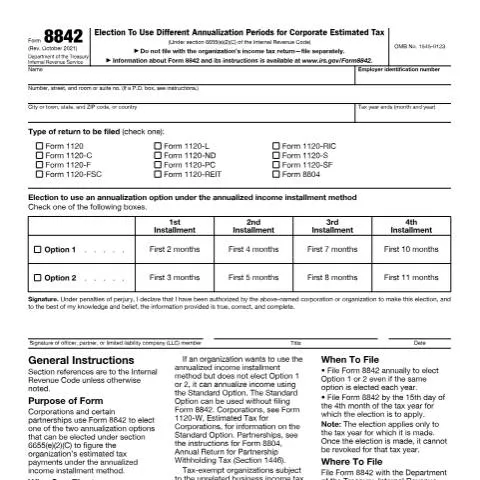
For corporations and certain partnerships, understanding the nuances of IRS Form 8842 can significantly impact their financial obligations and tax planning strategies. This form, officially titled "Election To Use Different Annualization Periods for Corporate Estimated Tax," allows eligible organizations to select a specific annualization option for computing their estimated tax payments. As with many IRS forms, grasping its intricacies is vital to ensure compliance and financial accuracy.
Understanding the Context: Who Needs to Engage with Form 8842?
The requirement to file Form 8842 is specifically tailored for corporations—including S corporations—and partnerships that are obligated to pay withholding tax under section 1446 of the Internal Revenue Code (IRC). A precise grasp of your organizational structure is crucial since only specified entities can utilize this form.
- Corporations: This encompasses various types of corporations such as C corporations, S corporations, and those filing Form 1120 or its variations.
- Partnerships: Partnerships that have partners subject to withholding tax are also eligible to elect the annualization method.
Entities not required to file this form include tax-exempt organizations and private foundations that fall under different IRS guidelines. Knowing whether your organization falls under these categories is essential to avoid unnecessary paperwork and potential legal issues.
Decoding the Annualization Options: What to Choose?
When completing Form 8842, organizations must decide between two annualization options: Option 1 and Option 2. Each option affects how estimated tax payments are calculated throughout the tax year. Understanding these options is key to optimizing tax payment strategies.
| Option | 1st Installment | 2nd Installment | 3rd Installment | 4th Installment |
|---|---|---|---|---|
| Option 1 | First 2 months | First 4 months | First 7 months | First 10 months |
| Option 2 | First 3 months | First 5 months | First 8 months | First 11 months |
Each option simplifies the calculation of estimated tax payments by allowing corporations to annualize their income based on different periods during the tax year. Choosing the right option can lead to optimized cash flow and tax liabilities.
Preparation is Key: What Documents and Information Are Required?
Gathering the right documentation is crucial when preparing to fill out Form 8842. The process involves understanding not only your corporate structure but also specific financials that will substantiate the election made in the form.
- Employer Identification Number (EIN): This is a must-have for all corporations and partnerships.
- Tax Year Information: Ensure you have the correct tax year details ready.
- Type of Return: Identify which form you will be filing, such as Form 1120, 1120-S, etc.
Additionally, if a fiduciary such as a receiver or trustee is signing the form on behalf of a corporation or partnership, a copy of the court order authorizing this action must be attached to the submission.
Filing Mechanics: Where and How Do You Submit Form 8842?
Proper submission of Form 8842 is essential to ensure that your election is recognized by the IRS. The form must not be filed alongside the organization’s income tax return; it has to be sent separately.
- Submission Address: Mail Form 8842 to:
- Department of the Treasury
- Internal Revenue Service Center
- Kansas City, MO 64999
- Filing Deadline: Be mindful of the deadline: Form 8842 must be filed by the 15th day of the fourth month of the tax year for which the election is made.
- Annual Requirement: Corporations and partnerships must file Form 8842 each year to elect their chosen option, even if it remains the same from year to year.
Post-Filing: Understanding the IRS Processing and Follow-Up
Once you file Form 8842, awareness of how the IRS processes this form and the subsequent actions required is important. Typically, Form 8842 is processed along with your estimated tax returns; however, there are nuances in the follow-up.
- Confirmation of Election: The IRS does not provide formal confirmation of your election; therefore, it is crucial to keep a copy of the submitted form for your records.
- Tax Preparation: Ensure that your tax preparer is aware of the election made as this will impact future estimated tax calculations.
- Monitoring Your Account: Regularly check your tax account status online, or contact the IRS directly if you have concerns or queries about your election.
Potential Pitfalls: What Happens if You Fail to File or Make an Error?
Neglecting to file Form 8842 or making mistakes while filling it out can lead to unintended consequences. In particular, the absence of the form can result in the IRS applying a standard method of income annualization, which may not be beneficial for the organization financially.
- Missed Opportunities: Without filing, you could miss out on potential tax savings by not using the preferred annualization method.
- Penalties: Failure to pay the correct estimated taxes based on the standard method may lead to penalties, interest, and additional tax liabilities.
- Fixed Filing Method: Once a method is established without Form 8842, it becomes the default election, and changing this can be complex.
Distinguishing Features: How Form 8842 Stands Apart from Other Filings
In the realm of IRS forms, Form 8842 holds a unique position due to its specific application for annualization of corporate estimated tax payments. Understanding how it differs from other forms is essential for proper tax handling.
- Focus on Corporate Tax: Unlike individual tax forms such as the 1040, Form 8842 explicitly caters to corporate taxes and selected partnerships.
- Annualization Options: The form provides specific options that are not available on many other tax forms, such as self-employment tax returns or personal income tax filings.
Final Considerations: Preparing for Future Elections
As tax regulations evolve and financial landscapes shift, staying informed about your obligations and opportunities regarding Form 8842 is vital. Regularly reviewing your tax strategy and ensuring that your organization remains compliant with IRS requirements can significantly influence your financial health.
In summary, while Form 8842 may appear as just another piece in the vast puzzle of tax filings, its implications are far-reaching for eligible corporations and partnerships. Mastery of this form can lead to better financial management and compliance with tax laws, ultimately setting your organization on a path toward successful fiscal health.
Understanding Eligibility Requirements for IRS Form 8842
Determining your eligibility for IRS Form 8842, also known as the "Election for Early Termination of an S Corporation," is foundational to effectively navigating the complexities of tax implications related to S Corporations. This form is primarily used by S Corporations that wish to terminate their S status and revert to being a regular C Corporation. The eligibility criteria primarily revolve around the ownership structure, the number of shareholders, and compliance with specific IRS regulations.
Firstly, to qualify for the use of Form 8842, the S Corporation must have been in existence for at least one year prior to the election, and the decision to terminate must be unanimous among the shareholders. Furthermore, all shareholders must consent to the termination, which requires careful documentation to ensure compliance with IRS regulations. Failure to obtain unanimous consent can lead to significant consequences, including potential tax liabilities for the corporation and its shareholders.
It’s also worth noting that there are specific timelines associated with the filing of this form. The election must be made by the 15th day of the third month of the tax year in which the termination is to take effect. This means, for most calendar-year taxpayers, the deadline would typically fall on March 15 of that year. Awareness of these timelines is crucial for effective planning and tax compliance.
Common Pitfalls When Filing IRS Form 8842
While completing IRS Form 8842 might seem straightforward, there are several common pitfalls that corporations and their tax preparers should be wary of to avoid delays or rejections. One of the most common mistakes is incorrect or incomplete information within the form itself. For instance, omitting a shareholder’s consent signature or misreporting the corporation's EIN (Employer Identification Number) can lead to processing delays.
Another frequent issue arises from misunderstanding the implications of terminating S Corporation status. Many S Corporations assume that once they file Form 8842, they can simply revert to C Corporation status without considering the potential tax ramifications. This lack of foresight can result in unexpected taxation of built-in gains, which refers to the corporation's appreciation in asset value since it became an S Corporation.
The IRS has specific guidelines surrounding built-in gains tax, which can apply for up to five years after the termination of S status. Corporations must plan accordingly to mitigate these risks. Additionally, corporations often overlook the impact of terminating S status on their shareholders. For example, any distributions made after termination may be subjected to different tax treatments than distributions made while still an S Corporation.
Post-Filing Steps Following IRS Form 8842 Submission
Once IRS Form 8842 has been successfully filed and the S Corporation status has been terminated, there are several important post-filing steps that corporations must undertake to ensure compliance and smooth operations going forward. The first step is to notify all shareholders about the termination and to update any corporate records to reflect the change in tax status. This not only maintains transparency but also aids in avoiding potential disputes regarding the corporation's tax obligations.
Next, the corporation should prepare to adopt new accounting practices that align with C Corporation tax rules, which differ significantly from those applicable to S Corporations, particularly concerning income taxation and the distribution of dividends. Understanding these differences is crucial, as C Corporations are subject to double taxation: once at the corporate level and again at the shareholder level when dividends are distributed.
Finally, the corporation should consult with a tax professional to evaluate any potential implications on future tax filings and compliance obligations. This might include revising estimated tax payments or planning for potential built-in gains tax, as previously discussed. Engaging a knowledgeable accountant can help ensure that the corporation navigates this transition smoothly and stays in good standing with the IRS.