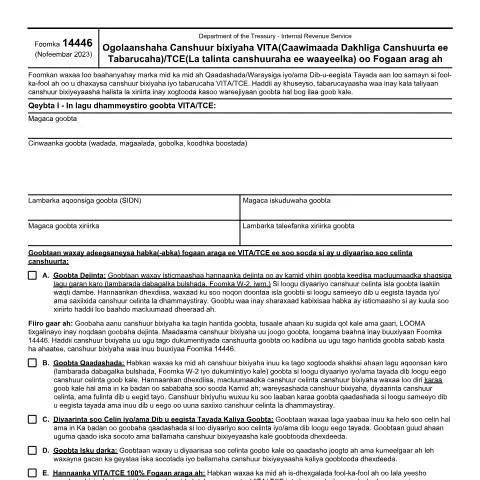
Navigating the Intricacies of IRS Form 14446SO: A Vital Tool for Taxpayers
For many taxpayers, the labyrinth of IRS regulations can feel overwhelming. The IRS Form 14446SO stands as a crucial document in the landscape of tax filing, especially when it involves virtual tax assistance under the Volunteer Income Tax Assistance (VITA) and Tax Counseling for the Elderly (TCE) programs. Understanding its purpose, completion criteria, and submission can significantly impact your tax filing experience.
Understanding the Context: Who Needs to Complete Form 14446SO?
This form is essential for tax preparers when conducting remote interviews or quality reviews with clients. Specifically, it applies in circumstances when personal identifiable information (PII) is exchanged between the taxpayer and tax volunteers, often in a virtual setting.
Special Cases: Who Should Pay Attention?
- Foreign Nationals: If you are a non-resident alien who has taxable income in the U.S., understanding the specifics of Form 14446SO is crucial as it links to your filing obligations.
- Minors: Tax returns filed for minors may require additional documentation and parental consent, thus making the role of Form 14446SO even more significant.
- Urgent Situations: Tax preparers who need to act quickly to assist those facing deadlines (like tax return due dates) must familiarize themselves with this form.
The Timeline: Key Dates for Form 14446SO Submission
The submission timeline for IRS Form 14446SO aligns with the general tax filing schedule, which usually concludes on April 15 each year. However, certain circumstances, such as extensions or specific filing statuses, may affect these deadlines.
Calendar Breakdown for Tax Season
| Date | Description |
|---|---|
| January 1 | Start of the tax season; preparation begins for Form 14446SO. |
| April 15 | Deadline for submitting Form 14446SO along with tax returns unless an extension is filed. |
| October 15 | Final deadline for extended filings, including Form 14446SO for those who filed for an extension. |
Channels for Form Submission: Online vs. Paper
Taxpayers have options when it comes to submitting Form 14446SO, each with its benefits and potential drawbacks.
Online Submission Process
- Convenience: Submitting online offers a streamlined process that can be completed from home.
- Tracking: You can track your submission status in real-time, reducing uncertainty.
Submitting by Mail: The Traditional Route
- Physical Documentation: Some taxpayers may prefer this method, especially if they feel more comfortable with paper forms.
- Lengthier Processing Times: Be aware that mailed forms may take longer to process.
The Core of Form 14446SO: Essential Information to Provide
Completing Form 14446SO accurately is a non-negotiable step in the tax preparation journey, especially for VITA/TCE volunteers. Below are some key components to consider while filling out this form.
Information Required on Form 14446SO
- Site Identification: Provide the name and address of the VITA or TCE location.
- Site Identification Number: Input the unique identifier for the site, crucial for record-keeping.
- Contact Information: Include a point of contact for additional queries, ensuring that taxpayers can easily get in touch.
Post-Submission: What Happens Next?
Upon submission of Form 14446SO, several processes unfold, pivotal for both taxpayer and preparer.
Understanding the Review Process
Once the form is submitted, it enters a review phase. Here’s what to expect:
- Quality Review: Tax returns may be subjected to an internal review to ensure accuracy and compliance.
- Follow-Up: Taxpayers will be contacted if additional information is required, and the method of communication will typically mirror that outlined in the submitted form.
Distinctive Features: What Sets Form 14446SO Apart?
Form 14446SO is often confused with other IRS forms. However, it has unique characteristics that define its purpose and usage.
Comparison with Similar Forms
| Form | Purpose | Key Distinction |
|---|---|---|
| Form 1040 | Individual tax return | Used for filing personal income taxes, whereas Form 14446SO is specifically for VITA/TCE remote assistance. |
| Form W-2 | Reports employee wages | W-2 is for employer reporting; Form 14446SO deals with the volunteer assistance process. |
| Form 8862 | Claiming the Earned Income Credit | 8862 is used to claim credits; Form 14446SO is about ensuring the correct processing of the tax return. |
Preparing Supporting Documents: What You Need
To have a smooth experience while completing Form 14446SO, gather the necessary documentation beforehand.
Checklist of Essential Documents
- Personal Identification: Social Security Numbers (SSNs) or Individual Taxpayer Identification Numbers (ITINs).
- Income Documentation: Forms such as W-2 or 1099s that outline total earnings for the year.
- Previous Tax Returns: Having these on hand can facilitate accurate data entry and verification.
By following this guide, you can effectively navigate the complexities associated with IRS Form 14446SO, thereby empowering yourself and those you assist with timely and accurate tax filings. Ultimately, this form is not merely a bureaucratic hurdle; it represents a critical step in ensuring compliance with IRS requirements while facilitating indispensable tax support for those in need.
Understanding IRS Form 14446: A Guide for Tax Professionals
IRS Form 14446, also known as the "Application for the Remote Signing of Tax Returns by a Certifying Professional," was introduced to facilitate the filing of tax returns by allowing tax professionals to remotely sign on behalf of their clients. This form enables a more streamlined process for those who may be unable to meet in person due to various circumstances, such as health concerns or geographical obstacles. It is particularly relevant in the context of the ongoing digital transformation in tax processes, underscoring the IRS's adaptation to modern needs.
Tax professionals should be well-versed in the specifics of Form 14446 to ensure compliance and accuracy in their submissions. The form includes critical information like the tax professional's name, the client's information, and the specific circumstances requiring remote signing. Furthermore, the IRS mandates that a valid Power of Attorney (POA) be in place, typically established through Form 2848, which must be submitted alongside Form 14446.
One significant consideration for tax professionals is the necessity of maintaining clear communication with clients regarding their responsibilities. For instance, clients must review the return carefully before signing off on it, even if they are not present for the actual filing. This ensures that clients remain informed about their tax obligations and the information being filed in their names, thereby reducing the risk of errors or misrepresentation.
Moreover, tax professionals should note the filing deadline associated with this form. While the general tax filing deadline is April 15, the remote signing provisions may introduce unique timelines depending on the specific circumstances of the client. It is essential to stay updated with IRS announcements that may affect these deadlines, particularly in light of any extensions granted during emergency situations.
Common Mistakes and How to Avoid Them When Filing Form 14446
Filing IRS Form 14446 may seem straightforward, but many tax professionals and taxpayers make common mistakes that could lead to delays or IRS inquiries. Recognizing these pitfalls in advance can save time and alleviate stress during the tax filing season.
One frequent error is the incomplete filling of the form. Every section must be thoroughly addressed to prevent processing delays. Tax professionals should take the time to double-check that all required fields are filled accurately, including client information and the specific reasons for requesting remote signing.
Another common mistake is related to the Power of Attorney (POA). It’s not enough to merely mention that a POA exists; the actual Form 2848 must accompany Form 14446 for it to be valid. A missing POA can lead to the IRS rejecting the filing. Tax professionals should ensure that they have explicit consent from their clients for remote signing and that this consent is documented properly.
Additionally, improper use of the remote signing option can create problems. Clients may misunderstand the implications of giving a tax professional the authority to sign on their behalf. Clear communication about what remote signing entails is crucial. Tax professionals should provide clients with a detailed explanation of the process and ensure they understand their rights and responsibilities.
Remember, the IRS takes errors seriously, especially when it involves the representation of a taxpayer’s financial information. Consulting the IRS's official guidelines for Form 14446 can provide additional clarity and insights into best practices for filing.
The Future of Remote Tax Services and IRS Form 14446
The introduction of IRS Form 14446 is just one example of how the IRS is evolving in response to the changing landscape of tax services. As more individuals and businesses turn to remote interactions, the demand for efficient, secure methods of dealing with tax filing is on the rise. This trend raises questions about the future of tax services and how professionals can adapt to remain competitive.
Remote tax services are likely to continue evolving with advancements in technology. The IRS has already implemented various digital platforms aimed at simplifying taxpayer interactions. Expect to see more integration of artificial intelligence and machine learning tools to assist tax professionals in preparing and filing returns, which may also include enhancements to the capabilities of forms like 14446.
Additionally, as the need for remote services grows, it is possible that the IRS will introduce more forms and provisions tailored to remote interactions. This could include enhanced guidelines around electronic signatures or further clarification on the use of remote signing under specific circumstances. Tax professionals should keep an eye on IRS updates and announcements that signal shifts in policy or procedural changes.
Finally, as remote tax services become more mainstream, the importance of cybersecurity will increase. Tax professionals must ensure that their methods for sharing sensitive documents remain secure to prevent breaches of confidential client information. Implementing strong encryption protocols and secure file sharing solutions will be paramount to maintaining client trust and compliance with federal regulations.