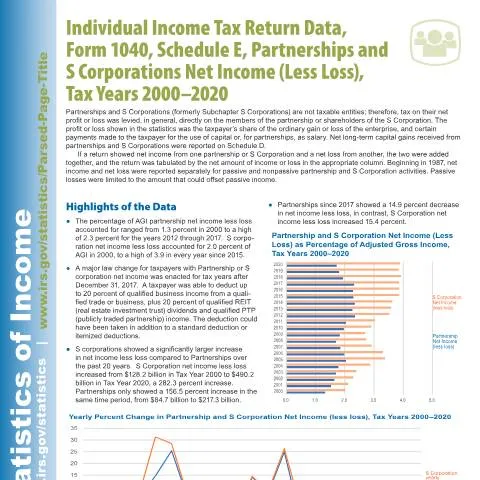
Navigating the Waters of IRS Publication 5819
For many taxpayers involved in partnerships or S Corporations, understanding the intricacies of IRS Publication 5819 is crucial. This publication serves as a comprehensive guide to the reporting of partnership and S Corporation net income less loss, particularly for tax years 2000 through 2020. Given the evolving landscape of tax regulations, this document provides essential insights for both taxpayers and tax professionals.
Understanding the Role of IRS Publication 5819
IRS Publication 5819 does not simply summarize data; it details the methodologies used to compile vital statistics regarding the income dynamics of partnerships and S Corporations. This publication outlines how net income or loss is reported on Form 1040, Schedule E, and how taxpayers are affected by these figures.
The Historical Context
The framework for understanding Publication 5819 can be traced back to significant legislative changes. Partnerships and S Corporations are pass-through entities, meaning they do not pay federal income tax directly. Instead, the tax liability passes through to the individual partners or shareholders, who report it on their tax returns. This system was designed to create fairness and encourage small business growth, reflecting a shift in tax philosophy that has evolved since the mid-20th century.
Who Needs to Pay Attention?
Publication 5819 is particularly relevant for:
- Individuals engaged in partnerships or S Corporations.
- Tax professionals advising clients in these structures.
- Accountants and financial advisors looking for accurate data related to pass-through entities.
Understanding who this publication affects lays the groundwork for comprehending the implications of net income less loss and how it is treated for tax purposes.
Breaking Down the Data: Net Income and Loss
At the heart of Publication 5819 is the data regarding net income and loss from partnerships and S Corporations. Taxpayers should understand how these amounts are calculated and reported. The publication states that net income from one partnership can offset a net loss from another, allowing for a more nuanced tax obligation.
The Calculative Nuances
These calculations involve several components:
- Ordinary Gain or Loss: This is the profit or loss derived from the regular business operations.
- Salary Payments: For partnerships, payments made to partners for their services are considered when calculating net income.
- Long-Term Capital Gains: Net long-term capital gains from partnerships and S Corporations are reported separately to provide clarity on the taxpayer's overall financial picture.
Strategizing Your Filing
Timeliness is key when it comes to filing taxes associated with partnerships and S Corporations. Typically, the tax filing deadline is April 15. However, entities need to consider the possibility of extending this deadline by filing Form 7004, which grants an extension for certain business returns.
Understanding Key Dates and Extensions
| Event | Date | Description |
|---|---|---|
| Tax Filing Deadline | April 15 | Standard deadline for submitting tax returns. |
| Extension Application Deadline | April 15 | Filing Form 7004 grants up to a six-month extension. |
| Extended Filing Deadline | October 15 | Final deadline for filing after an extension. |
Insights into Common Pitfalls
Completing the necessary forms associated with Publication 5819 can present several challenges. Taxpayers must navigate various nuances to ensure accurate reporting and compliance.
Pitfalls in Reporting Net Income and Loss
Below are common pitfalls to avoid when completing the forms:
- Incorrectly Combining Income and Loss: Be cautious not to inadvertently mix different types of income or losses, as this can significantly impact the overall tax obligation.
- Neglecting Passive Loss Limitations: Remember, passive losses can only offset passive income, which adds a layer of complexity.
- Failure to Include Salary Payments: For partnerships, ensure all salary payments distributed to partners are accurately reported, as they affect net income calculations.
Gathering Necessary Documentation
Before filing, it is crucial to gather all relevant documents that support your income and loss claims. IRS Publication 5819 outlines the need for:
- K-1 Statements: These are necessary for partners or S Corporation shareholders to report their share of income, deductions, and credits.
- Financial Statements: Detailed records indicating the partnership's earnings and losses. This includes profit and loss statements.
- Tax Returns from Previous Years: Having previous returns on hand can provide a reference point for what to report this year.
Examples of Documentation Based on Status
| Status | Required Documentation |
|---|---|
| Partner in a Partnership | K-1 Form, Profit and Loss Statement, Previous Year’s Tax Returns |
| S Corporation Shareholder | K-1 Form, Annual Financial Statements, Previous Year’s Tax Returns |
| Both | All of the above along with any personal income documentation |
Tracking the Progress of Your Submission
After submitting your return based on the guidance from IRS Publication 5819, understanding how to track your submission and its outcomes is vital. To ensure everything is processed correctly, taxpayers can utilize several strategies:
Ways to Monitor Your Tax Filing
- IRS Online Tools: Utilize the IRS's "Where's My Refund?" tool, which provides real-time updates on the status of your return and any refunds owed.
- Documentation Retention: Keep copies of all submitted forms and communication with the IRS. This can aid in resolving discrepancies or answering inquiries.
- Follow-Up Calls: If your return is under review or if you experience delays, don't hesitate to contact the IRS directly. Be prepared with your details to facilitate the inquiry.
Understanding Processing Times
While many returns are processed relatively quickly, it’s essential to understand that if your return contains complex issues, such as those related to partnerships or S Corporations, it may take longer. Generally, expect a processing period of 21 days for e-filed returns, whereas paper filings may take longer, sometimes up to six weeks or more.
Final Considerations and Resources
Taxpayers involved with partnerships or S Corporations must have a firm grasp on the implications of IRS Publication 5819. Familiarity with the essential components of reporting net income less loss, understanding the historical context, and being aware of common pitfalls can significantly impact one’s tax obligations. Moreover, knowing the right documentation to gather and the means to track submissions can enhance one’s efficiency in dealing with federal tax matters.
For additional information, taxpayers can consult the official IRS website, specifically the page dedicated to Publication 5819. This resource offers not only the publication itself but also related forms and further explanatory material that can illuminate the process of filing taxes involving partnerships and S Corporations.
Understanding IRS Publication 5819: Overview and Purpose
IRS Publication 5819 provides crucial guidance on the tax treatment of foreign trusts, specifically focusing on how they are taxed in the United States. This publication is essential for U.S. taxpayers who are beneficiaries of foreign trusts or have foreign trust reporting obligations. It outlines the tax implications, filing requirements, and the necessary forms to be used when dealing with foreign trusts, ensuring compliance with U.S. tax laws.
The primary purpose of Publication 5819 is to help individuals understand the complexities associated with foreign trusts. Trusts can be intricate financial instruments, and the IRS has specific rules and regulations governing their taxation. This publication serves as a comprehensive resource that delineates the responsibilities of U.S. taxpayers regarding these foreign entities, thus assisting them in avoiding potential pitfalls and penalties associated with non-compliance.
Key Provisions and Reporting Requirements for Foreign Trusts
In IRS Publication 5819, taxpayers can find detailed information concerning the reporting requirements for foreign trusts. Understanding these requirements is crucial, as failing to report a foreign trust can result in significant penalties.
One of the most critical aspects covered is the necessity of filing Form 3520, "Annual Return To Report Transactions With Foreign Trusts and Receipt of Certain Foreign Gifts." This form must be submitted by U.S. persons who are grantors of, or beneficiaries of, foreign trusts, detailing any distributions received and income generated by the trust. It’s important to note that Form 3520 is separate from an individual's income tax return and must be filed by the due date, which is typically the 15th day of the fourth month following the end of the tax year (April 15 for calendar year taxpayers).
Additionally, Form 3520-A, "Annual Information Return of Foreign Trust With a U.S. Owner," may also need to be filed. This form is used by foreign trusts to report their activities and provide necessary information about the trust to the IRS. U.S. owners of the foreign trust are responsible for ensuring that this form is filled out accurately and timely.
It’s also essential to understand that foreign trusts must follow different accounting and tax rules, which can vary widely depending on the jurisdiction where the trust is established. Publication 5819 provides insights into these differences, enabling U.S. beneficiaries to grasp how their foreign trust may be treated under U.S. tax law.
Tax Implications of Foreign Trusts on U.S. Beneficiaries
The tax implications for U.S. beneficiaries of foreign trusts can be complex. IRS Publication 5819 outlines how distributions from foreign trusts are taxed, and the tax rates that may apply. Understanding these implications is crucial for beneficiaries to avoid unexpected tax liabilities.
Distributions from foreign trusts may be classified as either "principal" or "income." It's essential to note that U.S. beneficiaries are typically taxed on the income distributed to them from the trust as ordinary income, which means that the income retains its character when distributed. For example, if the trust distributes dividend income to a U.S. beneficiary, that income is taxed at the beneficiary’s ordinary income tax rate, not at the lower capital gains rate.
Moreover, U.S. beneficiaries must be aware of the potential for double taxation. Some countries have treaties with the United States that may provide relief from double taxation; however, understanding these treaties and how they apply to foreign trusts is vital. Publication 5819 provides a brief overview of tax treaties, but beneficiaries should consult the IRS website and tax professionals for specific details regarding applicable treaties.
Furthermore, if a foreign trust retains earnings, these can create additional tax liabilities for U.S. beneficiaries. The IRS may require beneficiaries to report their share of the trust’s income, even if they did not receive a distribution. Publication 5819 elaborates on the criteria for determining income that must be reported, emphasizing the importance of maintaining accurate records and staying informed about the trust's financial activities.