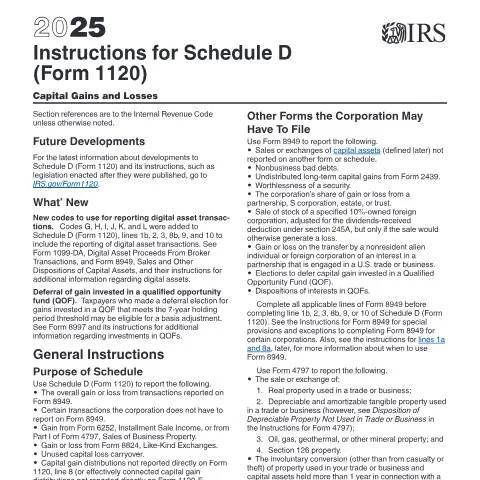
Understanding the Significance of IRS Instructions for Schedule D (Form 1120)
Navigating the complexities of corporate taxation can be daunting, especially when it comes to accurately reporting capital gains and losses. The IRS Instructions for Schedule D (Form 1120) act as an essential guide for corporations to ensure compliance and accurate reporting. This document is particularly important for business entities that engage in activities leading to capital gains or losses, as it provides the framework for reporting these transactions appropriately. Whether your corporation is dealing with investments, sales of business property, or other capital assets, understanding the nuances contained within this guide is crucial for tax compliance and effective financial planning.
Who Benefits from the Instructions?
The primary audience for the IRS Instructions for Schedule D includes corporations that file Form 1120 and related forms, such as Form 1120-C, 1120-F, and others. These include:
- Tax-exempt organizations looking to report capital gains.
- C-Corporations involved in the sale or exchange of capital assets.
- Corporations making use of Like-Kind Exchanges or installment sales.
- Entities that have invested in Qualified Opportunity Funds (QOFs) and need to report deferrals or adjustments related to these investments.
Understanding the instructions helps these entities to not only fulfill their tax obligations but also to optimize their tax liability through various reporting mechanisms.
Key Components of the Instructions
The Instructions for Schedule D encompass a variety of critical aspects that facilitate effective tax reporting. Here are some key components that users should familiarize themselves with:
- Overall Gain or Loss Reporting: It includes how to compile gains and losses from transactions reported on Form 8949 and other relevant forms.
- Specific Transactions: The document details which transactions must be reported and which do not, such as gains from Installment Sales and Like-Kind Exchanges.
- Capital Loss Carryovers: It provides guidance on reporting unused capital loss carryovers from prior years.
- Digital Asset Transactions: With the recent updates, the instructions include new codes for reporting digital asset transactions, a growing area of interest in corporate taxation.
Step-by-Step Utilization of the Instructions
To effectively use the IRS Instructions for Schedule D, corporations should follow a systematic approach:
- Gather Relevant Documentation: Collect all necessary documents, including previous tax returns, Form 8949, Form 6252, and any other relevant financial statements.
- Assess Capital Transactions: Identify all transactions that resulted in capital gains or losses throughout the tax year. This includes sales, exchanges, and distributions.
- Complete Related Forms: Ensure that Form 8949 and other related forms are accurately filled out, as these will feed into Schedule D.
- Report on Schedule D: Using the data compiled, report the overall capital gain or loss calculation on Schedule D, referencing the instructions for correct entries.
- Review and Submit: Before submission, conduct a thorough review to ensure all information aligns with other filings and that there are no discrepancies.
Interactions with Other Tax Documents
The IRS Instructions for Schedule D (Form 1120) cannot be viewed in isolation; they interact with various forms that corporations may also need to file:
| Form | Use Case |
|---|---|
| Form 8949 | Reporting sales or exchanges of capital assets not reported elsewhere. |
| Form 4797 | Sales or exchanges of business property and involuntary conversions. |
| Form 8824 | Exchanges of Like-Kind properties. |
| Form 8997 | Initial and annual statement of Qualified Opportunity Fund investments. |
Understanding how these forms interrelate ensures that corporations can report their transactions comprehensively and accurately.
Common Misunderstandings and Misinterpretations
Even with comprehensive instructions, misinterpretation can arise. Here are some common areas of confusion regarding the IRS Instructions for Schedule D:
- Digital Assets: With the introduction of new codes for digital asset reporting, many corporations might be unsure about how to classify and report these transactions, leading to potential compliance issues.
- Capital Loss Carryovers: Misunderstanding how to apply carryovers from previous years can lead to incorrect filings, affecting overall tax liability.
- Like-Kind Exchanges: Corporations may not recognize the specific requirements for reporting gains or losses from Like-Kind exchanges, which can differ significantly from typical capital asset transactions.
Corporations should take the time to read these instructions carefully to avoid such pitfalls.
Strategies for Efficient Reporting
To streamline the reporting process, corporations can adopt several strategies:
- Maintain Detailed Records: Keeping meticulous records throughout the fiscal year can simplify the data-gathering process during tax season.
- Utilize Software Tools: Consider leveraging tax software that integrates with financial systems to auto-populate capital gain/loss data into appropriate forms.
- Collaborate with Tax Professionals: Engaging with tax advisors can provide insights into optimizing tax reporting and compliance efforts.
Future Developments and Updates
The IRS continually updates its guidelines and requirements. Taxpayers should stay informed about:
- Changes to the reporting of digital assets.
- Updates on Qualified Opportunity Funds and associated tax benefits.
- New legislation that could affect capital gains taxation.
Regularly checking IRS.gov/Form1120 will ensure that corporations are using the most current and applicable instructions for their tax filings.
Understanding Form 1120-SD: When and Why It's Necessary
Form 1120-SD, officially known as the "U.S. Income Tax Return for an S Corporation," is essential for S Corporations that have made an election under Section 1362(a) of the Internal Revenue Code. This form is specifically designed for corporations that have elected to be taxed as S Corporations, allowing them to avoid double taxation on corporate income. It's crucial to understand that the form’s purpose is not just about reporting income; it also involves complying with specific eligibility requirements and the timing for filing.
One of the primary reasons for filing Form 1120-SD is to report the income, deductions, and credits of the corporation. It enables the S Corporation to pass corporate income, losses, deductions, and credits to shareholders for federal tax purposes. The shareholders then report this information on their individual tax returns, typically using Form 1040 along with Schedule E.
However, not every corporation can file this form. To qualify as an S Corporation, the entity must meet several requirements, including:
- Being a domestic corporation.
- Having only allowable shareholders, which include individuals, certain trusts, and estates.
- Having no more than 100 shareholders.
- Having only one class of stock.
Failure to meet these qualifications can result in the loss of S Corporation status, which can have significant tax implications. Therefore, understanding the implications of Form 1120-SD is key for compliance and tax planning.
Navigating Common Issues and Errors in Filing Form 1120-SD
Filing Form 1120-SD isn't without its challenges. Many S Corporations encounter common issues that can lead to errors, which may trigger audits or penalties. Here are several prevalent issues and how to navigate them:
- Missing or Incorrect Information: One of the most common mistakes is omitting essential information or entering it incorrectly. This includes the corporation's EIN (Employer Identification Number), the total income, or deductions. It's pivotal to double-check all entries against your books and records to ensure accuracy before submitting.
- Filing Late: The due date for Form 1120-SD is typically March 15th for corporations with a calendar year-end. Late filings can result in penalties, so it's beneficial to establish a consistent filing schedule and set reminders well in advance of the deadline.
- Failure to Issue K-1 Forms: Each shareholder must receive Schedule K-1, which details their share of the corporation's income or loss. Failing to issue these forms can lead to an inaccurate filing on the shareholder's tax returns and may prompt inquiries from the IRS.
To mitigate these concerns, S Corporations should consider working closely with a tax professional who is well-versed in corporate tax law. An expert can help ensure that all relevant information is reported accurately and that the corporation remains compliant with IRS regulations.
Making the Most of Deductions on Form 1120-SD
Deductions play a crucial role in reducing the overall tax liability of an S Corporation. Understanding which deductions can be claimed on Form 1120-SD is essential for optimizing tax benefits. Here are some key deductions that S Corporations should be aware of:
- Business Expenses: Ordinary and necessary business expenses are fully deductible. This includes salaries, rent, utilities, and supplies that are directly related to the business operations. Maintaining thorough documentation of these expenses is necessary for substantiation during an audit.
- Depreciation: S Corporations can also take depreciation deductions on property used in the business, such as equipment or buildings. Understanding the Modified Accelerated Cost Recovery System (MACRS) can help businesses maximize their depreciation deductions.
- Health Insurance Premiums: If an S Corporation pays health insurance premiums for its employees, including shareholders who are employees, these amounts can be deductible. It’s essential, however, to ensure that the premiums are included in the shareholder’s wages for income tax reporting purposes.
Additionally, S Corporations may be eligible for various tax credits, such as the Small Business Health Care Tax Credit or the Work Opportunity Tax Credit. These credits can greatly enhance tax savings and should be explored thoroughly to ensure nothing is overlooked.
In conclusion, understanding Form 1120-SD and its implications is vital for the financial health of an S Corporation. By recognizing common pitfalls, maximizing deductions, and maintaining compliance with IRS regulations, corporations can effectively navigate the complexities of tax filing.