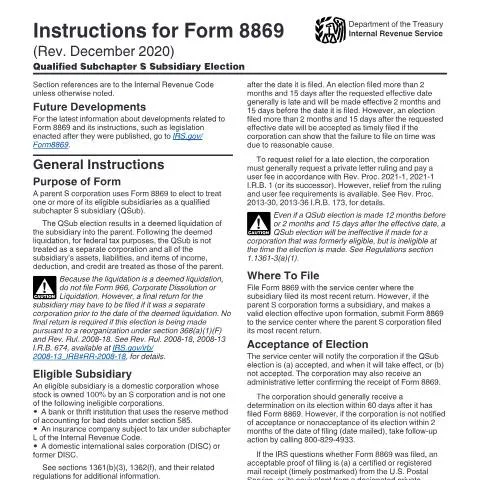
Understanding the IRS Instructions for Form 8869: A Comprehensive Guide
Navigating the complexities of the U.S. tax system can be daunting, especially for S corporations considering the election of a Qualified Subchapter S Subsidiary (QSub). The IRS Instructions for Form 8869, last revised in December 2020, provide a crucial framework for S corporations looking to optimize their tax structure through this election. This guide will delve into the key components of this document, addressing its applications, implications, and procedural intricacies.
Clarifying the QSub Election Process
The QSub election enables a parent S corporation to treat one or more of its eligible subsidiaries as a QSub for federal tax purposes. The essence of this election is that it leads to a deemed liquidation of the subsidiary, merging its assets, liabilities, and income items with those of the parent corporation.
Who is Eligible for the QSub Election?
To qualify for the QSub election, a subsidiary must be a domestic corporation wholly owned (100%) by an S corporation. However, not all corporations can be considered eligible. The following are examples of ineligible corporations:
- A bank or thrift institution utilizing the reserve method of accounting for bad debts under section 585.
- An insurance company subject to taxation under Subchapter L of the Internal Revenue Code.
- A domestic international sales corporation (DISC) or any former DISC.
Understanding these exclusions is vital for S corporations to ensure they do not inadvertently apply for a QSub election for entities that do not meet the criteria.
Timing: When to File for the QSub Election
One critical aspect covered in the IRS instructions is the timeline for making the QSub election. The parent S corporation can file at any point during the tax year, but the effective date of the election is subject to specific limitations:
- The election can be effective no more than 12 months after the filing date.
- It cannot be dated more than 2 months and 15 days prior to the filing date.
If the election is filed outside these boundaries, it will typically be effective 12 months after it is filed, or at the earliest allowable date under the rules. However, for late filings, a corporation may request relief by demonstrating reasonable cause, which can involve the submission of a private letter ruling along with a user fee.
A Step-by-Step Approach to the Election Process
Implementing the QSub election involves several steps laid out in the IRS instructions. Here’s a simplified process for S corporations to follow:
- Evaluate eligibility: Confirm that the subsidiary meets all criteria for QSub eligibility, ensuring it is wholly owned by the S corporation and not one of the ineligible types.
- Determine timing: Assess the appropriate timing for filing, ensuring compliance with the effective date rules.
- Prepare Form 8869: Complete this form accurately, adhering to all IRS guidelines.
- Filing the Form: Submit Form 8869 to the appropriate service center where the subsidiary filed its last return, or the parent S corporation's service center for newly formed subsidiaries.
- Await confirmation: After filing, the S corporation should expect a notification regarding the acceptance or rejection of the election within approximately 60 days.
This structured approach not only ensures compliance but also minimizes potential roadblocks in the process.
Understanding Acceptance and Rejection Notifications
After filing Form 8869, the IRS communicates the acceptance status of the QSub election to the corporation. This communication may provide important details, including the effective date of the election. If a corporation does not receive any notification within two months of filing, it should take proactive steps to follow up.
Proof of Filing
In instances where the IRS questions whether Form 8869 was filed, it’s prudent to maintain acceptably proof of filing. This could include one of the following:
- A certified or registered mail receipt showing a timely postmark.
- A Form 8869 that has been stamped by the IRS as received.
- An IRS letter indicating acceptance of Form 8869.
Being diligent in maintaining these records can save the corporation from potential issues down the line.
Long-Term Implications of the QSub Election
Once made, the QSub election remains in effect until it is terminated. Understanding the ramifications of this decision is crucial for the ongoing operations and tax strategy of both the parent S corporation and its subsidiaries. If a corporation decides to terminate its QSub election, it should be aware that IRS consent is generally required for any future QSub elections regarding the former QSub or its successor for a period extending into future tax years.
Termination Conditions
Termination of the QSub election can occur under various conditions, including:
- Voluntary termination by the parent S corporation.
- Loss of eligibility by the subsidiary.
- Changes in ownership or structure that no longer satisfy the QSub requirements.
Corporations should carefully consider these factors as they can significantly impact future tax planning and compliance.
Interplay with Other IRS Documents and Regulations
The instructions within Form 8869 do not exist in a vacuum. They interact with various other IRS documents, forms, and regulations that govern S corporations and their subsidiaries. Familiarity with these interactions can enhance a corporation's ability to navigate its tax obligations effectively.
Related IRS Regulations
Understanding key sections of the Internal Revenue Code that pertain to S corporations and QSubs is essential:
- Section 1361: This section defines an S corporation and outlines the eligibility criteria for subsidiaries to qualify as QSubs.
- Section 1362: This section deals with making the S corporation election and includes provisions relevant to subsidiaries.
- Regulations Section 1.1361-3: Provides additional guidance on eligibility and conditions for QSub elections.
Corporations should seek legal or tax professional advice to ensure comprehensive understanding and compliance of these regulations.
Practical Scenarios for Applying Form 8869 Instructions
Deciding to elect a QSub can have varying impacts depending on the corporation's structure and strategic goals. Here are practical scenarios illustrating the application of the IRS Instructions for Form 8869:
Example 1: A Growing S Corporation
An S corporation with several successful operating subsidiaries may consider electing them as QSubs to benefit from streamlined tax reporting. This can simplify tax filings and enhance overall tax efficiency, allowing profits and losses to be reported at the parent level.
Example 2: Planning for Future Changes
A corporation anticipating restructuring or potential sale of a subsidiary might weigh the pros and cons of a QSub election. While it can provide short-term tax advantages, future changes could necessitate careful planning regarding the implications of terminating the QSub status.
Each corporation's situation will vary, and tailoring the approach to their specific context is essential for maximizing the benefits of the QSub election.
Final Thoughts on Leveraging the IRS Instructions for Form 8869
Understanding and effectively utilizing the IRS Instructions for Form 8869 is fundamental for S corporations aiming to optimize their tax structure through the QSub election. By comprehending the eligibility criteria, filing timelines, acceptance processes, and long-term implications, corporations can navigate the complexities of the tax system more effectively. Keeping abreast of ongoing developments, as noted in the IRS instructions, ensures compliance and strategic advantage in the ever-evolving tax landscape.
Understanding the IRS Form 8869: Election to Claim a Credit for Prior Year Minimum Tax
Form 8869, officially titled "Election to Claim a Credit for Prior Year Minimum Tax," is specifically designed for taxpayers who want to claim the Minimum Tax Credit in the current tax year. This credit is particularly relevant for individuals and businesses that were subject to the alternative minimum tax (AMT) in previous years. Understanding the nuances of this form can significantly impact your tax liabilities.
Before diving into the instructions, it’s crucial to know that the Minimum Tax Credit can be carried forward to offset future tax liabilities, but it cannot be carried back to previous tax years. Therefore, it is essential to evaluate your tax situation carefully before submitting Form 8869. The form is filed with your regular tax return, typically due on April 15. However, if you file for an extension, you can submit it with your extended return, but remember, the same AMT rules apply.
In the first part of the form, you must provide detailed information regarding the years you were subject to AMT and the amounts of tax paid during those years. This information is crucial, as it determines your eligibility for the credit. The IRS mandates precise calculations, and any discrepancies may result in delays or denials of your claimed credit.
Moreover, if you are filing this form for an estate or trust, there are specific additional considerations to keep in mind. The IRS treats estates and trusts under different rules, so ensure you refer to the specific guidelines provided in the IRS instructions for Form 8869. These instructions also outline the necessary documentation your estate or trust must retain to substantiate the credit claim.
Common Mistakes When Filing Form 8869 and How to Avoid Them
Filing Form 8869 can be a straightforward process, but some common pitfalls can lead to mistakes that may delay your tax return or result in a denial of the credit. Being aware of these errors can save you time and stress down the line.
One frequent mistake is failing to accurately report the AMT paid in previous years. When filling out the form, ensure that the amounts correspond to your previous tax returns. Any misrepresentation, whether intentional or accidental, can trigger an audit by the IRS.
Another common error is not attaching necessary documentation. While Form 8869 itself does not require extensive paperwork, the IRS advises taxpayers to keep records of any calculations that led to the claimed credit. This includes prior year tax returns and any relevant worksheets. If the IRS requests these documents, having them readily available can expedite the process.
Additionally, many taxpayers neglect to review the instructions thoroughly. The IRS updates its forms and guidelines frequently, and relying on outdated information can lead to incorrect filings. Always check the IRS website for the latest version of Form 8869 and its instructions before preparing your submission. Pay careful attention to any specific notes or highlights that the IRS emphasizes in the guidance, as these often outline critical eligibility criteria or changes from previous years.
Lastly, consider employing the services of a tax professional if you find the process overwhelming. A certified tax preparer can provide insights tailored to your unique financial situation, ensuring that you maximize your benefits and avoid costly errors.
Strategizing Your Tax Planning Using Form 8869
Form 8869 isn't just a means to claim a credit; it can also play a pivotal role in your overall tax strategy. Understanding how to strategically leverage the Minimum Tax Credit can lead to substantial savings in subsequent tax years.
First, evaluate your taxable income and AMT history. If you expect your income to fluctuate or rise significantly in future years, it may be beneficial to maximize your credit claims now while your tax liability is lower. This proactive approach can provide a buffer against higher taxes down the road, allowing you to carry the credit forward to years when it can offer the most benefit.
In addition, consider the timing of your income recognition. If you find yourself facing AMT, timing your income and deductions can significantly affect your eligibility for the Minimum Tax Credit. For example, deferring income to a year when you won’t be subject to AMT can be a strategic move. Conversely, accelerating deductions in years you are subject to AMT might also help mitigate your overall tax burden.
Furthermore, reviewing your investments can yield strategic insights. If you hold investments that generate tax credits, such as certain types of municipal bonds, you can offset AMT liabilities with the right timing and management of your investment portfolio. Always consult with a financial advisor knowledgeable about tax implications to ensure your investment strategies align with your overall tax planning efforts.
Finally, keep abreast of tax law changes that may affect how you interact with Form 8869. Tax policies evolve, and staying informed about these changes can enable you to take advantage of new deductions or credits as they arise. Attend tax workshops, webinars, and consult IRS publications or a tax professional to remain updated.