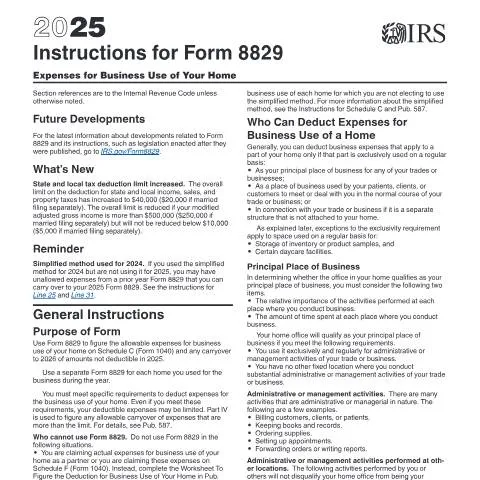
Understanding IRS Instructions for Form 8829: A Practical Guide
In the realm of small business ownership and self-employment, navigating tax deductions can become a complex web of regulations. Among the many forms that one might encounter is the IRS Form 8829, which addresses expenses related to the business use of home. This guide dives deep into the IRS Instructions for Form 8829 (referred to hereinafter as INST-8829), elucidating its content, its integral role in tax filing, and practical applications for both seasoned entrepreneurs and new self-employed individuals alike.
Decoding the Content: What Does INST-8829 Cover?
The IRS Instructions for Form 8829 serves multiple essential functions. While it may initially appear as a simple guide, it encapsulates detailed information about what expenses can be deducted, the requirements for claiming these deductions, and the limitations therein. Here’s what you can expect to find in this document:
- Eligibility Requirements: The instructions outline specific criteria that a taxpayer must meet to qualify for deductions related to the business use of their home. This includes requirements for the exclusivity of space used for business purposes.
- Calculating Allowable Expenses: The guide provides step-by-step calculations to help determine which expenses are deductible and how to report these expenses accurately on Schedule C of Form 1040.
- Carryover of Expenses: For those taxpayers who have expenses exceeding the allowed limits, the document details how to track and carry over these expenses to future tax years.
- Exceptions and Exclusions: Certain situations that preclude the use of Form 8829 are delineated, helping taxpayers avoid unnecessary mistakes in their filing.
Integrating with Other IRS Documents: A Necessary Intersection
Understanding the interplay between Form 8829 and other IRS documents, such as Schedule C (Form 1040) and Publication 587, is crucial for effective tax reporting. The instructions indicate that:
- Form 8829 must be filed alongside Schedule C to accurately reflect business income and expenses.
- Publication 587 offers broader context and additional guidance on the home office deduction, including definitions of key terms and further examples of allowable expenses.
- If a taxpayer has used the simplified method for reporting expenses in a prior year, they must consult the instructions regarding carryover potential for unclaimed expenses.
This synchronization ensures taxpayers are not only compliant but also optimized in their tax filings, gaining the maximum allowable deductions.
Recognizing When to Utilize INST-8829: Key Situations
Determining when to turn to the INST-8829 is vital for any self-employed individual. Here are specific scenarios where the instructions become indispensable:
- Home-Based Businesses: For those running their enterprises from home, understanding how to deduct related expenses can significantly affect profit margins.
- Multiple Business Locations: Taxpayers operating different business ventures from multiple homes must utilize separate Form 8829 filings for each home used.
- Shifted Business Models: Individuals transitioning from traditional office spaces to remote work must familiarize themselves with the home office deduction’s intricacies to avoid missing out on potential savings.
Step-by-Step: Navigating the Deductions with INST-8829
Utilizing the INST-8829 effectively requires a systematic approach. Here’s how to leverage the document in a stepwise manner:
1. Confirm Eligibility
Before diving into calculations, confirm that your home office qualifies based on exclusivity and regular use. Assess your workspace against the following:
- Is the space used exclusively for business activities?
- Do you not have another fixed location where substantial administrative or management activities occur?
2. Identify Deductible Expenses
Next, gather all financial records related to your home office. Deductible expenses may encompass:
- Utilities and home insurance
- Mortgage interest or property taxes
- Repairs and maintenance directly related to the office
3. Calculate the Allowable Deduction
Follow the instructions on Form 8829 to calculate allowable deductions, taking care to document everything meticulously. Keep in mind:
- Use the percentage of your home devoted to business activities to calculate the business portion of shared expenses.
- Pay attention to the maximum limits for certain deductions, which can vary based on legislation changes.
4. File Schedule C
Integrate the results from Form 8829 into Schedule C while ensuring all figures are accurately transcribed. A mistake here might trigger an audit or lead to discrepancies in your tax return.
Understanding Key Concepts: Avoiding Confusion
The IRS Instructions for Form 8829 introduces several key concepts essential for grasping the home office deduction landscape. Here are some critical notions:
Exclusive Use Requirement
The term “exclusive use” means the space must be dedicated solely to business operations. Mixed-use spaces (e.g., a bedroom used for both living and work purposes) do not qualify unless specific exceptions apply.
Principal Place of Business
A home office can only be deemed the principal place of business if it is where the majority of administrative or managerial tasks are carried out. This designation can influence the deduction limits significantly.
Limitations and Carryover
Be aware that if your expenses exceed the limits allowed, you may be eligible to carry over those excess amounts to subsequent tax years, as outlined in Part IV of Form 8829. This feature is particularly beneficial for businesses experiencing fluctuating expenses year-over-year.
Common Misinterpretations and How to Avoid Them
- Believing All Home-Related Expenses Are Deductible: Only expenses directly relating to the business use of the home qualify. Personal expenses do not count.
- Assuming Part-Time Home Business is Automatically Deductible: Even part-time home businesses must meet strict criteria to justify deductions.
- Misunderstanding 'Exclusivity': Many taxpayers mistakenly believe that sharing space for business and personal use counts. Exclusivity is a strict requirement that cannot be overlooked.
Planning Ahead: Recent Changes and Future Considerations
Tax regulations are subject to change, which can impact how Form 8829 is utilized. For instance, the recent increase in the state and local tax deduction limit to $40,000 (or $20,000 if married filing separately) highlights the need for ongoing education about tax law developments. Always consult the latest IRS updates on IRS.gov/Form8829 to remain informed.
Final Thoughts: Staying Informed and Prepared
As the landscape of business and tax law evolves, so does the importance of understanding the nuances of instructions such as INST-8829. By proactively engaging with these guidelines, maintaining organized records, and staying abreast of changes in tax legislation, taxpayers can maximize their deductions while ensuring compliance with federal requirements.
Ultimately, Form 8829 isn’t just a piece of paperwork; it’s a tool that empowers business owners to reclaim necessary expenses tied to their home office, fostering growth and sustainability in an increasingly competitive market.
Understanding the Eligibility Requirements for Form 8829
Before diving into the details of how to complete Form 8829, it’s crucial to understand the eligibility criteria. This form is used to claim expenses for the business use of your home, and specific conditions must be met to qualify.
To be eligible to use Form 8829, you must meet the following requirements:
- Principal Place of Business: Your home must be your principal place of business. This means you use it regularly and exclusively for trade or business activities. If you conduct business at multiple locations, the IRS will assess the time you spend at each location to determine if your home qualifies as your main place of business.
- Regular and Exclusive Use: The space you claim must be used regularly and exclusively for business purposes. For example, a spare room that serves as your office or a dedicated area in your basement that is not used for personal activities qualifies. A portion of your living room that doubles as a workspace might not meet this criterion.
- Renting vs. Owning: Both homeowners and renters can claim deductions using Form 8829. However, the calculation of expenses differs slightly. Homeowners can account for mortgage interest, property taxes, and depreciation, while renters can deduct rent paid and any associated expenses that are directly attributable to the business use of the home.
Understanding these requirements is paramount in ensuring you properly fill out the form and maximize your deductions while remaining compliant with IRS regulations.
Common Mistakes to Avoid When Filing Form 8829
Filing Form 8829 can be straightforward, but there are common pitfalls that many taxpayers encounter that can lead to issues with the IRS. Here are some mistakes to avoid:
- Miscalculating Business Use: One frequent error is not accurately calculating the percentage of your home used for business. If you claim a room that is also frequently used for personal activities, you may overstate your deductions. It is essential to maintain precise records and use a reasonable method for calculating the business area compared to the total home space.
- Neglecting to Maintain Documentation: The IRS requires that you keep detailed records of expenses related to business use. This includes not just utilities and maintenance costs but also documentation showing that the area is used exclusively for business. Without this, you risk losing your deductions if you are audited.
- Failing to Update Deductions: If your business situation changes—such as moving to a new home or changing the way you use your current home—you need to update your Form 8829 accordingly. For example, if you convert a guest bedroom into an office, you must adjust your deductions to reflect the new usage accurately.
- Not Considering the Simplified Method: In recent years, the IRS introduced a simplified method for home office deductions. Taxpayers can take a flat deduction of $5 per square foot for the area used for business, up to a maximum of 300 square feet. While this method is straightforward, some may overlook its advantages and may be missing out on a more beneficial option.
Avoiding these pitfalls will not only streamline your filing process but also help ensure you receive the full benefits available under tax law.
Additions to Your Filing: When to Include Other Forms
When you're filing Form 8829, there are scenarios where you might need to attach other forms to your tax return. Understanding when and why to include these additional forms can help ensure your tax filing is complete and accurate.
- Schedule C (Form 1040): If you are a sole proprietor, you typically need to include Schedule C when filing your taxes. This form is where you report income and expenses related to your business. Form 8829 ties into this, as the allowable home office expenses will directly reduce your business income reported on Schedule C.
- Form 4562 (Depreciation and Amortization): If you're claiming depreciation on your home office, you will need to fill out Form 4562. This form is vital for detailing the depreciation expense that you’re claiming over the life of your property. Make sure to keep detailed records of your home’s basis and any improvements that may affect your depreciation calculations.
- Form 1040-SR: If you are a senior taxpayer filing your taxes, you may opt to file Form 1040-SR. The process remains the same, but this version may provide larger font and a simplified layout, making it more accessible.
Ensuring you include all relevant forms will facilitate a smoother filing process and help you avoid unnecessary delays or audits.