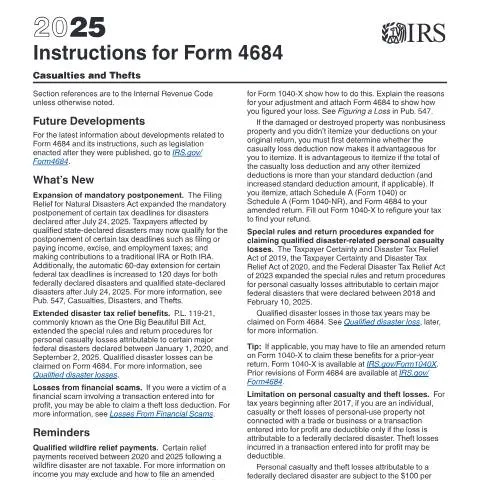
Understanding IRS Instructions i4684: Navigating Casualty and Theft Claims
When disaster strikes, understanding how to navigate the complexities of casualty and theft claims can be overwhelming. The IRS Instructions for Form 4684 serves as a crucial resource for taxpayers who have experienced losses due to accidents, thefts, or disasters. This comprehensive guide will delve into the specific contents of the instructions, how to utilize it effectively, and the significant changes that may impact your tax filings.
Grasping the Core Concepts: Casualty and Theft Losses
At the heart of Form 4684 are the essential concepts of casualty and theft losses. A casualty loss refers to damage caused by an unexpected event such as a natural disaster, while theft losses encompass the loss of property due to theft. Understanding these definitions is critical for correctly reporting losses on your tax returns.
Casualty Losses Defined
- Sudden and Unexpected: Casualty losses arise from events that are unforeseen and can include incidents like floods, fires, or earthquakes.
- Federally Declared Disasters: Only casualty losses that are connected to federally declared disasters are eligible for tax deductions after 2017.
Theft Losses Explained
- Profit-Motivated Transactions: Theft losses are deductible only if they involve transactions entered into for profit.
- Documentation Required: Taxpayers must maintain thorough records of the theft, including any police reports or documentation of property value.
Key Changes Impacting Taxpayers: What’s New in 2025?
The IRS Instructions i4684 document outlines crucial updates that may affect taxpayers' claims. Awareness of these changes is vital for accurately reporting losses and maximizing potential deductions.
- Mandatory Postponement Expansion: The Filing Relief for Natural Disasters Act has expanded the mandatory postponement of certain tax deadlines for disasters declared after July 24, 2025. Affected taxpayers may qualify for extended deadlines on filing or paying various taxes.
- Increased Automatic Extensions: The automatic extension for federal tax deadlines has been increased from 60 to 120 days for federally declared disasters and certain state-declared disasters.
Step-by-Step: Utilizing IRS Instructions i4684 in Your Tax Filing Journey
Engaging with the IRS Instructions for Form 4684 requires a structured approach. By following a systematic process, you can navigate the intricacies of casualty and theft loss reporting with confidence.
Identifying Your Losses
Begin with a thorough assessment of your losses. Determine if they qualify as either casualty or theft losses, and note whether they are connected to federally declared disasters.
Documentation Gathering
Gathering appropriate documentation is essential. You will need:
- Evidence of the event causing the loss (e.g., photographs, insurance claims, or police reports).
- Records of the property’s value before and after the incident.
- Any relevant correspondence with your insurance provider.
Calculating Your Losses
The next step involves calculating the amount of loss to report. Follow these guidelines:
- For Casualty Losses: Subtract the adjusted basis of the property from any insurance reimbursement.
- For Theft Losses: Determine the loss based on the fair market value before the theft.
Understanding Deductions and Limitations
Taxpayers must be aware of the limitations and deductions applicable to their losses:
| Type of Loss | Conditions for Deduction |
|---|---|
| Casualty Loss (Personal Use Property) | Must be attributed to a federally declared disaster; subject to $100 and 10% of AGI reduction. |
| Theft Loss | Must arise from a transaction entered into for profit; generally, fully deductible if properly documented. |
| Qualified Disaster Loss | Exempt from the AGI reduction and the $100 reduction is increased to $500. |
Leveraging Additional IRS Resources for Enhanced Clarity
While the IRS Instructions i4684 provide essential guidance, various additional resources can further assist taxpayers in navigating casualty and theft loss claims.
Publication 547: Casualties, Disasters, and Thefts
This publication offers comprehensive guidance on how to report losses and details the tax implications of various disasters. Taxpayers are encouraged to review it in conjunction with the i4684 instructions.
Form 1040-X: Amended U.S. Individual Income Tax Return
If you need to amend a prior return to claim casualty or theft losses, Form 1040-X must be filed. The i4684 instructions provide specific guidance on how to adjust your losses on this form.
Common Misinterpretations: Clarity Around Casualty and Theft Claims
Misinterpretations of the instructions can lead to costly errors, so understanding frequent misconceptions is critical.
The Misconception of General Loss Deductions
Many taxpayers mistakenly believe that all losses, regardless of their nature, are deductible. It’s important to remember:
- Only losses related to federally declared disasters or specific theft incidents are deductible.
- Personal-use property losses not related to a disaster are not eligible.
Confusion Over the Documentation Process
Another area of misunderstanding pertains to the required documentation:
- Taxpayers often underestimate the importance of thorough record-keeping. Proper documentation is essential for justifying claims.
- Failing to maintain evidence can result in disqualification of losses during audit processes.
Exploring the Interconnections: Form 4684 and Other Tax Procedures
Understanding how Form 4684 interacts with other IRS procedures is vital for effective tax reporting.
Itemizing Deductions vs. Standard Deductions
Taxpayers must determine if itemizing deductions is advantageous compared to taking the standard deduction. Considerations include:
- The total of the casualty loss deduction and other itemized deductions must exceed the standard deduction amount.
- If opting to itemize, attach Schedule A to your amended return along with Form 4684.
Claiming Qualified Disasters and Financial Scams
Moreover, it’s crucial to recognize that losses from financial scams may also be claimed under certain circumstances:
- Taxpayers affected by scams should document the incident thoroughly to establish the basis for their claims.
- This distinction allows for additional recovery avenues beyond traditional casualty loss claims.
Practical Tips for Navigating Disaster Relief Payments
In the aftermath of disasters, many taxpayers receive relief payments that influence their filings. Understanding the implications of these payments is essential.
Qualified Wildfire Relief Payments
Taxpayers receiving specific relief payments related to wildfires between 2020 and 2025 should note:
- Such payments are generally not taxable.
- Consult IRS guidance for how to adjust your income accordingly when filing your taxes.
East Palestine Disaster Relief Payments
Relief payments related to the February 2023 train derailment in East Palestine, Ohio, are similarly non-taxable:
- Taxpayers affected by this disaster should review IRS guidance on how these payments affect tax filings.
- In some cases, amending prior returns may be necessary to reflect changes from relief payments.
Final Considerations: Staying Informed and Prepared
As tax laws continue to evolve, staying informed about the latest developments in casualty and theft loss reporting is crucial. Regularly checking the IRS website for updates related to Form 4684 will ensure that you remain compliant and prepared for any changes that may affect your tax filings.
In conclusion, IRS Instructions i4684 is not just a set of guidelines; it is a lifeline for taxpayers who have experienced loss due to unexpected circumstances. By thoroughly understanding its contents and applying the information effectively, you can navigate the complexities of casualty and theft claims with greater ease and confidence.
Understanding Casualty and Theft Losses: The IRS Form 4684 Guide
The IRS Form 4684 is specifically designed for taxpayers who need to report income losses resulting from casualties or thefts. It’s critical to understand the specific criteria that qualify as a casualty loss. According to IRS guidelines, a casualty is a sudden, unexpected, or unusual event that causes damage to your property, such as severe weather events, fires, or vandalism. To effectively complete Form 4684, you must substantiate your claims with detailed information regarding the event, the property affected, and the measurement of the loss.
It's essential to distinguish between different types of losses: personal losses and business losses. While both can be reported on Form 4684, the implications for deductibility vary significantly. Personal casualty losses are generally subject to limitations and threshold amounts, while losses related to business use of property might be fully deductible. Taxpayers should be aware of these distinctions to avoid underreporting or overreporting their losses, which could lead to potential audits or penalties by the IRS.
Additionally, IRS guidelines detail specific deductibility rules for losses. For instance, personal casualty losses are typically calculated as the amount of your loss minus any insurance reimbursements received, and then further reduced by a $100 threshold and 10% of your adjusted gross income (AGI). Understanding these calculations is crucial for accurately completing Form 4684 and maximizing your eligible deductions.
Common Mistakes When Filing Form 4684
When filing IRS Form 4684, taxpayers often make several common mistakes that can lead to delays in processing or issues with their tax returns. One frequent error is failing to keep adequate records of the loss. The IRS requires detailed documentation, including photographs, repair estimates, and a description of the event. Without this evidence, taxpayers may find it challenging to substantiate their claims during an audit.
Another common pitfall is misclassifying the type of loss incurred. Taxpayers sometimes confuse personal property losses with business-related losses, which can have significant tax implications. If a loss is misreported, it might not only affect the immediate tax return but also future tax liabilities if the deductions are disallowed.
Furthermore, many taxpayers overlook the requirement to claim losses in the year they occur or in the year they are discovered if the loss was not immediately identifiable. Those who fail to adhere to these guidelines may lose out on the opportunity to claim a valid deduction. Hence, understanding the timeline and the nature of casualty losses is essential to ensure that you’re filing Form 4684 correctly.
Filing Deadlines and Associated Responsibilities
Filing Form 4684 has specific deadlines that correspond to the overall tax filing deadline, typically April 15 of each year. However, special circumstances may allow for extensions or earlier filing. Taxpayers who have experienced significant disasters may qualify for additional filing time through the IRS disaster assistance measures. Staying informed about these provisions is crucial for affected individuals to ensure compliance and to maximize their potential claims.
Moreover, once you file Form 4684, it becomes imperative to maintain all related documents and communications. Should the IRS choose to audit your tax return, you want to be prepared with all the relevant information at hand. Keeping copies of your Form 4684, any correspondence with the IRS, and all supporting documentation is advisable for your records.
Your responsibilities don’t end once the form is filed. If you receive any insurance payouts related to the casualty or theft, you must report these on your tax return for the year in which they were received. Additionally, some taxpayers may be required to amend prior tax returns if losses from previous years are being claimed now that the actual damage or loss has been established. Always consult with a tax professional if you are unsure about your obligations regarding casualty losses and reporting.