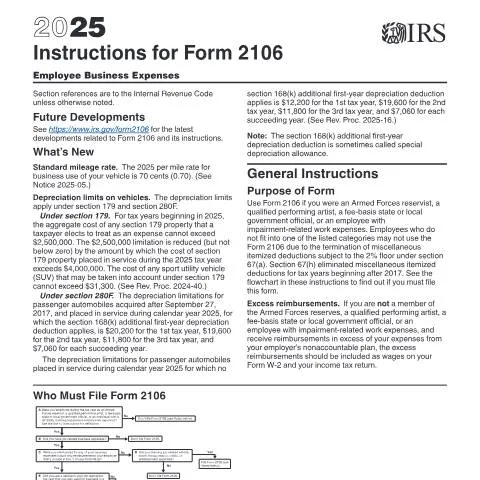
Understanding IRS Instructions i2106: A Comprehensive Overview
The IRS Instructions i2106 is a critical document for specific groups of employees seeking to claim business-related expenses. This guide primarily targets Armed Forces reservists, qualified performing artists, fee-basis state or local government officials, and employees with impairment-related work expenses. In an era where tax regulations can significantly affect financial outcomes, understanding these instructions can pave the way for accurate and beneficial tax filings.
Key Components of Form 2106 Instructions
The IRS Instructions i2106 outlines essential details regarding the eligibility, filing requirements, and specific guidelines for claiming employee business expenses. Here are some prominent features:
- Eligibility Criteria: Only certain categories of employees can utilize Form 2106. This includes individuals who incurred job-related expenses but were not reimbursed or whose employer's reimbursement was included in their taxable wages.
- Expense Categories: The instructions clearly delineate what constitutes deductible expenses, such as vehicle use, travel, transportation, meals, and entertainment.
- Recordkeeping Requirements: Proper documentation is crucial. The IRS emphasizes that you must maintain detailed records to substantiate claims.
Step-by-Step Guide to Utilizing i2106 Instructions
To effectively leverage the i2106 instructions, follow these steps:
- Determine Eligibility: Assess whether you belong to one of the eligible categories detailed in the instructions.
- Compile Expense Records: Gather receipts, logs, and any other documentation supporting your claims. Remember that mileage and other travel expenses need clear records.
- Review Reimbursement Status: If you have received reimbursements, check if they are accounted for properly in your Form W-2.
- Calculate Deductible Amounts: Identify expenses that surpass any reimbursements received, as this will determine your claimable amount.
- File Form 2106: If eligible, fill out the form following the provided guidelines in the instructions.
Important Updates for 2025
The IRS frequently updates details that could affect your tax filings. For the 2025 tax year, there are notable changes:
- Standard Mileage Rate: The business use mileage rate has increased to $0.70 per mile, which could impact deductions for those using personal vehicles for business.
- Depreciation Limits: New thresholds have been established under sections 179 and 280F concerning vehicle depreciation, which are pertinent for individuals claiming related deductions.
Recordkeeping: A Non-Negotiable Requirement
One of the most critical aspects highlighted in the instructions is the necessity of meticulous recordkeeping. The IRS mandates that you justify every claimed expense, and failure to do so can result in disallowance of deductions. Here’s what you need to maintain:
- Time and Place: Document when and where you incurred expenses.
- Business Purpose: Clearly state the reason for these expenses related to your job duties.
- Business Relationships: For gifts, maintain records detailing the recipient's business relationship.
- Expense Amounts: Keep receipts for all lodging expense claims and any other expenses exceeding $75.
Common Scenarios Requiring Form 2106
Understanding when to use Form 2106 can help ensure compliance and maximize potential deductions. Here are some scenarios where using the form is appropriate:
- Armed Forces Reservists: If you incur expenses related to your service that are not reimbursed, you can claim them using Form 2106.
- Qualified Performing Artists: Artists who face unreimbursed expenses associated with their performances can also benefit from this form.
- Fee-basis Government Officials: If you're a local or state official and have incurred costs that are not reimbursed, you should consider filing.
- Employees with Disabilities: For those claiming impairment-related expenses, this form is crucial.
Interplay with Other IRS Documents
The IRS Instructions i2106 does not exist in isolation. It interacts with various other tax filings and documents. Here’s how:
| Document | Purpose | Interaction with Form 2106 |
|---|---|---|
| Form W-2 | Reports employee wages and taxes withheld | Reimbursements noted in W-2 affect deductible amounts on Form 2106 |
| Schedule A | Itemized deductions | Previously, some expenses claimed on Form 2106 were reported here, but changes have shifted eligibility |
| Form 1040 | Annual income tax return | Deductions computed on Form 2106 feed into your 1040 filing |
| Form 8829 | Expenses for business use of your home | Clarifies the allocation of home office expenses versus other business expenses |
Understanding Specific Terminologies within the Instructions
The IRS lingo can sometimes be overwhelming. Here are some key terms from the i2106 instructions that you should familiarize yourself with:
- Nonaccountable Plans: Refers to employer reimbursement plans that do not require substantiation of expenses.
- Actual Expense Method: A method to calculate car expenses using actual costs incurred for operating the vehicle, as opposed to the standard mileage rate.
- Impairment-Related Work Expenses: Costs incurred due to a disability that are necessary for an individual to perform their job duties.
Utilizing the IRS Website for Ongoing Updates
Tax regulations can evolve, making it essential to stay updated. The official IRS website provides ongoing updates about Form 2106 and related instructions. Regularly checking the IRS portal can keep you informed about:
- Updates on mileage rates and expense limits for upcoming tax years
- Changes in eligibility or new categories of deductible expenses
- Additional resources or guides for specific employee groups
To maintain accuracy and compliance, always refer to the IRS website as a primary resource when dealing with tax forms, including Form 2106, and remember to consult a tax professional if uncertainties arise.
Understanding IRS Form 2106: Employee Business Expenses
IRS Form 2106 is essential for employees who incur unreimbursed business expenses. While not everyone will qualify, it’s crucial to understand both the general requirements and the specific scenarios in which this form applies. Typically, employees in sectors such as sales, construction, and certain fields of consulting may find themselves eligible.
The form allows for deductions related to expenses incurred in the performance of job duties such as travel, meals, and lodging. Employees should maintain meticulous records, including receipts and detailed logs of business-related activities. This documentation will be crucial not only for filling out Form 2106 but also in case of an audit by the IRS.
In the wake of the Tax Cuts and Jobs Act (TCJA) enacted in December 2017, many employees were impacted as the law suspended certain deductions. However, certain specifics still allow deductions for qualified employees, mainly those serving in the Armed Forces, certain reservists, and employees in specific professions.
Filing Form 2106 also requires a careful understanding of the distinction between direct and indirect expenses. Direct expenses are those that can be directly attributed to business activities, such as travel to a client meeting. Indirect expenses, however, relate to costs that are necessary for the conduct of business but may not be specifically tied to one activity, such as a portion of your home internet used for work purposes.
Step-by-Step Guide to Completing IRS Form 2106
Completing IRS Form 2106 involves several stages, each requiring attention to detail. Here is a step-by-step guide that can help you navigate through the form effectively.
- Gather Required Documentation: Start by collecting receipts for all business-related expenditures. This includes travel costs, meal expenses, and any other relevant costs incurred while performing your job duties.
- Determine Your Employment Status: Confirm whether your role qualifies for deductions under the current tax laws. Employees who work for wages and have not been reimbursed by their employer for business expenses typically qualify.
- Fill Out Section I: Vehicle Expenses: If you use your vehicle for business purposes, decide between the standard mileage rate and actual expenses method. The standard mileage rate for 2023 is 65.5 cents per mile. Calculate your business miles driven and multiply by this rate or list your actual costs incurred, including depreciation, gas, and maintenance.
- Complete Section II: Other Expenses: Here, you will need to specify other expenses like travel, lodging, and meals. Each category will have specific lines for you to detail your expenses. For example, meals are generally deductible at 50%, and you must comply with specific guidelines, like keeping track of who you were with and the purpose of the meal.
- Transfer Totals to Schedule A: Once you have completed Form 2106, the total amount of your unreimbursed business expenses should be transferred to Schedule A of Form 1040 if you are itemizing your deductions. Be mindful of the thresholds for itemization versus taking the standard deduction.
- Review and Submit: Double-check all entries for accuracy before submitting. If you are filing electronically, ensure that all documentation is properly uploaded and organized.
The Importance of Recordkeeping for IRS Form 2106
Recordkeeping is an indispensable part of filing IRS Form 2106. Without proper documentation, even legitimate expenses can be disallowed during an IRS audit. This is particularly important given the IRS’s scrutiny over employee business deductions in recent years.
Begin by establishing a system for tracking and storing receipts. Consider using digital tools or apps tailored for expense tracking, which can simplify the process of logging expenses in real-time. It’s advisable to keep each receipt with notes on the date, location, and purpose of the expense. This level of detail will create a clear audit trail.
Furthermore, employ a calendar or digital schedule to track business activities that correspond to your expenses. This will help clarify how each expense is related to your job duties, thereby fortifying your position should the IRS request further information.
Additionally, familiarize yourself with the IRS's guidelines regarding the retention of records. Generally, you should keep tax records for at least three years after the tax due date. However, in some cases—like if you fail to report income exceeding 25% of your gross income—the IRS may request records for up to six years.
In conclusion, maintaining a robust recordkeeping system can not only ease the burden of form preparation but also safeguard you from potential tax disputes. Make it a habit to review your expense reporting processes annually to improve and adapt as necessary.