Navigating the Intricacies of IRS Instructions i8915D
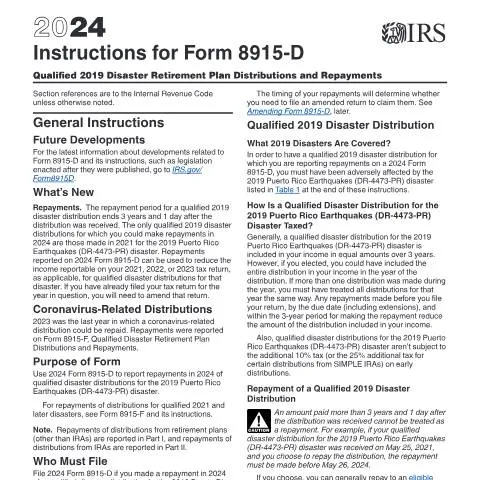
The IRS Instructions i8915D serve as a critical guide for those impacted by the 2019 Puerto Rico Earthquakes, specifically detailing how to manage qualified disaster retirement plan distributions and repayments. Understanding these instructions is essential not only for compliance but also to optimize your financial outcomes in the wake of disaster-related withdrawals.
Understanding Qualified Disaster Distributions
Qualified disaster distributions under the IRS Instructions i8915D pertain to specific events that allow individuals to withdraw funds from their retirement accounts without incurring the standard tax penalties typically associated with early withdrawals. The earthquakes that struck Puerto Rico in 2019 are a prime example. Below are the key components that define a qualified disaster distribution:
- Eligibility Criteria: To qualify, the distribution must stem from a retirement plan such as a 401(k) or similar arrangement.
- Tax Treatment: These distributions can be included in income over three years, offering taxpayers flexibility in managing their tax obligations.
- Exemption from Penalties: Distributions are exempt from the 10% early withdrawal penalty, which is particularly beneficial for individuals under the age of 59½.
What Constitutes an Adverse Effect?
For a distribution to be classified as qualified, the individual must demonstrate that they were adversely affected by the disaster. This may include property damage, loss of employment, or other financial hardships resulting from the earthquakes. Establishing this connection is vital for justifying the withdrawal to the IRS.
Step-by-Step Guide to Reporting Repayments
Repayments made in 2024 for qualified disaster distributions need to be correctly reported. This section provides a structured approach to ensure compliance and accurate reporting:
- Verify Your Distribution: Confirm that your distribution qualifies under the 2019 Puerto Rico Earthquakes provisions.
- Determine Repayment Amount: The repayment must not exceed the original distribution amount. Carefully assess the total withdrawn to avoid discrepancies.
- Prepare Form 8915-D: Complete the IRS Form 8915-D, ensuring all required sections are filled correctly according to the latest instructions.
- File with Your Tax Return: Include the completed Form 8915-D with your 2024 IRS Form 1040, 1040-SR, or 1040-NR.
- Monitor Deadlines: Payments must be made within the stipulated time frame to qualify for tax benefits and reduced income reporting.
Amending Prior Tax Returns
If you have already submitted your tax return for the years affected by the disaster distribution, you may need to amend those returns to reflect the repayment made in 2024. This process involves:
- Completing Form 1040-X, Amended U.S. Individual Income Tax Return.
- Clearly indicating the adjustments made due to the repayments.
- Filing the amended return with the IRS to ensure updated records.
Interplay with Other Forms and Regulations
Understanding the relationship between IRS Instructions i8915D and other related forms enhances clarity regarding your financial responsibilities. For instance, if you've also taken distributions related to COVID-19, these must be reported on different forms (specifically Form 8915-F). Here’s how they correlate:
| Form | Purpose | Specifics |
|---|---|---|
| Form 8915-D | Reporting repayments for 2019 Puerto Rico Earthquake distributions | Applicable for the 2024 tax year |
| Form 8915-F | Reporting coronavirus-related distributions and repayments | Applicable for 2021 and later disasters |
Key Differences in Reporting
One fundamental distinction between Forms 8915-D and 8915-F is the timing and nature of repayments. The IRS specifically allows for repayments of coronavirus-related distributions to be reported on Form 8915-F, but only for disaster distributions occurring after 2021. Therefore, ensure that you are using the correct form for your situation.
Audience and Usage Scenarios for Form 8915-D
Understanding who will benefit from the IRS Instructions i8915D is vital in recognizing its significance. This instruction set is primarily intended for:
- Individuals in Puerto Rico: Those directly affected by the 2019 earthquakes will find this guide indispensable.
- Tax Professionals: Accountants and tax advisors aiding clients who received qualified disaster distributions will need a firm grasp of these instructions to provide accurate advice.
- Financial Planners: Professionals helping clients navigate retirement planning will need to understand how disaster distributions affect long-term strategies.
Examples of Usage Scenarios
Several scenarios highlight the practical applications of Form 8915-D:
- A resident of Puerto Rico who withdrew from their 401(k) in response to the earthquakes and later decides to repay a portion of that distribution in 2024.
- A tax professional advising clients on how to amend prior returns to account for repayments made after disaster-related distributions.
- A financial planner integrating disaster repayment strategies into broader retirement investment plans.
Common Misconceptions and Clarifications
Even seasoned taxpayers and professionals may hold inaccurate beliefs regarding the IRS Instructions i8915D. Clarifying these misconceptions can lead to better compliance and enhanced financial outcomes:
- Misconception 1: All disaster distributions are treated the same. Clarification: Each disaster distribution is subject to specific conditions and reporting requirements. Understanding the nuances is essential.
- Misconception 2: Late repayments can be accepted without penalties. Clarification: Repayments must occur within the designated three-year period to avoid negative tax consequences.
- Misconception 3: Repayments do not need to be documented. Clarification: Proper documentation is necessary to substantiate claims made on tax returns.
Implications of Misunderstandings
Failing to grasp the intricacies involved in the IRS Instructions i8915D could potentially lead to costly mistakes. Taxpayers might incur unnecessary penalties or fail to claim refunds they are entitled to. Hence, thorough comprehension of these guidelines is crucial.
Conclusion: Proactive Steps for Compliance
In light of the complexities surrounding IRS Instructions i8915D, taking proactive steps is fundamental to navigating the aftermath of disaster-related distributions. Here are some actionable suggestions:
- Stay Informed: Regularly check for updates on IRS.gov/ Form8915D to stay current with changing regulations.
- Seek Professional Guidance: Engage with tax professionals familiar with disaster-related distributions for tailored advice.
- Document Everything: Keep detailed records of all distributions and repayments for future reference and compliance.
By taking these steps, you can ensure adherence to IRS guidelines while optimizing your financial strategy in the wake of disasters.
Understanding the Impact of Disaster Relief on Tax Responsibilities
The IRS Form I-8915-D is specifically designed for individuals who have been affected by federally declared disasters. Understanding how disaster relief funds and other assistance can affect your tax responsibilities is crucial for proper compliance. Often, disaster relief payments can be tax-free, but there are important exceptions to be aware of.
When you receive a distribution from a retirement plan or an IRA due to a qualified disaster, you might not have to pay the early withdrawal penalty. This is significant for those who may need immediate access to funds to recover from a disaster. However, you must report these distributions on your tax return, and they are subject to specific rules outlined in the IRS guidelines.
Additionally, if you've received any grants or loans that are part of the disaster relief efforts, such as those often administered through the Small Business Administration (SBA), you should check how these funds are characterized. Some may be treated as taxable income, while others might not affect your taxable status. It’s also worth noting that if you’ve claimed deductions related to losses from the disaster, you cannot double up by claiming further deductions for assistance you received.
For those filing Form I-8915-D, keeping detailed records of the amounts received, the purpose of each distribution, and the nature of the disaster (including the declaration number) is essential. Not only will this information help in accurately completing your tax forms, but it can also be beneficial in case of an audit.
State-Specific Considerations When Filing Form I-8915-D
While the IRS provides a federal framework for filling out Form I-8915-D, state tax regulations can vary significantly. It's crucial to understand how your state handles disaster relief funds and the potential tax implications that may arise. Some states have already adopted IRS guidelines, allowing taxpayers to follow similar procedures when reporting disaster-related distributions. However, others may impose additional requirements or have different exemptions.
For example, California has its own set of tax rules regarding how disaster relief payments are treated for state income tax purposes. Taxpayers in California should consult their state's official resources or the California Franchise Tax Board (FTB) to ensure compliance with local regulations while completing Form I-8915-D.
Moreover, be aware of the deadlines that may differ from federal dates, particularly for state tax filings related to federally declared disasters. Some states offer extended deadlines for those affected by disasters, which can provide much-needed relief during recovery periods.
If you reside in a state that does not conform to IRS guidelines, you may need to file additional forms or seek specific guidance from a tax professional familiar with both federal and state laws. This is particularly important if your state has special provisions for casualty losses or disaster relief that could benefit your overall tax situation.
Common Mistakes and How to Avoid Them When Filing Form I-8915-D
As with any tax form, mistakes on Form I-8915-D can lead to complications, penalties, or delays in receiving refunds owed to you. One of the most common errors is failing to accurately report all distributions related to disaster relief. Each distribution must be reported individually, and it's essential to include the correct amounts and dates to avoid discrepancies that could raise red flags with the IRS.
Another frequent issue arises from misunderstanding the definition of a "qualified disaster." Not every disaster qualifies for the tax relief provisions under IRS guidelines. Familiarizing yourself with the IRS list of declared disasters for the relevant tax year is critical. If you're not sure whether your situation qualifies, it's advisable to refer to IRS publication or consult a tax professional to ensure compliance.
Additionally, taxpayers often overlook the importance of documentation. As specified earlier, maintaining detailed records is vital, not just for filling out Form I-8915-D but also for supporting claims in case of an audit. Gather all relevant documents, such as distribution notices from retirement accounts, receipts for qualifying expenses, and any correspondence regarding disaster relief assistance you may have received.
Lastly, failing to consult the most current IRS guidelines or using outdated forms can lead to errors. The IRS periodically updates forms, instructions, and regulations, so always ensure you're working with the latest information available. Checking the IRS official website and confirming any changes directly with the agency can save you from potential pitfalls.