A Deep Dive into IRS Form 8801: Understanding the Credit for Prior Year Minimum Tax
Tax season can be an overwhelming time for many American taxpayers, but understanding specific forms can unlock potential benefits. Among these, IRS Form 8801 stands out for individuals, estates, and trusts who have faced the minimum tax in past years. This form enables taxpayers to claim a credit for prior year minimum tax, which can significantly impact their current tax liabilities. In this article, we delve into the intricacies of Form 8801, exploring its role, the process involved in its completion, and the nuances that taxpayers must be aware of.
The Timeline: Key Dates for Form 8801
The importance of timing in tax filing cannot be overstated. Understanding when to file Form 8801 is crucial for taxpayers looking to maximize their tax benefits. Typically, this form must be attached to your Form 1040, Form 1040-SR, Form 1040-NR, or Form 1041, which are the standard income tax returns for individual taxpayers and certain estates and trusts.
Filing Deadlines
- April 15: The general deadline for filing individual income tax returns, including any attached forms like 8801, unless a filing extension is obtained.
- October 15: Extended deadline for those who successfully file for an extension.
- Future Implications: Keep in mind that any unused minimum tax credits can carry forward to subsequent years, specifically to 2026 in this case, allowing taxpayers to benefit beyond the immediate filing year.
It is essential to plan ahead and ensure all necessary documents are prepared well before these deadlines to avoid last-minute complications.
Contextualizing Form 8801: The Broader Tax Landscape
Form 8801 serves a specific purpose in the broader tax landscape—it is designed for taxpayers who have previously paid a minimum tax and are eligible to claim a credit against their current taxes. This form is particularly relevant for those who have significant exclusion items, as identified in the Form 6251, which helps determine alternative minimum tax (AMT) liabilities.
Who Should Consider Filing Form 8801?
Taxpayers who may benefit from Form 8801 include:
- Individuals who previously paid the minimum tax and now wish to claim credits.
- Estates and trusts that encounter similar tax situations.
- Taxpayers subject to AMT who have exclusion items and wish to navigate their tax obligations more effectively.
This form is integral for those looking to recover tax liabilities from previous years and should not be overlooked during the tax filing process.
The Mechanics of Completing Form 8801
Completing Form 8801 requires a methodical approach, carefully following each instruction to ensure accuracy. The form comprises several sections that demand specific information related to minimum tax calculations and credits.
Detailed Breakdown of the Form's Parts
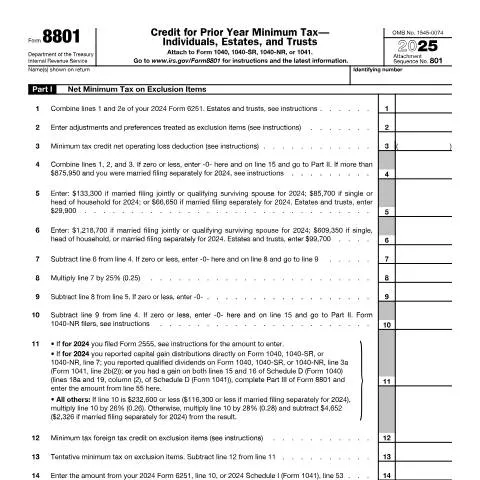
Part I: Calculating the Net Minimum Tax
The first part of Form 8801 focuses on determining the net minimum tax due on exclusion items. Here’s a closer look at the steps involved:
- Line 1: Combine the values from lines 1 and 2e of Form 6251. This establishes your starting point for calculations.
- Line 4: The total from the previous lines is crucial—if it exceeds $875,950 for a married couple filing separately, special instructions apply.
- Lines 5 and 6: Enter specified threshold amounts based on your filing status, which will guide your calculations going forward.
- Line 10: If your total is zero or less at this point, you may skip to Part II.
Part II: Minimum Tax Credit and Carryforward to 2026
This section addresses credits that can be carried forward, allowing taxpayers to apply unused credits to future tax liabilities. It is crucial to follow the computation steps closely, as they can significantly influence your tax return:
- Enter the amount from your prior Form 6251, ensuring you capture all relevant details.
- Accurately calculate the carryforward amount, as this will be essential for future filings.
Part III: Tax Computation Using Maximum Capital Gains Rates
Not all taxpayers will need to complete this section, but if your situation requires it, follow these steps:
- Ensure you have completed the requisite qualified dividends and capital gains worksheets, as these will inform your calculations.
- Carefully verify each line entry to avoid any potential pitfalls that could affect your tax outcomes.
Understanding Potential Consequences of Form 8801
Filing Form 8801 can yield significant benefits, but it also carries certain responsibilities and consequences that taxpayers must navigate. Missing or incorrectly filing this form could lead to overpaying taxes or losing out on potential refundable credits.
What Happens if You Forget to File?
- Failure to file Form 8801 can result in missing out on potential credits, leading to higher tax liability.
- In some cases, the IRS may assess penalties or interest on unpaid taxes, further complicating the taxpayer's situation.
- Taxpayers should consult with a tax professional if they realize they forgot to file to explore options for correction, such as amending their tax return.
Addressing Unique Taxpayer Scenarios
Not all taxpayers will face the same circumstances, so understanding the nuances can be critical. The following scenarios illustrate different situations that might require special attention when filing Form 8801.
Case Studies: When Form 8801 Becomes Essential
Case 1: A Married Couple Facing AMT
A married couple has consistently faced AMT due to high income and significant exclusion items. They realize they have not claimed the prior year minimum tax credit and decide to file Form 8801 to potentially recover some of their tax payments from the previous year. This might result in a lower effective tax rate for the current year, underscoring the form's importance in their tax strategy.
Case 2: Trusts and Estates
Estates that have not fully utilized their minimum tax credits from prior years must file Form 8801 to claim any remaining credits. This is particularly relevant for estates in their administration phase, where every dollar counts towards liabilities and distributions.
Case 3: A Single Filer with Capital Gains
A single taxpayer with substantial capital gains is subject to AMT. They find that filing Form 8801 not only allows them to claim a credit but also enables them to manage their tax burden more effectively, given their unique income situation.
Form 8801 vs. Other Related IRS Forms
Form 8801 is often confused with other IRS forms that deal with tax credits and liabilities. Understanding the distinctions between these forms can clarify when and why to use them.
Comparative Overview of IRS Forms
| Form | Purpose | Relation to 8801 |
|---|---|---|
| Form 6251 | Alternative Minimum Tax—Individuals | Form 8801 utilizes data from this form to calculate minimum tax credits. |
| Form 1040 | Individual Income Tax Return | Form 8801 is attached to this primary return. |
| Form 1041 | Income Tax Return for Estates and Trusts | Similar to Form 8801 for individual filers but applies to estates and trusts. |
Maximizing Your Benefits with Form 8801
Using Form 8801 wisely can greatly benefit your tax situation. Taxpayers are encouraged to stay informed about their tax obligations and potential credits to leverage their financial situations effectively.
Strategies for Successful Filing
- Maintain meticulous records of your tax filings, especially if you’ve faced AMT in previous years; this will simplify the process of filling out Form 8801.
- Consult with a qualified tax professional whenever your tax situation becomes complicated or if you are unsure about how to proceed with the form.
- Stay updated on any changes in tax law that could impact the credit amounts or the eligibility for claiming the credit in subsequent years.
By understanding the critical components and processes tied to IRS Form 8801, taxpayers can ensure they are not leaving money on the table and are fulfilling their tax responsibilities effectively. Whether for individuals, estates, or trusts, Form 8801 serves as a vital tool for managing past tax obligations and optimizing future tax outcomes.
Understanding the Purpose and Scope of IRS Form 8801
IRS Form 8801, officially titled "Credit for Prior Year Minimum Tax—Individuals, Estates, and Trusts," serves a critical role for taxpayers who may have previously paid an alternative minimum tax (AMT). The purpose of this form is to allow individuals, estates, and trusts to claim a credit for the AMT they paid in prior years against their regular tax liability. This credit helps ensure that taxpayers do not face double taxation, particularly in years where their income fluctuates or when they benefit from certain deductions that might not be available in future tax years.
The necessity of Form 8801 arises when a taxpayer's income exceeds certain thresholds, prompting the AMT to kick in. The Alternative Minimum Tax is a separate tax calculation designed to ensure that individuals who benefit significantly from various deductions still contribute a minimum amount in taxes. If a taxpayer has previously been subject to AMT, they may be eligible to recoup some of those taxes when their situations change favorably, such as a decrease in income or a significant tax deduction in subsequent years.
One crucial aspect of Form 8801 is that it can be complex, given the calculations involved. Taxpayers must reference prior years' tax returns to accurately compute the credit. Thus, it is advisable to maintain thorough records, including any documentation related to AMT paid in earlier years, as this will provide the basis for filling out the form accurately.
Filing Requirements and Special Considerations for Form 8801
Filing IRS Form 8801 is not mandatory for all taxpayers but applies specifically to those who have previously paid AMT and are looking to claim credits in subsequent years. To qualify, taxpayers must have a valid Social Security Number (SSN) or Employer Identification Number (EIN) and have filed Form 1040 or another applicable income tax return, submitting their AMT details in prior years.
One important consideration is that the credit can be claimed only if the taxpayer is not subject to AMT in the current tax year. If a taxpayer is again facing AMT, they cannot claim a credit for prior years. Moreover, Form 8801 must be attached to the taxpayer's annual return, and the credit is non-refundable, meaning it can only offset tax liability and cannot result in a refund. However, if the credit exceeds the tax due, the excess can be carried forward to future years, underlining the importance of accurate calculations and record-keeping.
Additionally, taxpayers should be aware of the implications of various deductions and credits that might affect their tax situation. For instance, those claiming the standard deduction versus itemized deductions might see different results concerning AMT and, consequently, the applicability of Form 8801. It is essential to consult the IRS instructions for Form 8801 periodically, as tax rules can change, and staying updated ensures accurate filing.
Common Mistakes and How to Avoid Them When Filling Out Form 8801
Filing taxes can be daunting, and Form 8801 is no exception. Numerous pitfalls can lead to errors, which could delay processing, trigger audits, or lead to unwelcome surprises at tax time. Understanding common mistakes and proactively avoiding them can save taxpayers time and stress.
One common mistake is neglecting to include all necessary information from prior year returns. Taxpayers must provide accurate figures related to prior AMT paid, and missing documentation can lead to inaccurate calculations or credit claims that are not honored. It's crucial to ensure that the data from previous tax returns is complete and accurate, particularly the AMT-related amounts.
Another frequent error occurs in miscalculating the allowable credit based on the AMT paid in previous tax years. Taxpayers often overlook the necessity of using Form 6251 (Alternative Minimum Tax—Individuals) to determine if AMT was applied in the years they are referencing. Failing to correctly calculate AMT may result in claiming too little or too much credit.
Furthermore, failing to attach Form 8801 to the annual return can lead to rejection of the claim for credit. Taxpayers must ensure all required forms are submitted together and that they keep copies of everything filed for their records. As a best practice, taxpayers should double-check that the correct version of Form 8801 is being used, as forms are often updated with new revision dates.
Finally, it’s beneficial to seek professional assistance if there’s any confusion regarding the eligibility criteria or calculations involved in Form 8801. Given the potential financial implications of errors, investing in tax preparation services or consulting with a tax professional can help mitigate risks and ensure compliance.