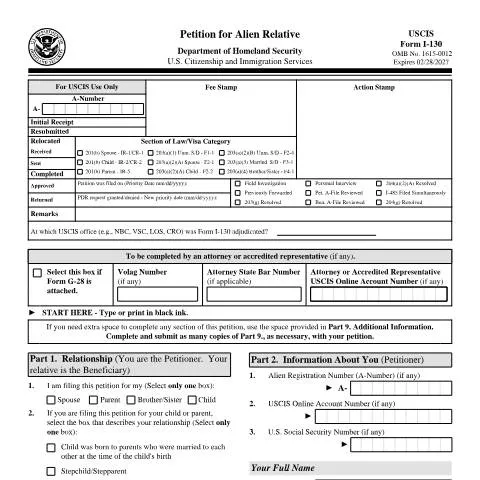
Navigating the USCIS Form I-130: A Comprehensive Guide
Filing the USCIS Form I-130 is a pivotal step for U.S. citizens or lawful permanent residents wishing to bring their relatives into the country. This petition, known as the "Petition for Alien Relative," serves as an essential component of family-based immigration, establishing a qualifying relationship between a petitioner and their relative, known as the beneficiary. The I-130 is often the first step in a journey that can lead to permanent residency for the beneficiary.
Understanding the I-130's Role in Family Immigration
The I-130 form is the starting point for many family-based immigration cases. It is designed to prove the legitimacy of the relationship between the petitioner and the beneficiary. By submitting this form, you are essentially requesting that the U.S. government recognize your family relationship, thereby enabling your relative to apply for a visa or adjust their status to become a lawful permanent resident.
- Petitioner: This is the individual (U.S. citizen or lawful permanent resident) filing the I-130.
- Beneficiary: The relative for whom the petitioner is requesting immigration benefits.
This form is critical for various family relationships, including spouses, children, siblings, and parents. Each relationship category may come with different waiting times and processing conditions, influencing the overall immigration timeline.
The Process: From Petition to Visa Approval
The steps following the submission of the I-130 are significant. Once filed, the USCIS will process the petition, and upon approval, will forward it to the National Visa Center (NVC) if the beneficiary is outside the U.S. If the beneficiary is already in the U.S., they may be eligible to adjust their status without leaving the country. The entire process can take several months to years, depending on various factors.
Challenges and Solutions: What If the I-130 Is Denied?
Receiving a denial for your I-130 can be disheartening, but it is essential to understand the options available. Denials can occur due to various reasons, such as inadequate proof of the relationship, incomplete forms, or failure to meet eligibility criteria. If your petition is denied, you have the right to appeal the decision or file a motion to reopen or reconsider.
Steps to Take After a Denial
- Review the Denial Notice: Understand the specific reasons for the denial.
- Gather Additional Documentation: If applicable, collect evidence that addresses the reasons cited in the denial.
- File an Appeal or Motion: If you believe the denial was unjust, consider appealing to the Administrative Appeals Office or filing a motion to reopen.
Each option has strict filing deadlines and requirements, so it's critical to act promptly and consult with an immigration attorney if necessary.
Distinguishing the I-130 from Other USCIS Forms
It’s easy to confuse the I-130 with other similar forms, particularly those related to visa applications or status adjustments. Understanding the distinctions is crucial for ensuring the proper filing.
| Form | Purpose | Who Files |
|---|---|---|
| I-130 | Petition for Alien Relative | U.S. Citizen or Permanent Resident |
| I-485 | Application to Register Permanent Residence or Adjust Status | Beneficiary in U.S. |
| I-129F | Petition for Alien Fiancé(e) | U.S. Citizen |
While the I-130 establishes the relationship, the I-485 allows the beneficiary to adjust their status to that of a permanent resident. The I-129F, on the other hand, is tailored for foreign fiancés of U.S. citizens, demonstrating the nuances of family immigration processes.
Timelines and Processing: What to Expect
Understanding the timeline involved with the I-130 is crucial for effective planning. The entire process, from filing to receiving an approved petition, can vary depending on several factors including the relationship type and processing center.
Typical Timelines
- Initial Processing: Usually takes between 6 to 12 months.
- Approval Notification: Upon approval, you will receive a notice, which includes instructions for the next steps.
- National Visa Center Processing: This can add several additional months before a visa interview is scheduled.
It's essential to check the USCIS processing times for your specific situation as these can fluctuate based on workload and policy changes.
Who Can File the I-130? Profiles and Exceptions
Not everyone can file an I-130. It’s essential to understand who qualifies as a petitioner and what relationships are eligible, along with any exceptions that may apply.
Eligible Relationships
- Spouses: Legal marriage is required.
- Children: Biological, step, or adopted (under certain conditions).
- Siblings: Must demonstrate proof of shared parentage.
- Parents: Must be able to demonstrate the relationship through legal documents.
Exceptions may arise in cases of divorce, illegitimate relationships, or those involving children born out of wedlock. Each case is unique and may require additional documentation to prove the legitimacy of the relationship.
Preparing Supporting Documents: Essential Tips
Accompanying your I-130 with the right documentation is crucial for a successful application. Lack of sufficient proof can lead to delays or denials.
Required Documents
- Proof of Relationship: Marriage certificates, birth certificates, or adoption papers.
- Proof of Petitioner Status: A copy of a U.S. passport, naturalization certificate, or green card.
- Form Fees: Include the appropriate fee, which can change, so it’s critical to check the current USCIS fee schedule.
Every document should be submitted in copies, accompanied by translations if they are not in English. Ensuring that all documentation is accurate and complete is vital to prevent unnecessary delays.
Conclusion: The Road Ahead
Filing the I-130 can be a daunting process, but understanding its role in family reunification can ease some of the challenges. By being well-prepared and informed, petitioners can navigate through the complexities of U.S. immigration. Consulting with an immigration attorney can provide personalized guidance tailored to your specific circumstances, ensuring that your petition is as robust as possible.
Understanding the Role of Form I-130 in Family-Based Immigration
Form I-130, officially known as the Petition for Alien Relative, is a cornerstone document in the family-based immigration process in the United States. This form serves as a crucial first step for U.S. citizens and lawful permanent residents (LPRs) seeking to bring their relatives to live permanently in the U.S. The primary purpose of Form I-130 is to establish a qualifying relationship between the petitioner (the U.S. citizen or LPR) and the beneficiary (the relative seeking a green card).
The significance of this form cannot be overstated; it is not just a bureaucratic hurdle but a legal instrument that helps determine eligibility. For U.S. citizens, the form can be filed for a spouse, child, parent, or sibling, while LPRs can only petition for spouses and unmarried children. Understanding the nuances of who can file and the implications of the relationship is crucial for a successful application.
It’s important to provide thorough documentation with Form I-130. This includes proof of the petitioner's status as a U.S. citizen or LPR, such as a copy of the passport, birth certificate, or permanent resident card. Additionally, evidence of the relationship must be submitted, like a marriage certificate for spouses or birth certificates for children. In cases where the beneficiary is from a country with a high rate of immigration, such as Mexico or the Philippines, the processing times can be lengthier due to the backlog. Therefore, being proactive and organizing documents early in the process is advisable.
Common Challenges and How to Navigate Them
Filing Form I-130 can be an overwhelming experience, especially for first-time petitioners. Various challenges can arise during this process—ranging from inadequate documentation to misunderstandings regarding relationship qualifications. One common challenge is the issuance of Requests for Evidence (RFEs) by USCIS. An RFE is a formal request to provide additional information to support the petition. When this occurs, it is crucial to respond promptly and thoroughly. Failure to do so can lead to delays or even denial of the petition.
Moreover, relationship-based petitions, especially involving marriages, may come under scrutiny for authenticity. USCIS officers often look for signs of a legitimate relationship, so applicants should include photographs, joint financial documents, and affidavits from friends and family. If the marriage is recent, providing additional evidence, such as travel itineraries or plans for the future together, can bolster the case.
Consider hiring an immigration attorney if your case involves complications, such as prior immigration violations or if you have any criminal history. Experienced legal counsel can navigate the complex landscape of immigration law and represent you effectively before USCIS. While hiring an attorney may involve additional costs, it can save time and stress in the long run.
The Importance of Maintaining Accurate Records
Maintaining accurate and detailed records is crucial throughout the application process for Form I-130. Not only does this help in the preparation and submission of all necessary documents, but it can also be invaluable in case of an audit or review by USCIS. Petitions may take several months or even years to process; therefore, keeping meticulous records of communications, submissions, and any correspondences with USCIS cannot be overstated.
Additionally, applicants should be aware that any changes in circumstances—such as a change of address, a divorce, or a change in employment—must be reported to USCIS immediately. Failure to update your information can result in complications, including delayed processing or denial of the petition. For this purpose, using a well-organized filing system that ensures that all documents are easily accessible is a prudent strategy.
Finally, understanding the timelines involved in processing Form I-130 is essential. While USCIS does provide estimated processing times on their website, these are just estimates and can fluctuate based on a variety of factors. Applicants should regularly check their case status online and be prepared for potential delays, particularly in times of high demand or changes in immigration policy. Staying informed and ready to act can make a significant difference in the smooth progression of your petition.