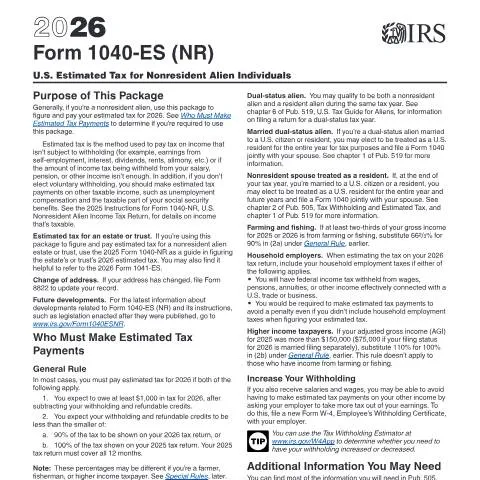
Understanding IRS Form 1040-ES (NR): A Crucial Tool for Nonresident Aliens
Navigating the U.S. tax system can be particularly challenging for nonresident aliens, especially when it comes to understanding their obligations regarding estimated taxes. The IRS Form 1040-ES (NR) serves a vital function in this regard, as it enables eligible individuals to calculate and pay their estimated taxes for a given tax year. In this comprehensive guide, we will delve into the specifics of this form, its historical significance, its role in the tax process, and critical insights that will help ensure accurate completion and timely submission.
The Historical Context of Form 1040-ES (NR)
Estimated tax payments have a long-standing history in U.S. tax law. The concept emerged as a way for the government to secure revenue throughout the fiscal year rather than solely relying on year-end tax returns. Originally, these payments were primarily geared towards U.S. citizens, but as globalization has increased and more nonresident aliens earn income in the U.S., the need for a specific process accommodating these individuals became evident.
Form 1040-ES (NR) is specifically designed for nonresident aliens who must pay estimated taxes. This evolution reflects the IRS's commitment to inclusivity and the recognition that nonresident aliens often have income types that do not have adequate tax withholding. Understanding this form is crucial for compliance and to avoid penalties.
Who Needs to File Form 1040-ES (NR)?
Before diving into the details of how to fill out the form, it is essential to identify who is required to file it. The general rule stipulates that a nonresident alien must make estimated tax payments if:
- They expect to owe at least $1,000 in tax after subtracting any withholding and refundable credits.
- Their withholding and refundable credits will be less than the smaller of:
- 90% of the tax to be shown on their 2026 tax return, or
- 100% of the tax shown on their 2025 tax return.
It's important to note that certain exceptions and special rules apply, particularly for individuals with specific income sources, such as those engaged in farming or fishing.
Understanding Special Rules and Exceptions
To further clarify the obligations regarding estimated tax payments for nonresident aliens, let's explore some of the special rules and exceptions:
- Dual-Status Aliens: If a nonresident alien qualifies as both a nonresident and a resident during the same tax year, they may have different filing obligations. Key IRS publications, particularly Pub. 519, provide detailed guidance on how to proceed in such cases.
- Household Employers: Nonresident aliens who employ household help must include household employment taxes when estimating their tax obligations. This requirement is crucial for compliance and helps ensure that all tax liabilities are accurately accounted for.
- Higher Income Taxpayers: If an individual’s adjusted gross income (AGI) exceeds certain thresholds, the estimated payments rules may differ. For example, if the AGI for 2025 was more than $150,000, different percentages apply, and understanding these nuances is essential.
Dissecting the Sections of Form 1040-ES (NR)
Form 1040-ES (NR) is structured to facilitate the calculation and payment of estimated taxes. Each section is designed with a specific purpose, and knowing how to navigate these sections is key to a successful filing.
Section Breakdown
Personal Information: This section requires basic information about the taxpayer, including name, address, and Social Security Number (SSN) or Individual Taxpayer Identification Number (ITIN). Accuracy is crucial here; errors can lead to delays or misdirected correspondence.
Income Calculation: Taxpayers must estimate their income for the year, including wages, self-employment income, dividends, and any other sources of income. Careful consideration should be given to the accuracy of these estimates to avoid underpayment penalties.
Tax Calculations: Using the estimated income, taxpayers will calculate their expected tax liability. This section includes considerations for deductions and credits, which can significantly impact the final tax amount owed.
Payment Schedule: The form specifies when estimated payments are due throughout the year. Misunderstanding these deadlines can result in penalties, so keeping a calendar with due dates is advisable.
Signature and Declaration: At the end of the form, the taxpayer must sign and date the return, declaring that the information provided is accurate to the best of their knowledge.
The Filing Process: From Completion to Submission
Once the form is completed, it enters a critical phase: filing. Here are the key steps involved in this process:
Step-by-Step Filing Instructions
- Review the Completed Form: Before submission, double-check all entries against your supporting documents to ensure accuracy.
- Make Payments: Depending on the IRS's guidance, payments can be made electronically or via mail. If you choose to mail your payment, ensure it is postmarked by the due date.
- Submit the Form: Send the completed Form 1040-ES (NR) and payment to the appropriate address as specified by the IRS. This address may vary depending on whether you are paying electronically or via check.
- Keep Records: Retain copies of the filed form and payment confirmations for your records. These documents may be required in the future for various tax-related inquiries or audits.
What Happens After You Submit Form 1040-ES (NR)?
The filing of Form 1040-ES (NR) does not conclude the process. Understanding what occurs after submission can help taxpayers stay ahead of their obligations.
Post-Submission Process and Tracking
Once the IRS receives your estimated tax payment and Form 1040-ES (NR), they will process the information. Here’s what happens next:
- Payment Acknowledgment: The IRS will record your payment. If you filed electronically, you may receive immediate confirmation. However, if you mailed your payment, be sure to monitor your bank account or payment method for clearance.
- Adjustments: Should the IRS notice discrepancies in your estimated tax payments compared to what they have on file, they may reach out for clarification or adjustment. Always respond promptly to such inquiries to avoid penalties.
- Future Liability: Based on the estimates provided in your form, your future tax liabilities will be adjusted. If it turns out you have overpaid or underpaid, you will need to reconcile this when filing your final tax return.
Case Scenarios: Who Should Be Paying Attention to Form 1040-ES (NR)?
Not all nonresident aliens have the same tax obligations or situations. Here, we examine various profiles that might influence when and how a person must file Form 1040-ES (NR).
Profile-Specific Considerations
Freelancers and Self-Employed Individuals: Those earning income through freelancing or self-employment must be especially vigilant about their estimated taxes, as most of their income may be subject to self-employment tax without adequate withholding.
Students: International students often work part-time on campus and may receive income that does not have taxes withheld. If their income exceeds specific thresholds, they must file Form 1040-ES (NR).
Investors: Nonresident aliens earning income from U.S. investments, such as dividends and interest, may also need to file estimated taxes. The nature of the income can affect withholding rates.
Retirees: Individuals receiving retirement income or pension payments may find themselves in a unique situation where their withholding does not cover their tax liability, necessitating the filing of Form 1040-ES (NR).
Conclusion: Navigating the Tax Landscape as a Nonresident Alien
Understanding IRS Form 1040-ES (NR) is fundamental for nonresident aliens who earn income in the United States. This form not only facilitates compliance with federal tax laws but also offers a pathway to manage tax liabilities effectively.
As you navigate this process, remember to pay attention to detail in each section, keep organized records for your filings, and stay aware of deadlines to avoid penalties. Engaging with IRS resources and publications can further enhance your understanding and compliance, ensuring a smoother tax experience.
In situations where complexities arise, seeking advice from tax professionals familiar with nonresident alien tax obligations can also prove invaluable. They can provide tailored guidance that aligns with your unique circumstances, ultimately leading to a more manageable and compliant tax process.
Understanding IRS Form 1040-ES: Making Estimated Tax Payments
The IRS Form 1040-ES is used for making estimated tax payments for individuals. This form is particularly significant for those whose income isn't subject to withholding, such as self-employed individuals, freelancers, or those who earn income from investments. It's important to grasp how to effectively use this form to avoid penalties and ensure compliance with federal tax laws.
To properly use Form 1040-ES, first determine if you need to pay estimated taxes. Generally, if you expect to owe at least $1,000 in taxes after subtracting withholding and refundable credits, you will need to make estimated payments. Additionally, if you did not have a tax liability in the previous year, you may be exempt from making estimated payments. However, tax situations can vary widely, so it's essential to analyze your specific circumstances.
Form 1040-ES includes several worksheets that help in calculating your estimated tax for the year. These include the Estimated Tax Worksheet, which considers your expected income, deductions, and credits. You'll want to estimate your total annual income accurately. This can be a challenge for individuals with variable income, such as self-employed workers, so it's advisable to keep meticulous records. Using prior year tax returns as a guideline can also help you gauge your expected liability.
Once you've calculated your estimated tax, the form guides you in determining your payment schedule. The IRS typically requires payments to be made quarterly, with deadlines falling on April 15, June 15, September 15, and January 15 of the following year. Failing to pay on time could result in penalties, so it's essential to adhere to these deadlines. Moreover, keeping track of any special tax situations, like changes in income or major life events, can affect your estimated payments, so regular reassessment is beneficial.
Common Mistakes to Avoid When Filing Form 1040-ES
Filing IRS Form 1040-ES can be straightforward, yet several common pitfalls can lead to penalties or underpayment of taxes. Awareness of these mistakes can help ensure that your estimated tax payments are accurate and timely.
Firstly, one of the most frequent errors is failing to update your income estimates throughout the year. If your income changes significantly, such as through a new job or a drop in freelance work, your initial estimate may no longer be accurate. Underestimating your tax liability could incur penalties, so it’s wise to adjust your estimates as your financial situation evolves.
Secondly, many taxpayers do not account for all sources of income when calculating their estimated taxes. Be sure to include all forms of income, including wages, dividends, interest, and rental income. Omitting income can lead to a larger tax bill than anticipated, and potential penalties for underpayment.
Another mistake is neglecting the available deductions and credits that can lower your tax bill. For instance, contributions to retirement accounts or certain business expenses can reduce your taxable income. Stay informed about possible deductions and ensure you factor them into your calculations.
Lastly, some taxpayers forget to make their estimated payments altogether, which can result in an unexpected tax burden. Setting reminders for quarterly payment deadlines can help avoid this scenario. Alternatively, consider setting up electronic payments for convenience and to ensure timely submissions.
Impact of State Tax Considerations on Form 1040-ES
While the IRS Form 1040-ES pertains specifically to federal estimated tax payments, it's crucial to recognize that many states have their own estimated tax payment requirements. State income tax laws can differ significantly, and certain states may require taxpayers to file their own estimated tax forms.
For instance, states like California and New York have their own guidelines on estimated payments, which may necessitate additional calculations and forms. It's essential to verify your state’s requirements to avoid underpayment penalties at both the federal and state levels. Some states may align their deadlines with the federal schedule, while others may impose differing due dates.
Additionally, residents in states without a state income tax—such as Texas or Florida—may find themselves solely focused on federal tax obligations. Conversely, individuals living in states with higher tax rates may need to adjust their estimated payments higher to accommodate both federal and state liabilities. Be sure to consult your state's department of revenue or taxation website for specific details regarding estimated payments and requirements.
In summary, while IRS Form 1040-ES is essential for managing federal tax obligations, understanding the broader context of state tax obligations is equally important. Failure to account for state requirements can lead to unexpected tax liabilities and penalties.
Leveraging IRS Resources for Effective Tax Planning
The IRS offers a variety of resources to assist individuals in properly filing Form 1040-ES and managing their estimated tax payments. Understanding how to navigate these resources can significantly enhance your tax planning and compliance processes.
The IRS website (www.irs.gov) provides guidance under the “Forms and Instructions” section. You can access Form 1040-ES, along with its instructions, which include comprehensive information on eligibility, payment options, and filing tips. Additionally, the IRS offers the Interactive Tax Assistant tool, which can help determine your need to pay estimated taxes based on your specific financial situation.
In addition to online resources, consider reaching out to the IRS directly for assistance. The IRS has a toll-free number for general inquiries. However, be prepared for potential long wait times, especially during peak tax season. Moreover, local IRS offices offer in-person assistance, albeit you may need to schedule an appointment, which can be beneficial for more complex tax situations.
Furthermore, taxpayers may also benefit from utilizing tax professional services, especially if you have a complicated tax situation. A certified public accountant (CPA) or an enrolled agent can provide tailored advice and assist in navigating the intricacies of estimated tax payments. They can also help with tax projections and strategizing deductions, ensuring effective tax planning throughout the year.
By leveraging the available IRS resources, coupled with professional advice when necessary, you can ensure that your estimated tax payments are calculated accurately and submitted on time, minimizing potential penalties and maximizing your compliance with federal tax laws.