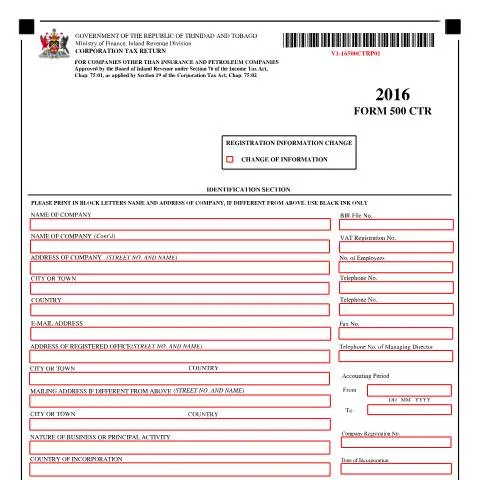
Understanding the 500-CTR Corporation Tax Return Form in Trinidad and Tobago
The 500-CTR Corporation Tax Return Form is a crucial document for companies operating in Trinidad and Tobago, ensuring compliance with the local tax laws. This form is specifically designed for corporations (excluding insurance and petroleum companies) to report their income and calculate their corporate tax obligations. Distinct from other tax forms such as individual income tax returns or VAT declarations, the 500-CTR focuses on the intricate details of corporate finances, providing both the Inland Revenue Division (IRD) with necessary information and corporations with a structured approach to fulfilling their tax responsibilities.
Who Needs to Complete the 500-CTR Form?
Corporations registered under the Companies Act of Trinidad and Tobago must complete the 500-CTR form annually. This includes a range of entities such as:
- Private and Public Limited Companies
- Non-Resident Companies operating within Trinidad and Tobago
- Charitable Organizations that are incorporated as companies
- Small Enterprises that meet the necessary criteria for tax reliefs
It is essential for company directors or authorized agents to be familiar with the requirements. This ensures that all relevant income sources, deductions, and tax credits are accurately reported, thus avoiding potential penalties.
Key Differences from Similar Forms
The 500-CTR form is often misunderstood or confused with other tax-related forms due to its specific nature. Unlike the personal income tax forms that cater to individual taxpayers, the 500-CTR is tailored for corporation-specific taxation issues. Here are some distinguishing features:
- Scope: The 500-CTR includes comprehensive financial metrics such as gross receipts, chargeable profits, and tax liabilities, which are not present in individual tax forms.
- Complexity: The form accounts for various profit calculations and allowable deductions specific to corporate entities.
- Submission Deadlines: Corporations have different submission deadlines compared to individual filers, typically due 30 days after the fiscal year-end.
Filling Out the 500-CTR Form: Step-by-Step Guidance
Completing the 500-CTR form requires careful attention to detail, as inaccuracies can lead to significant fines. Below is a breakdown of the critical sections of the form that need to be addressed:
Identification Section
This section requires the company’s name, registration number, and contact details, including:
- Name and Address of the Company
- BIR File Number
- Telephone Number of the Managing Director
Accuracy is paramount, as this information is used to identify the corporation in the tax system.
Nature of Business
Corporations must describe their primary activity in detail. This is crucial for the IRD to categorize the business correctly for tax obligations and possible incentives.
Financial Data Submission
One of the most critical parts of the form involves the submission of financial data:
- Gross Receipts/Sales
- Cost of Sales or Operations
- Total Income Calculations
This data is vital for the calculation of chargeable profits, which subsequently determines the corporation tax liability.
Tax Calculation and Reliefs
The form includes sections to calculate the corporation tax due and eligible reliefs:
- Chargeable Profits: Reported as the total income minus allowable deductions.
- Tax Rates: Corporations must select an appropriate tax rate based on their profit levels (10%, 25%, or 35%).
- Reliefs: Corporations can claim various tax reliefs such as Double Tax Relief or other credits.
Documentation Required for Submission
Accompanying the 500-CTR form, corporations must prepare and submit key documentation to support their financial data:
- Profit and Loss Statements
- Copies of any relevant financial schedules (e.g., Schedule A for Profit and Loss)
- Supporting documents for claimed deductions and reliefs
These documents play a crucial role in validating the details reported in the 500-CTR form.
Submission Process: Where and How to File
The completed 500-CTR form must be submitted to the IRD, either in person or via their online platforms. Here’s a simple guide to the submission process:
- Online Submission: Companies can file electronically using the e-Tax system with a ttconnect ID, enhancing convenience and tracking.
- Physical Submission: Corporations can also opt to submit their forms and accompanying documents in person at IRD offices.
- Deadline: The deadline for filing the 500-CTR form is 30 days post the end of the corporation’s fiscal year. Missing this deadline can incur penalties.
What Happens After Submission?
Upon submission, the IRD processes the 500-CTR form and may take the following actions:
- Assessment: The IRD will assess the submitted details against tax regulations. Companies may receive a notice for any discrepancies or additional information needed.
- Tax Liability Notification: Companies will be informed about any tax dues or refunds based on the assessment conducted by the IRD.
- Audit Potential: Depending on the nature and complexity of the filing, corporations may be subjected to an audit, especially if significant deductions or tax reliefs are claimed.
Special Considerations: Unique Situations for Corporations
Certain situations can complicate the filing process for corporations. Here are some examples:
- Foreign Companies: Non-resident entities operating in Trinidad and Tobago must navigate additional requirements, such as ensuring compliance with local taxation rules.
- Start-Ups and SMEs: Small and medium enterprises may qualify for specific tax reliefs, making it critical for them to understand how these affect their 500-CTR submissions.
- Charitable Organizations: Charities incorporated as companies have specific guidelines and allowable exemptions that differ from standard corporations.
Real-World Implications of Accurate Reporting
Accurate completion of the 500-CTR form not only ensures compliance but also significantly impacts the corporation's financial health. Misreporting can lead to:
- Financial Penalties: Fines are imposed for incorrect or late submissions.
- Legal Repercussions: Companies may face legal actions if false declarations are made.
- Impact on Future Tax Obligations: Inaccuracies can affect future assessments, audits, and tax relief eligibility.
The stakes are high, underscoring the need for companies to be vigilant and proactive in their tax reporting obligations.
Conclusion: Importance of Compliance and Accuracy
The 500-CTR Corporation Tax Return Form is more than just a bureaucratic obligation; it is an essential tool that ensures corporations contribute fairly to the national revenue while receiving the necessary deductions and credits they are entitled to. By understanding its structure, complying with deadlines, and preparing accurate documentation, companies can navigate this landscape effectively, maintaining their operational integrity and financial well-being.
Understanding the Corporation Tax Framework in Trinidad and Tobago
The taxation framework for corporations in Trinidad and Tobago is primarily governed by the Income Tax Act, Chapter 75:02. Corporations are subjected to various tax obligations that differ depending on their activities, income levels, and structure. A critical aspect of this tax framework is the Corporate Income Tax (CIT), levied on the profits of companies operating within Trinidad and Tobago.
Corporations must first accurately determine their taxable income, which is calculated by deducting allowable expenses from gross income. Allowable expenses include costs that are wholly and exclusively incurred in the production of income, such as operational costs, salaries, and interest on loans. However, it’s essential to note that certain expenses, such as capital expenditures, are not deductible in the year incurred but may be subject to capital allowance provisions.
Moreover, different tax rates are applicable based on the nature of the business. For instance, the standard corporate tax rate is currently set at 30%, while smaller businesses may benefit from preferential rates depending on their income level. It's important for corporations to maintain detailed financial records to substantiate their positions during tax assessments by the Board of Inland Revenue (BIR).
Corporations are required to file their tax returns using Form TD 4 (Corporate Income Tax Return), which must be submitted by April 30th of the year following the fiscal period. As part of the filing process, corporations must also pay any due taxes. The BIR provides digital facilities via the e-Tax platform, allowing for easier filing and management of tax obligations.
Furthermore, corporations engaged in specific sectors, such as oil and gas or financial services, may need to comply with additional sector-specific regulations and taxes, which could change the effective tax liability considerably. Understanding these nuances is critical for compliance and effective financial planning.
The Role of Tax Incentives for Corporations
In an effort to stimulate economic activity and attract foreign investment, the government of Trinidad and Tobago offers various tax incentives to corporations. These incentives are designed to promote growth in specific industries or regions, thereby fostering a conducive environment for business development.
Tax holidays are among the most attractive incentives granted to new investors in designated sectors, allowing corporations to operate without paying corporate tax for a specific period. Such incentives are often tied to job creation, investment thresholds, and compliance with local laws. For instance, the Trinidad and Tobago Free Zones Act enables companies operating within designated Free Zones to enjoy tax exemptions on income generated within these areas.
Furthermore, the government periodically reviews and amends the list of qualifying sectors to align with national development goals, such as renewable energy, technology, and tourism. Corporations interested in availing themselves of these incentives should consult the Ministry of Finance or the Trinidad and Tobago Chamber of Industry and Commerce to assess eligibility and application procedures.
For instance, if a corporation invests in renewable energy technologies, it may qualify for additional capital allowances or special tax rates. To take advantage of these opportunities, corporations must prepare a comprehensive business plan demonstrating how their operations align with the government’s economic objectives.
Common Compliance Challenges for Corporations
While the regulatory framework in Trinidad and Tobago provides various opportunities for corporations, it also presents numerous compliance challenges. One of the most significant challenges is navigating the complexities of tax legislation, which can be difficult for both local and international businesses.
Corporations often struggle to remain compliant with evolving tax laws, amendments, and additional regulations. The frequent updates to policies and procedures can lead to confusion on what is required for compliance, particularly for businesses that operate across multiple sectors. To mitigate this risk, it is advisable for corporations to engage tax professionals or consultants who specialize in Trinidad and Tobago’s tax laws to ensure adherence to the latest stipulations.
Moreover, another common hurdle is maintaining accurate and comprehensive financial records. The BIR requires corporations to keep books of accounts that reflect their financial position accurately. Failure to maintain proper records can lead to difficulties in substantiating claims during audits, resulting in penalties or additional tax liabilities.
Corporations should also be cognizant of their obligations in relation to Goods and Services Tax (GST) and the implications of Value Added Tax (VAT). In cases where corporations are involved in the supply of taxable goods or services, they must ensure compliance with the regulations governing collection and remittance of these taxes to avoid legal repercussions.
Lastly, the digital aspects of tax compliance have become increasingly relevant. The shift towards online tax filing and payment systems has streamlined many processes, but it also requires corporations to invest in training and resources to ensure that their staff is equipped to handle electronic submissions correctly. Engaging in regular training sessions on the use of platforms like e-Tax can significantly reduce compliance errors and enhance efficiency in filing processes.