Decoding the New Rates for Medical Expenses: Understanding the Official Document
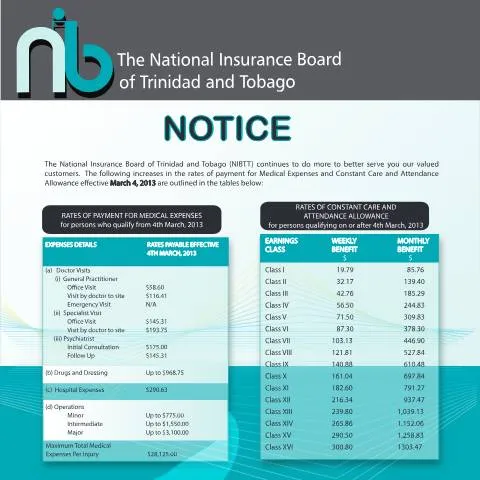
In March 2013, the National Insurance Board of Trinidad and Tobago (NIBTT) announced significant changes to the rates of payment for medical expenses and constant care and attendance allowance. This official document details the newly established rates, which hold substantial importance for both the beneficiaries and the healthcare professionals involved in the social security landscape of Trinidad and Tobago.
The Role of the New Rates in the Framework of Social Security
The adjustments outlined in this document directly impact the financial assistance available to insured individuals seeking medical treatment. The new rates are designed to ensure that beneficiaries receive adequate support for their medical expenses, thereby enhancing their access to necessary healthcare services. These changes reflect the NIBTT's commitment to continuously improving its service delivery and meeting the evolving needs of its clients.
The Connection to the National Insurance Scheme
The National Insurance Scheme serves as the foundation for social security in Trinidad and Tobago. The updated rates for medical expenses play a crucial role in this system by:
- Providing financial support for medical consultations, treatments, and follow-ups
- Ensuring that individuals can access quality healthcare without overwhelming financial burden
- Encouraging timely medical intervention, which can lead to better health outcomes
Unpacking the Document: Key Components of the Rates
To effectively utilize the document, understanding its sections is essential. The main components are categorized into earnings, benefits, and specific expenses. Here is a closer look:
| Class | Weekly Benefit (TTD) | Monthly Benefit (TTD) |
|---|---|---|
| I | 19.79 | 85.76 |
| II | 32.17 | 139.40 |
| III | 42.76 | 185.29 |
| IV | 56.50 | 244.83 |
| V | 71.50 | 309.83 |
| VI | 87.30 | 378.30 |
| VII | 103.13 | 446.90 |
| VIII | 121.81 | 527.84 |
| IX | 140.88 | 610.48 |
| X | 161.04 | 697.84 |
| XI | 182.60 | 791.27 |
| XII | 216.34 | 937.47 |
| XIII | 239.80 | 1,039.13 |
| XIV | 265.86 | 1,152.06 |
| XV | 290.50 | 1,258.83 |
| XVI | 300.80 | 1,303.47 |
Expense Details and Maximum Allowances
The document further breaks down the specific expenses that will be covered under these new rates:
- Doctor Visits:
- General Practitioner Office Visit: TTD 58.60
- Specialist Office Visit: TTD 145.31
- Initial Psychiatrist Consultation: TTD 175.00
- Drugs and Dressing: Up to TTD 968.75
- Hospital Expenses: TTD 290.63
- Operations:
- Minor: Up to TTD 775.00
- Intermediate: Up to TTD 1,550.00
- Major: Up to TTD 3,100.00
The maximum total medical expenses per injury stands at TTD 28,125.00, reinforcing the NIBTT’s responsibility to safeguard the health of its contributors.
The Application Process: From Submission to Outcome
Understanding the procedural pathway is key for effective engagement with the NIBTT regarding claims for medical expenses. The application process follows a structured timeline, from initiation to the final decision.
Initial Steps: Preparing the Necessary Documentation
Before submitting the official form, ensure you have all pertinent documentation ready. This includes:
- Medical reports from healthcare providers
- Itemized receipts for any medical expenses incurred
- Proof of identity, such as a National ID or a passport
Filing the Application
Once the necessary documents are in order, you can proceed to fill in the official form for medical expenses. There are multiple channels available for submission:
- Online Submission: Utilizing the NIBTT’s digital platform can expedite the filing process.
- Physical Submission: Alternatively, you may visit any NIBTT office to submit your application in person.
Regardless of the method chosen, ensure that all information provided on the form is accurate to prevent delays in processing.
The Review Process and Decision Making
After submission, the NIBTT will review your application. This phase includes:
- Verification of documents
- Assessment of the medical necessity of the claimed expenses
- Determination of eligibility based on the new rates
The outcome of your claim will be communicated via your preferred contact method, either through postal mail or electronically if submitted online.
Understanding Historical Context and Regulatory Framework
The evolution of medical expense rates is rooted in the broader context of social security legislation in Trinidad and Tobago. Since the inception of the National Insurance Scheme, adjustments to benefits have been influenced by economic conditions, healthcare costs, and demographic changes.
Legislative Changes and Their Impact
Numerous legislative acts contribute to the framework governing the NIBTT and its operations. Changes in medical rates have typically been instigated by:
- Annual reviews of social security benefits
- Economic assessments that warrant adjustments to align with inflation
- Demands from stakeholders advocating for improved healthcare access
Submission Channels: Online vs Paper Applications
The choice between online and paper applications can significantly influence the overall experience of submitting a claim. Understanding the nuances of each method is vital.
Advantages of Online Submission
- Faster processing times due to automated systems
- Immediate confirmation of receipt
- Reduced likelihood of lost documents
Challenges of Paper Applications
- Longer processing times due to manual handling
- Potential for documents to be misplaced
- Requires physical travel to NIBTT offices
Dissecting the Form: Navigating Potential Pitfalls
While completing the official form for medical expenses, certain sections may pose challenges. A meticulous approach will aid in avoiding common errors.
Key Sections Explained
Each section of the form requires careful attention:
- Personal Information: Ensure your BIR number is correctly entered, as this is critical for identification.
- Medical Expenses: Be thorough in specifying the nature of expenses claimed, adhering closely to the outlined rates.
- Supporting Documents: Double-check that all required documents are included and well-organized to avoid delays in processing.
By understanding the details of the new rates for medical expenses, applicants can navigate the bureaucratic landscape with greater ease and confidence, ensuring that they access the benefits available to them under the National Insurance Scheme.
Understanding the New Medical Expense Rates in Trinidad and Tobago
The announcement of new medical expense rates in Trinidad and Tobago is essential for both taxpayers and healthcare providers. These updated rates reflect the government’s commitment to improving healthcare accessibility and alleviating the financial burdens of medical expenses on citizens. It is crucial for taxpayers to familiarize themselves with the new rates and understand how they can apply these changes to their tax returns effectively.
As of March 2023, the updated rates cover various medical expenses, including hospitalization, outpatient services, and prescription drugs. The changes aim to ensure that taxpayers can deduct eligible medical expenses from their taxable income, thereby reducing their overall tax liability. To effectively utilize these new rates, taxpayers should gather all necessary documentation, including receipts and invoices, to substantiate their claims.
Moreover, it is vital to note that different types of medical expenses may be subject to specific limits and conditions under the current tax laws. For example, while some expenses are fully deductible, others may have certain caps or require pre-approval from the Ministry of Health. It is advisable for taxpayers to consult the latest guidelines published by the Board of Inland Revenue (BIR) to ensure compliance.
Tax Implications of Medical Expenses for Businesses
Businesses in Trinidad and Tobago also need to consider the implications of the new medical expense rates. Employers often provide health benefits to their employees, which can include coverage for medical expenses. Understanding how the new rates affect these benefits is essential for both tax planning and compliance purposes.
For corporate entities, medical expenses incurred on behalf of employees can be treated as tax-deductible expenses, provided they meet the eligibility criteria set by the Ministry of Finance. This can significantly lower a business's tax liability, offering a financial incentive to invest in employee health and wellness programs. Companies should maintain accurate records of all medical benefits provided, ensuring that they are in line with the regulations set forth by the BIR.
Furthermore, businesses that are considering expanding their healthcare offerings may find that the new rates make it more feasible to include comprehensive health plans. This not only boosts employee morale and productivity but also enhances the company's overall competitiveness in the labor market.
How to Prepare for Tax Season with the Updated Medical Expense Rates
As the tax season approaches, it is imperative for both individuals and businesses to prepare adequately for filing their tax returns, especially in light of the new medical expense rates. The process can be simplified by taking proactive measures to organize all relevant documents and ensure compliance with the updated regulations.
The first step is to collect all necessary documentation, including medical receipts, invoices from healthcare providers, and, if applicable, proof of payment for any medical insurance premiums paid. Taxpayers should categorize these expenses to determine which items qualify for deductions based on the latest rates released by the BIR.
Additionally, it is advisable to utilize the online e-Tax portal, which allows taxpayers to submit their medical expense claims electronically. This not only streamlines the submission process but also helps in tracking the status of claims more efficiently. Taxpayers can also access guidelines and FAQs on the BIR’s website, providing clarity on frequently asked questions related to medical expenses and their deductibility.
Finally, seeking the assistance of a qualified tax professional can offer additional insights, particularly for complex cases or for those unsure about how to navigate changes in medical expense rates. A tax advisor can help identify opportunities for additional deductions and ensure that all submissions comply with local tax laws.