Understanding the R&D Claim Form (YA 2019 and onwards) for Singapore Companies
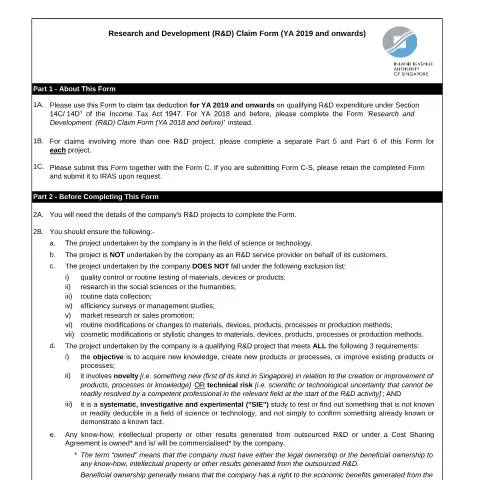
The Research and Development (R&D) Claim Form, identified by the code RND-CLAIM-FORM-YA-2019-N-AFTER, is an official document issued by the Inland Revenue Authority of Singapore (IRAS). This form is essential for companies seeking to claim tax deductions on qualifying R&D expenditures under Sections 14C and 14D of the Income Tax Act 1947. It is part of Singapore’s broader strategy to promote innovation and technological advancement within its business landscape.
Purpose and Scope of the Form
The primary purpose of this form is to enable eligible companies to claim tax deductions for their R&D activities conducted in or outside Singapore. It applies specifically to projects undertaken from the Year of Assessment 2019 onwards. The form captures detailed information about each R&D project, including the nature of activities, ownership rights, and whether the results are being commercially exploited.
It is important to note that this form is only applicable for qualifying R&D activities that involve the creation or improvement of products, processes, or knowledge, and where there is scientific or technological uncertainty or novelty involved. Routine testing, cosmetic modifications, or market research activities are excluded from this claim.
Who Should Fill Out the Form?
The form is intended for companies that have undertaken R&D projects meeting the criteria specified by IRAS. The company must be the owner or beneficial owner of the know-how, intellectual property, or results generated from the R&D activities. Additionally, the project must be in the field of science or technology and not solely for routine or social science research.
If a company has multiple R&D projects, each project requires a separate submission of Part 5 and Part 6 of the form. It is also necessary to submit this form together with the company's Form C or retain it for submission upon IRAS request.
How to Complete the R&D Claim Form
The form is structured into several sections, each capturing specific details about the company and its R&D projects:
- Part 1: Basic information about the company, including trade description, tax reference number, and declaration of the accuracy of the provided data.
- Part 2: Overview of the R&D claim, including the project name, year of assessment, and whether the project is a new or continuation project.
- Part 3: General details such as the project start and completion dates, the nature of the R&D activities, and whether the activities were conducted in-house, outsourced, or under a Cost Sharing Agreement (CSA).
- Part 4: Declaration by authorized personnel affirming the accuracy and ownership of the R&D results, with signatures and dates.
- Part 5: Detailed information about each R&D project, including project name, location, funding sources, and whether the activities involve novelty or technological risk.
It is crucial to provide accurate and comprehensive information to avoid delays or rejection of the claim. For activities conducted overseas, the expenditure must still relate to the company's existing trade or business, and ownership rights must be clearly established.
Supporting Documentation and Submission
While the form itself requires detailed disclosures, companies should also prepare supporting documentation, such as project descriptions, expenditure records, and ownership agreements. These documents may be requested by IRAS to substantiate the claim.
The completed form, along with any supplementary sheets, should be submitted electronically via the IRAS myTax Portal or as instructed. Companies should retain copies of all submissions for their records, as the IRAS may request additional information or clarification.
Common Errors to Avoid
- Failing to distinguish qualifying R&D activities from routine or cosmetic modifications.
- Incorrectly claiming expenditures that do not meet the criteria of scientific or technological uncertainty.
- Omitting details about ownership rights or misrepresenting the ownership of R&D results.
- Submitting incomplete or inconsistent project information, especially regarding project dates and funding sources.
Additional Resources and Support
Companies are encouraged to consult the IRAS e-Tax Guide on "Research and Development Tax Measures," available on the IRAS website, for detailed guidance on qualifying activities and expenditure. For further assistance, IRAS provides contact support via their helpline or through their online portal.
Adhering to the proper procedures and accurately completing the R&D Claim Form ensures that companies can benefit from Singapore’s R&D tax incentives and foster continuous innovation within their operations.