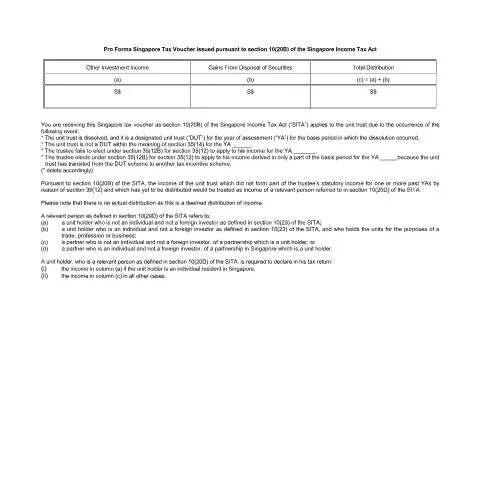
Understanding the Pro Forma Singapore Tax Voucher Issued Pursuant to Section 10(20B) of the Singapore Income Tax Act
The Inland Revenue Authority of Singapore (IRAS) issues the Pro Forma Singapore Tax Voucher under specific circumstances outlined in Section 10(20B) of the Singapore Income Tax Act (SITA). This document plays a crucial role in the taxation process for unit trusts, particularly when certain events lead to deemed distributions of income. This guide aims to clarify the purpose, scope, and implications of this tax voucher for relevant parties involved in unit trust investments and trusts managed within Singapore's tax framework.
Purpose and Legal Basis of the Tax Voucher
The Pro Forma Singapore Tax Voucher is issued to record deemed income distributions resulting from specific events affecting a unit trust. Unlike a traditional distribution, which involves actual transfer of funds to unitholders, this voucher documents a deemed or constructive distribution as stipulated under Section 10(20B) of the SITA. Its primary purpose is to ensure transparency and proper tax reporting by relevant persons, aligning with Singapore’s emphasis on clear and enforceable tax compliance.
This document is issued when a unit trust experiences one of the following events:
- The trust is dissolved and qualifies as a designated unit trust (DUT) for the relevant year of assessment (YA).
- The trust no longer qualifies as a DUT within the meaning of Section 35(14) for a specified YA.
- The trustee fails to make an election under Section 35(12B) for Section 35(12), affecting the trust’s income treatment for the YA.
- The trustee elects under Section 35(12B) to apply Section 35(12) to income derived during part of the basis period due to transitioning from the DUT scheme to another tax incentive scheme.
In these circumstances, the trust’s income that has not been distributed but is deemed to have been distributed is captured through this voucher, ensuring it is included in the relevant person's taxable income.
Scope and Application of the Tax Voucher
Who Receives the Tax Voucher?
The tax voucher is issued to a relevant person as defined in Section 10(20D) of the SITA. This includes:
- A unit holder that is not an individual and not a foreign investor.
- An individual unit holder who is not a foreign investor and holds units for trade, profession, or business purposes.
- A partner in a partnership that is a unit holder, when the partner is not an individual or foreign investor.
- A partner who is an individual, not a foreign investor, in a Singapore-based partnership holding units.
Implications for Relevant Persons
Relevant persons are required to declare the deemed income in their respective tax returns:
- Unit holders who are individuals resident in Singapore must report the income in Column (a).
- All other relevant persons, including non-resident entities and foreign investors, must report the income in Column (c).
This declaration ensures that the income, although not physically distributed, is taxed appropriately under Singapore’s tax laws, maintaining compliance and transparency.
Understanding the Deemed Distribution
The issuance of the tax voucher signifies a deemed distribution of income, which is not an actual transfer of cash or assets. Instead, it reflects the trust’s income that, due to specific legal and tax provisions, is treated as if it has been distributed to unitholders. This approach aligns with Singapore’s tax regime, which emphasizes accurate income recognition and reporting, especially in complex trust and investment structures.
Practical Impact for Trusts and Unitholders
For trustees and unit holders, understanding the implications of this tax voucher is essential for proper tax compliance. Trustees must ensure timely and accurate issuance of the voucher when the triggering events occur. Unitholders, on the other hand, should incorporate the deemed income into their tax filings, even if no actual distribution has taken place.
Failure to account for this income can lead to penalties or discrepancies in tax assessments. Therefore, it is advisable for relevant persons to review the details of the tax voucher carefully and consult with tax professionals if needed.
Conclusion
The Pro Forma Singapore Tax Voucher issued pursuant to Section 10(20B) of the SITA serves as a critical instrument for maintaining compliance with Singapore’s tax regulations concerning trusts and unit trusts. It ensures that deemed income is appropriately recognized and reported, fostering transparency and fairness in the taxation process. Both trustees and relevant persons should understand the circumstances under which this voucher is issued and the corresponding reporting obligations to uphold Singapore’s commitment to a robust and clear tax system.