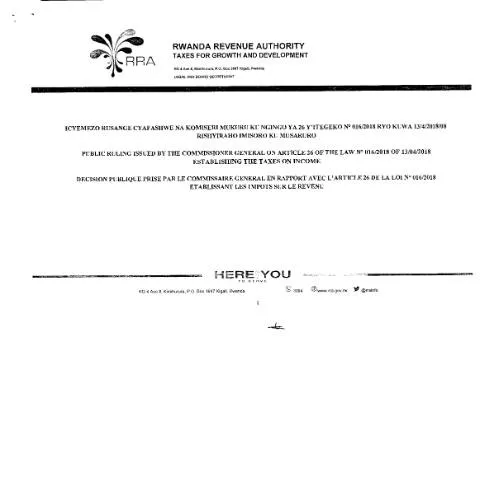
Understanding the Ruling on Article 26 of the Law on Income Tax in Rwanda
The official document titled "CG Ruling on Article 26 of the Law on Income Tax" issued by the Rwanda Revenue Authority (RRA) provides essential guidance for taxpayers and tax professionals regarding the application of specific provisions within Rwanda's income tax legislation. This ruling clarifies how certain management, technical, and royalty fees are to be treated under the law, ensuring clarity and consistency in tax compliance and enforcement.
Scope and Object of the Ruling
This ruling specifically addresses the interpretation and application of Article 26(1) of Law No. 016/2018 of April 13, 2018, which pertains to the taxation of management, technical, and royalty fees paid to non-resident persons. The primary objective is to determine whether these payments are subject to income tax and under what conditions they qualify as deductible expenses for the payer. The document aims to provide a legal and procedural framework to guide taxpayers, tax authorities, and other stakeholders in understanding their obligations and rights concerning these types of payments.
Main Provisions and Interpretations
Application of Article 26(1) of the Law
The ruling confirms that payments classified as management, technical, or royalty fees paid to non-resident entities are subject to the provisions of Article 26(1). These payments are considered as income for the recipient and, consequently, may be subject to withholding tax at the source, depending on the specific circumstances and applicable tax treaties.
Scope of Deductibility
One critical aspect clarified by this ruling is the treatment of these fees as deductible expenses for the payer. It emphasizes that such expenses are deductible only if they are properly supported by documentation and are related to income-generating activities. The ruling also specifies that the expenses must be reasonable, justifiable, and in accordance with the principles of transfer pricing and arm’s length standards.
Interpretation of Management, Technical, and Royalties Fees
The document further elaborates on what constitutes management, technical, and royalty fees. Management fees refer to payments for administrative and managerial services; technical fees cover payments for specialized technical services; and royalty fees involve payments for intellectual property rights, patents, trademarks, or copyrights. The ruling stresses that these payments should be clearly documented, with appropriate contractual agreements specifying the nature and amount of the fees.
Implications for Taxpayers and Stakeholders
This ruling provides valuable guidance for both domestic and international companies operating in Rwanda. It underscores the importance of maintaining accurate documentation and adhering to transfer pricing regulations to ensure that management, technical, and royalty payments are correctly reported and taxed. For non-resident service providers, it clarifies the circumstances under which their income will be taxed in Rwanda and the obligations of the payer to withhold and remit taxes accordingly.
Furthermore, the ruling aims to promote transparency and fairness in tax administration by establishing clear criteria for the deductibility of these expenses. It encourages taxpayers to align their practices with legal requirements, thereby reducing disputes and potential penalties during tax audits.
Legal and Administrative Context
Issued in accordance with the legal framework established by Law No. 22/2018, this ruling aligns with Rwanda's broader efforts to modernize tax laws and improve compliance through clear guidance. It complements other regulations issued by the Rwanda Revenue Authority and is accessible via the official channels, including the Irembo platform, for ease of reference by taxpayers and practitioners.
In summary, the CG ruling on Article 26 of the Law on Income Tax is an essential document that clarifies the application of specific provisions related to management, technical, and royalty fees paid to non-residents. It emphasizes proper documentation, adherence to transfer pricing standards, and compliance with tax obligations, thereby fostering a transparent and predictable tax environment in Rwanda.