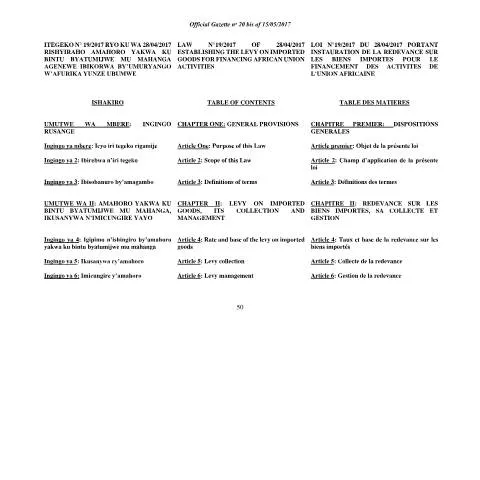
Understanding the Law Establishing the Levy on Imported Goods for Financing African Union Activities in Rwanda
The Law No. 19/2017, enacted on April 28, 2017, and published in the Official Gazette No. 20 bis of May 15, 2017, represents a significant legal framework in Rwanda aimed at supporting the African Union’s initiatives. This law introduces a specific levy on imported goods, with the primary objective of generating revenue to finance activities undertaken by the African Union (AU). It is a crucial piece of legislation that aligns Rwanda’s trade policies with continental development goals and demonstrates the country's commitment to regional integration and cooperation.
Scope and Purpose of the Law
The law explicitly establishes a levy on all imported goods, with the exception of goods that are legally exempted under specific laws. Its overarching purpose is to contribute financially to the activities of the African Union, which include peacekeeping missions, development programs, and political integration efforts across member states. By imposing this levy, Rwanda ensures that part of its international trade contributes directly to the continent's collective development initiatives.
Key Definitions and Legal Framework
Definitions of Core Terms
- Levy: A fee paid on imported goods intended to support the activities of the African Union.
- Goods: Both tangible and intangible property, excluding cash and monetary instruments, that are imported into Rwanda.
Legal Basis and Application
This law applies universally to all goods imported into Rwanda, establishing a clear legal basis for customs authorities to collect the levy. It does not apply to goods that are exempted by other legislation, such as essential goods or those for diplomatic purposes, ensuring targeted and efficient revenue collection for AU activities.
Implementation and Management of the Levy
Rate and Calculation
The law specifies that the levy is to be calculated based on a percentage of the customs value of the imported goods. Although the exact rate is not detailed here, it is determined by the relevant authorities and aligned with Rwanda’s trade and fiscal policies. The calculation is integrated into the customs declaration process, simplifying compliance for importers.
Collection and Oversight
The Rwanda Revenue Authority (RRA) is tasked with the collection and management of this levy. The authority ensures that the process is transparent, efficient, and in accordance with the legal provisions. Revenues collected are then allocated to fund African Union activities, contributing to the continent’s broader development agenda.
Legal and Administrative Provisions
The law includes provisions for the drafting, consideration, and adoption process, emphasizing transparency and adherence to legal procedures. It also establishes mechanisms for the repeal of any conflicting laws, ensuring consistency within Rwanda’s legal framework. The law officially came into force upon its publication, marking the beginning of its implementation in facilitating Rwanda’s contribution to African Union initiatives.
Implications for Importers and Trade Practitioners
For importers operating in Rwanda, this law means that any imported goods will be subject to an additional levy aimed at supporting continental development projects. Customs procedures will incorporate the calculation and collection of this levy, which is a legal obligation. Importers should stay informed about the applicable rates and exemptions to ensure compliance and avoid penalties.
Conclusion
The law establishing the levy on imported goods for financing African Union activities underscores Rwanda’s commitment to regional integration and development. By legally mandating a contribution from international trade, Rwanda not only supports the AU’s mission but also demonstrates leadership in fostering continental solidarity. The efficient management of this levy by the Rwanda Revenue Authority ensures that the funds are effectively channeled towards meaningful projects that benefit the entire African continent.