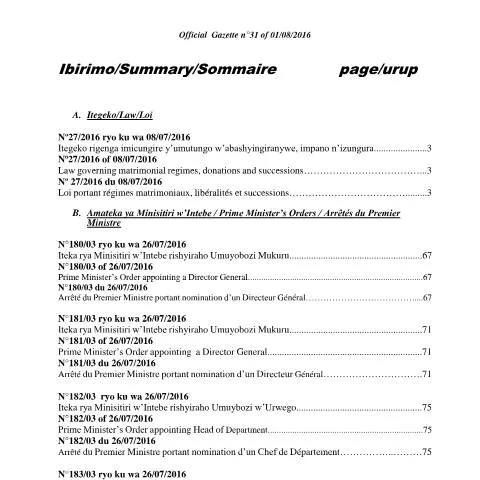
Overview of the Law on Matrimonial Regimes, Donations, and Successions in Rwanda
The law titled "Law governing matrimonial regimes, donations, and successions," officially published in the Official Gazette No. 31 of August 1, 2016, establishes the legal framework for managing property, donations, and inheritance rights within the context of Rwandan marriage and family law. This legislation aims to clarify the modes of property management between spouses, regulate donations, and define succession procedures, thereby ensuring legal certainty and protection for individuals and families.
Legal Context and Objectives
The law is rooted in Rwanda's legal system, particularly under Law No. 22/2018 relating to the Civil, Commercial, Labour, and Administrative Procedures. Its primary purpose is to regulate the management of property acquired during marriage, the conditions under which donations are made, and the procedures governing inheritance upon death. By providing clear definitions and rules, the law seeks to promote equitable property management, protect spouses' rights, and facilitate transparent succession processes.
Scope and Key Provisions of the Law
Definitions and Basic Concepts
The law begins by defining essential terms, including what constitutes a matrimonial regime, donations, and succession. It distinguishes between different types of matrimonial regimes, notably the community of property and separate property systems, each with specific management rules and implications for spouses.
Matrimonial Regimes
The legislation recognizes several matrimonial regimes, with the community of property being the most prominent. Under this regime, all assets acquired during the marriage are considered joint property, managed collectively by both spouses. The law specifies how these assets are to be managed, how debts are paid, and the procedures for dividing property in case of separation or divorce.
- Community of Property Regime: All assets and liabilities acquired during marriage are shared equally, unless otherwise stipulated in a marriage contract.
- Separate Property Regime: Assets acquired before marriage or through inheritance remain individual property, with specific rules for management and division.
Management of Property and Debts
In the community of property regime, spouses jointly manage their assets, with each having equal rights and responsibilities. The law details the procedures for managing property, paying debts, and handling financial obligations, emphasizing transparency and mutual consent.
In the case of separate property regimes, each spouse retains control over their assets, with specific provisions for managing inherited property or assets acquired before marriage.
Donations and Succession
The law also addresses donations, detailing the conditions under which donations can be made between spouses or to third parties, and the legal effects thereof. Regarding succession, the law establishes procedures for inheritance, prioritizing the surviving spouse and heirs, and ensuring the proper transfer of assets according to legal principles.
It emphasizes the importance of proper documentation and legal formalities to validate donations and inheritance claims, aligning with other national legal provisions.
Fill in your form directly online
No printing: type your details into the boxes of the official form, tick, then download the PDF ready to send.
- 1Type into the form boxes
- 2Tick in one click
- 3Save and download the PDF
Legal Framework and Implementation
This legislation is part of Rwanda's broader legal system, aligning with the Civil Code and other relevant laws governing family, property, and inheritance. Its implementation is overseen by competent authorities, including the Ministry of Local Governance (MINALOC) and the judiciary, with particular attention to ensuring compliance and protecting the rights of all parties involved.
The law encourages the use of digital platforms, such as Irembo, to facilitate access to legal procedures related to property management, donations, and succession, promoting transparency and citizen convenience.
Conclusion
The Law No. 27/2016 of July 8, 2016, provides a comprehensive legal framework for managing matrimonial property, donations, and inheritance in Rwanda. By clearly defining regimes, management procedures, and legal formalities, it aims to promote fairness, protect individual rights, and streamline legal processes in family and property matters. Citizens are encouraged to consult legal professionals and utilize available online services to ensure compliance and safeguard their rights under this legislation.