Understanding the Law on Matrimonial Regimes, Donations, and Successions in Rwanda
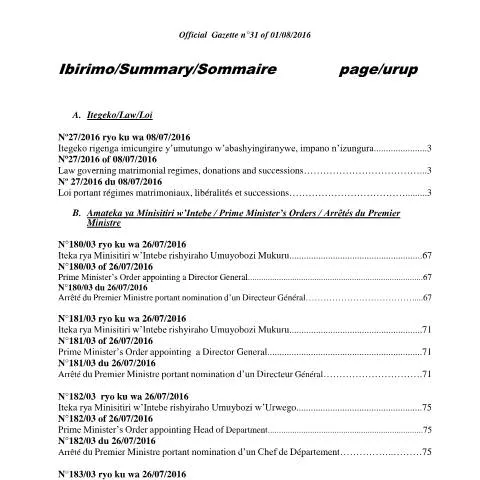
The Law No. 27/2016, enacted on July 8, 2016, and published in the Official Gazette n°31 of August 1, 2016, provides a comprehensive legal framework governing matrimonial regimes, donations, and successions in Rwanda. This law aims to regulate the management of property within marriage, clarify the legal status of donations and inheritance, and protect the rights of spouses and heirs under Rwandan law.
Scope and Purpose of the Law
This law applies to all married persons in Rwanda, regardless of their religion or customary practices, and sets out the legal principles for managing marital property, donations, and successions. Its primary objective is to establish clear rules to prevent disputes and ensure equitable treatment of spouses and heirs in matters of property transfer and inheritance.
Legal Definitions and Key Concepts
The law defines several key terms essential for understanding its provisions:
- Matrimonial regime: The legal system that governs the management and ownership of property between spouses during marriage and upon its dissolution.
- Donation: A voluntary transfer of property made during the lifetime of the donor, which can be either inter vivos or mortis causa.
- Succession: The process of transferring property from a deceased person to their heirs, either according to the law or a will.
Matrimonial Regimes Provided by the Law
1. Community of Property Regime
This regime presumes that all property acquired during the marriage is jointly owned by both spouses, regardless of whose name is on the title. The management of this shared property is governed by specific rules, and debts incurred during marriage are generally the joint responsibility of both spouses.
Management and Responsibilities
Under this regime, spouses are jointly responsible for managing the community property. Decisions regarding the disposition or sale of shared assets typically require mutual consent, and debts are paid from the communal estate unless otherwise specified.
2. Separate Property Regime
Alternatively, spouses may opt for a regime where each maintains ownership and management over their individual property acquired before or during the marriage, unless they agree otherwise. This regime emphasizes independence and individual control over assets.
Legal Implications for Spouses and Heirs
1. Effect on Property Management
The law clarifies how property is to be managed, whether under the community of property or separate property regime. It specifies procedures for handling joint assets, debts, and the division of property upon divorce or death.
2. Succession and Inheritance
In matters of succession, the law stipulates the rights of heirs, including spouses, children, and other relatives. It provides guidelines on how estate assets are to be distributed, whether through intestate succession or according to a valid will.
Fill in your form directly online
No printing: type your details into the boxes of the official form, tick, then download the PDF ready to send.
- 1Type into the form boxes
- 2Tick in one click
- 3Save and download the PDF
Impact on Citizens and Legal Practitioners
This law significantly influences how Rwandans manage their property rights within marriage and in inheritance cases. It promotes transparency, legal certainty, and fairness in property dealings. Citizens are encouraged to be aware of their rights and obligations under this legal framework, especially when planning marriages, making donations, or preparing for succession.
Utilizing Digital Platforms for Legal Procedures
While the law itself sets out the legal principles, the Rwandan government facilitates access to related services via digital platforms such as Irembo. Citizens can find information, access legal forms, and initiate procedures related to matrimonial regimes, donations, and successions online, ensuring convenience and efficiency.
Conclusion
The Law No. 27/2016 on matrimonial regimes, donations, and successions provides a structured legal approach to managing property rights in Rwanda. It aims to protect spouses' and heirs' interests while promoting clarity and fairness in property transactions and inheritance. Citizens, legal practitioners, and institutions are encouraged to familiarize themselves with its provisions to ensure compliance and safeguard their rights within the evolving legal landscape of Rwanda.