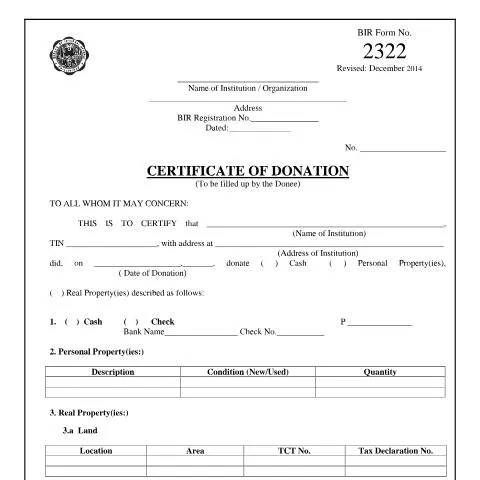
The BIR Form No. 2322: Understanding the Certificate of Donation
In the realm of charitable giving and philanthropy in the Philippines, the importance of proper documentation cannot be overstated. The Certificate of Donation, formally known as BIR Form No. 2322, serves as a crucial instrument for both donors and donees. This official certificate not only validates the act of donation but also facilitates the deductibility of such contributions from the donor's gross income, thereby promoting charitable activities within the country.
Unlocking the Value of the Certificate of Donation
The legal standing of the Certificate of Donation is particularly noteworthy. It attests to the transfer of ownership of cash, personal property, or real estate from the donor to the donee. This document provides essential details regarding the nature of the donated items, ensuring transparency and accountability in charitable transactions.
The Legal Implications
The Certificate of Donation carries significant legal weight. Under the Administrative Code of 1987, specifically in the provisions governing administrative procedures, the document serves as an official record of the donation. In cases of disputes or verification, this certificate can be referenced to authenticate the donation, making it indispensable for both parties involved.
Tax Benefits for Donors
For donors, the Certificate of Donation is not just a regulatory form; it can also translate into tangible financial benefits. According to the Bureau of Internal Revenue (BIR) guidelines, donations that are properly documented can be deducted from the donor's gross income. This can lead to substantial tax savings, depending on the value of the contribution.
The valuation of donated items is critical; the BIR stipulates that the deductibility amount should be derived from the net book value of the assets as they appear in the donor's financial statements. The donor must ensure that the values declared are accurate and supported by appropriate documentation, such as the Deed of Sale or a sworn statement regarding the net book value.
Getting Your Hands on the BIR Form No. 2322
Acquiring the Certificate of Donation is a methodical process, requiring the collaboration of both the donor and the donee. Primarily, the donee fills out the first page of the BIR Form No. 2322, including critical elements such as the institution’s name, address, and Tax Identification Number (TIN).
Step-by-Step Guide to Obtaining the Certificate
- Initiate the Donation Process: The donor identifies the items to be donated and agrees with the donee on the specifics.
- Complete the Required Documentation: The donee fills out the first page of BIR Form No. 2322, detailing the donation's nature, including cash, personal property, or real property.
- Valuation of Donation: The donor completes the second page, providing details of the valuation of the donation. This includes the acquisition cost, depreciation, and net book value for each item being donated.
- Sign and Date the Document: Both parties must sign the form, and it must be dated accurately to reflect the transaction's timing.
- Distribution of Copies: The original copy goes to the donor, while a duplicate is submitted to the Bureau of Internal Revenue (BIR), and a triplicate is retained by the donee.
Who Can Obtain a Certificate of Donation?
While theoretically any individual or organization can participate in donation activities, the issuance of the Certificate of Donation is generally reserved for institutions and entities under the auspices of the BIR. This includes:
- Non-Profit Organizations: Charitable institutions that are recognized by the government and have the authority to receive tax-deductible donations.
- Educational Institutions: Schools and universities that qualify as non-profit entities can issue and receive donations.
- Hospitals and Health Institutions: Non-profit hospitals can document donations for medical supplies, equipment, and other resources.
- Religious Organizations: Places of worship that are duly registered and recognized as charitable entities.
The donee must ensure that they possess a valid BIR registration number, which signifies their official capacity to receive donations.
Real-World Applications of the Certificate of Donation
The Certificate of Donation is increasingly recognized across various sectors within the Philippines. It plays a vital role in numerous contexts, such as:
- Tax Returns: Donors often utilize the certificate when filing their annual tax returns, particularly around the deadlines set by the BIR, which is usually on April 15 each year.
- Audits and Financial Statements: Organizations may need to present the Certificate of Donation during financial audits to validate their income sources or demonstrate community involvement.
- Funding and Grants: Non-profits seeking further funding or grants may be required to provide documentation of past donations as proof of their community support and financial management.
- Corporate Social Responsibility (CSR): Businesses that engage in CSR activities often utilize the Certificate of Donation to substantiate their contributions and improve their public image.
What Happens in Cases of Loss or Errors?
Given the importance of the Certificate of Donation, any loss or error in its details can pose significant challenges for both donors and donees.
Steps to Take in Case of Loss
If the original Certificate of Donation is lost, the following steps should be taken:
- File a Report: Report the loss to the local police station to create a legal record, which could be beneficial if disputes arise.
- Notify the BIR: Contact the Bureau of Internal Revenue to inform them of the loss. They may have specific procedures for reissuing or documenting the loss.
- Obtain Duplicate Copies: If the donee has recorded the transaction, they may issue a duplicate certificate, although this may require additional verification from the BIR.
Addressing Errors in the Document
In cases where there are errors in the Certificate of Donation, it is vital to act quickly:
- Identify the Error: Determine whether the error is in the donee's information, donor's details, or the valuation.
- Correct the Information: Both parties should agree on the corrections and reissue the document if necessary.
- Submit Corrections to the BIR: Notify the Bureau of Internal Revenue to ensure that their records align with the corrected Certificate of Donation.
Understanding the Validity Period
The validity of the Certificate of Donation is another aspect that both donors and donees should consider. While the document itself does not have an expiration date, it is crucial to maintain accurate records, especially during tax assessments or audits.
Maintaining Proper Records
To comply with tax regulations and ensure the proper deductibility of donations, it is advisable for donors to retain the following:
- Original Copy of the Certificate: This should be kept in a secure location.
- Supporting Documents: All relevant documents, such as the Deed of Sale or any financial statements used for valuation, must be readily available.
- Transaction Records: Detailed notes regarding the transaction, including communication between the donor and donee, are beneficial for future reference.
A Tool for Encouraging Philanthropy
The BIR Form No. 2322, as the Certificate of Donation, is more than a mere formality; it is a tool designed to foster a culture of giving and support within the Philippines. By providing clear benefits and legal recognition for donations, the BIR encourages individuals and organizations to contribute to societal betterment.
As philanthropy continues to evolve in the Philippines, understanding and utilizing the Certificate of Donation effectively becomes paramount. By following the proper procedures, maintaining accurate records, and recognizing the associated benefits, donors and donees alike can ensure that their contributions have lasting impacts on the communities they serve.
Final Thoughts: Leveraging the Certificate of Donation for Greater Impact
The potential for positive change through charitable giving is immense, and the Certificate of Donation serves as a vital link between generosity and tax benefits. Whether you are a seasoned donor or a new non-profit organization, familiarizing yourself with BIR Form No. 2322 is essential in maximizing the impact of your charitable endeavors. By adhering to the guidelines and properly documenting each donation, not only do you comply with regulations, but you also contribute to a culture of accountability and transparency in the philanthropic sector.
Understanding BIR Form No. 2322: Certificate of Donation in the Philippine Tax System
The BIR Form No. 2322, also known as the Certificate of Donation, is an essential document that serves as proof of donations made, particularly to charitable institutions or non-profit organizations. This form is crucial for both the donor and the recipient as it provides necessary information about the contributions, allowing for tax compliance and potential deductions. Understanding the nuances of this form can significantly benefit both parties involved.
The Certificate of Donation must be accomplished by the donor and submitted to the Bureau of Internal Revenue (BIR) to ensure that the donation is properly recorded. It is important to note that this form is not only relevant for monetary contributions but also for donations in kind, which can include properties, goods, or services. The valuation of these donations, along with the supporting documentation, must adhere to the standards set forth by the BIR, ensuring accuracy and compliance with the Philippine tax code.
Eligibility Criteria for Donors and Donees
Before proceeding with the completion of BIR Form No. 2322, it is essential to understand the eligibility criteria for both donors and donees. The qualifications for donors typically include individuals, corporations, or partnerships that are recognized by the BIR and are compliant with tax obligations. On the other hand, donees must also meet the requirements set by the BIR to ensure that they are legitimate charitable institutions or organizations.
To be considered eligible, donees must be registered with the Securities and Exchange Commission (SEC) or the Department of Social Welfare and Development (DSWD) as non-profit organizations. They must also be listed in the BIR’s Database of Donees. This ensures that donations to these entities qualify for potential tax deductions under the National Internal Revenue Code (NIRC). Donors should meticulously verify the registration status of the donee organization prior to making any contributions, to ensure compliance with the relevant laws and regulations.
Documentation Required for Submission of BIR Form No. 2322
Filing BIR Form No. 2322 necessitates the preparation of specific supporting documents which serve as proof of the donation. These documents aid in substantiating the claim of the donor and facilitate the validation process by the BIR. The following items are typically required:
- Proof of Donation: This includes any contracts, receipts, or letters of acknowledgment from the donee confirming the receipt of the donation. For cash donations, bank transaction records may also be necessary.
- Donee's Registration Documents: A copy of the donee's SEC or DSWD registration certification is essential to demonstrate that the organization is legitimate and recognized by the authorities.
- Tax Identification Number (TIN): Both the donor and donee should include their respective TINs on the form to facilitate the proper recording of the transaction within the BIR’s system.
- Valuation Reports (for non-cash donations): When donating properties or goods, a valuation report from a certified appraiser or a credible third party may be required to substantiate the fair market value of the donated item.
By preparing these documents in advance, both donors and donees can streamline the filing process, minimizing delays and potential complications with the BIR. Ensuring compliance with these requirements is vital for receiving tax benefits and maintaining proper records.