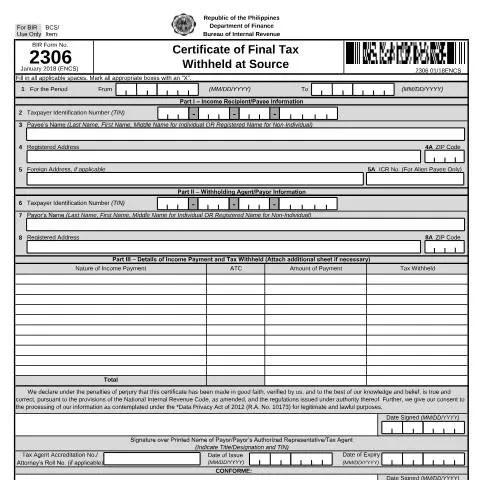
Navigating the BIR Form No. 2306: Understanding Its Significance
The BIR Form No. 2306, officially known as the Certificate of Final Tax Withheld at Source, serves as a crucial document for individuals and entities involved in tax transactions in the Philippines. This certificate is a testament to the final withholding tax deducted by the payor on income payments made to the payee. Its implications extend far beyond simple compliance; it plays a pivotal role in establishing tax credibility and ensuring the efficient processing of tax-related obligations.
Who Qualifies for the BIR Form No. 2306?
The criteria for obtaining the BIR Form No. 2306 are explicit, with distinct categories based on the residency and nature of the income recipient. Both citizens and non-resident aliens engaged in trade or business within the Philippines may qualify, but specific conditions must be met:
- Citizens and Resident Aliens: These individuals must be involved in taxable income activities, ensuring that the income source is compliant with Philippine tax laws.
- Non-Resident Aliens: This category is divided into two.
- Engaged in Trade or Business: Must demonstrate that income is derived from sources within the Philippines.
- Not Engaged in Trade or Business: Typically has different withholding tax implications.
- Income Payment Types: The certificate applies to various types of income, including but not limited to dividends, interest, and royalties.
The Legal Standing of the BIR Form No. 2306
Legally, the BIR Form No. 2306 carries significant weight. It serves as proof that the withholding agent (the party making the payment) has deducted the appropriate final tax from the income paid to the payee. This certificate is essential for the following reasons:
- Tax Compliance: It demonstrates compliance with the National Internal Revenue Code, providing the payee with necessary documentation to file tax returns.
- Avoiding Double Taxation: The form ensures that the payee is not taxed again on income that has already had taxes withheld, protecting the rights of the taxpayer.
- Official Record: It serves as an official record of taxation for both the payor and payee, which can be critical in case of audits.
Step-by-Step Process to Obtain the BIR Form No. 2306
Acquiring the BIR Form No. 2306 requires a systematic approach, ensuring that all necessary steps are followed accurately. Below is a detailed outline of the procedure:
- Determine Eligibility: Ensure you meet the requirements outlined above based on your residency and the nature of your income.
- Gather Required Documents: The following documentation is typically required:
- Taxpayer Identification Number (TIN)
- Payee’s complete name and registered address
- Payor’s details, including TIN and address
- Details of income payment, including the nature of income and tax withheld
- Fill Out the Form: Complete the BIR Form No. 2306 accurately, ensuring that all applicable fields are filled in, including dates and amounts.
- Submit the Form: Submit the completed form to the Bureau of Internal Revenue (BIR) via designated submission points, including online platforms where applicable.
- Receive Confirmation: Upon submission, ensure you obtain a stamped copy or confirmation receipt as proof of submission.
Duration and Validity of the BIR Form No. 2306
The BIR Form No. 2306 does not have an explicit expiration date; however, it is tied to specific transactions and should be retained for a minimum period. Here are some key points regarding its validity:
- Retention Period: It is advisable to keep the certificate for at least five years, aligning with the BIR's audit period.
- Renewal Considerations: Should the same income payment situation occur again, a new Form No. 2306 must be issued for each taxable event.
- Updates on Personal Information: If there are any changes in the payee’s information, a new certificate reflecting these changes must be obtained.
Addressing Issues: Loss, Errors, and Disputes
In the event of loss, errors, or disputes related to the BIR Form No. 2306, it is vital to take immediate action to rectify the situation:
What to Do in Case of Loss
- Report the Loss: Inform the BIR immediately and provide details regarding the original form.
- Request a Replacement: Submit a formal request for a replacement, including any necessary identification and supporting documents.
Handling Errors on the Form
- Notify the BIR: If an error is detected, promptly notify the BIR to address the mistake.
- Correction Process: Follow the BIR's guidelines to amend the form, which may involve submitting a correction form alongside the original.
Disputes Related to Tax Withholding
- Gather Documentation: Collect all relevant documents supporting your claim, including receipts and prior certificates.
- Formal Dispute Resolution: Initiate a formal dispute process through the BIR, which may include filing an appeal or requesting a review.
The Broader Context of the BIR Form No. 2306 Within Philippine Taxation
The BIR Form No. 2306 plays a vital role not only on an individual level but also within the larger framework of the Philippine tax system. Its integration with various tax revenue mechanisms influences how the government collects and manages tax income:
- Part of a Larger Compliance Structure: Understanding Form 2306 is integral to grasping the broader compliance requirements that taxpayers must navigate in the Philippines.
- Facilitating Government Revenue: The efficient processing of this certificate assists the government in accurate tax collection and revenue forecasting.
- Encouraging Taxpayer Responsiveness: The issuance of this certificate encourages taxpayers to remain compliant, as it offers transparency in transactions.
Conclusion: The Importance of the BIR Form No. 2306 in Tax Compliance
In summary, the BIR Form No. 2306 is a vital document that encapsulates the essence of compliance, authority, and tax transparency within the Philippine tax system. Its accurate acquisition and utilization not only benefit individual taxpayers but also contribute to the overall integrity of the revenue collection system. Being well-informed about the form's requirements, processes, and implications is essential for anyone engaging in financial transactions within the legal framework of the Philippines.
Understanding BIR Form No. 2306: Purpose and Importance
BIR Form No. 2306, also known as the Certificate of Final Tax Withheld at Source, plays a pivotal role in the Philippine taxation system. This certificate signifies that a certain amount has been withheld from an individual's or entity's income as a final tax. The withholding tax is an essential mechanism as it ensures tax compliance and maintains a steady revenue stream for the government.
This form serves multiple purposes: it is a proof of payment for taxpayers, a critical document during audits, and a necessary requirement for various transactions such as loan applications and other financial dealings. When taxpayers receive this certificate from their employer or any withholding agent, it becomes integral in their tax reporting and filing processes. Understanding its purpose and importance underlines the necessity for both businesses and individuals to accurately account for their tax obligations.
Who is Obligated to Issue and Receive BIR Form No. 2306?
Understanding who is responsible for issuing and receiving BIR Form No. 2306 is essential for compliance with tax regulations. Employers and certain withholding agents are mandated to issue this certificate to their employees or payees from whom they have withheld taxes. This includes corporations, partnerships, or any business that makes payments subject to withholding tax. The law requires that this form be issued to ensure transparency and accountability in the collection of taxes.
On the other side, the recipients of BIR Form No. 2306 include employees, independent contractors, or any individuals and entities that have received income subject to withholding tax. It is crucial for these recipients to collect and retain their copies of the certificate, as they will need it for filing their annual income tax returns and verifying their tax payments with the Bureau of Internal Revenue (BIR).
Common Issues and Challenges in Filing BIR Form No. 2306
Filing BIR Form No. 2306 can present several challenges for both issuers and recipients. One common issue is the accuracy of the information contained within the certificate. Incorrect details, such as mismatched Tax Identification Numbers (TIN) or incorrect income amounts, can lead to complications, including delays in tax filings or issues during audits. To mitigate such challenges, it is essential for both parties to communicate clearly and verify all information before finalizing the form.
Another challenge arises from the compliance requirements set forth by the BIR. With the constant updates to tax laws and regulations, keeping abreast of the latest requirements for filing BIR Form No. 2306 can be daunting. Failure to comply with these regulations can result in penalties or additional scrutiny from tax authorities. Taxpayers should consider seeking assistance from tax professionals to ensure they are meeting all necessary compliance obligations and to help navigate any complexities in filing.