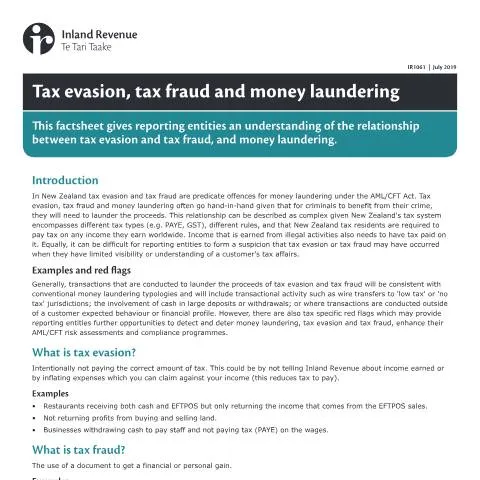
Understanding the IR1061: Tax Evasion, Tax Fraud, and Money Laundering
The IR1061 form is a critical document within New Zealand's tax framework, aimed at combating the complex issues of tax evasion, fraud, and money laundering. As outlined in the Anti-Money Laundering and Countering Financing of Terrorism (AML/CFT) Act, these offences are not merely isolated issues but are deeply intertwined with the financial integrity of our tax system. Understanding this form is essential for reporting entities, as well as anyone involved in managing tax-related obligations.
The Legislative Framework Behind IR1061
The foundation of the IR1061 form is rooted in New Zealand's commitment to uphold tax compliance and to identify illicit activities that endanger the financial system. Tax evasion and fraud are identified as predicate offences under the AML/CFT Act, meaning they are precursors to money laundering. This relationship is crucial for understanding how tax compliance is monitored. The Official Information Act 1982 and the Plain Language Act 2022 also guide the transparency and accessibility of information related to this form’s processes.
Historical Context
The formal recognition of tax evasion and tax fraud as significant issues in New Zealand has evolved over decades. Historically, the introduction of various tax reforms aimed to close loopholes that allow for tax evasion and fraudulent activities. Awareness campaigns and enforcement measures have made it clearer that failing to report income accurately, regardless of its source, is subject to penalties.
Navigating the IR1061: A User's Guide
Completing the IR1061 form necessitates careful preparation and an understanding of the specific requirements involved. Reporting entities must be aware of the documentation necessary for a successful submission.
Preparation: Documentation and Evidence
Prior to filling out the IR1061, it is vital to gather all relevant documents. These can vary depending on the nature of the case. Here are some essential categories:
- Financial Records: Bank statements, transaction records, and invoices.
- Income Sources: Documentation of all income streams, including those that may be informal or cash-based.
- Client Information: Know Your Customer (KYC) documentation to verify client identity and source of funds.
By categorizing records beforehand, you can effectively address the complexities of your tax situation and ensure that no critical detail is overlooked.
Diving into the IR1061: Key Sections Explained
The IR1061 form itself comprises various sections, each addressing critical aspects of tax evasion and fraud reporting. Understanding the nuances of these sections can prevent common pitfalls.
Section Breakdown
| Section | Description | Common Issues |
|---|---|---|
| Personal Details | Identification information of the reporting entity. | Missing information can lead to processing delays. |
| Income Reporting | Details about all income sources, including illicit activities. | Underreporting or misrepresentation is a serious offence. |
| Transaction Details | Comprehensive transaction descriptions. | Vague descriptions can raise suspicions. |
| Client Background | Information on clients linked to reported transactions. | Inadequate KYC can lead to compliance issues. |
Each section is designed to provide clarity and detail, ensuring that reporting entities meet their obligations without exposing themselves to further scrutiny.
Methods of Submission: Online vs. Paper
When it comes time to submit the IR1061, the method of submission can greatly influence processing times and follow-up requirements. Understanding these methods is crucial for efficiency.
Online Submission
Online submission is encouraged for its speed and convenience. The IRD portal allows for direct and immediate filing, and users can track the progress of their submissions. This digital approach aligns with New Zealand's strong emphasis on enhancing online services.
Paper Submission
For those who prefer traditional methods, a paper submission is still an option. However, this can often lead to longer processing times. If you choose this route, ensure that you send the documents to the correct address, as misdirected submissions can cause significant delays.
Identifying the Right Profile for Reporting
The IR1061 is particularly relevant for a diverse range of reporting entities and individuals. Understanding who is impacted can help tailor your approach to compliance.
Profiles of Concern
- Businesses with Cash Transactions: Sectors such as hospitality or retail often face scrutiny due to the high volume of cash transactions.
- Real Estate Entities: Those involved in property transactions may encounter tax evasion tactics through underreporting profits.
- Freelancers and Contractors: Individuals working in informal settings must be vigilant regarding undeclared incomes.
Each of these profiles carries unique challenges and risks, and being aware of them allows for better preparation and compliance.
Post-Submission: What Happens Next?
After submitting the IR1061, it is essential to understand the next steps in the process. The IRD undertakes rigorous reviews of all submitted forms, and depending on findings, several outcomes can occur.
Follow-Up and Potential Outcomes
- Additional Information Requests: The IRD may reach out for more details, especially if there are concerns about accuracy.
- Investigation: In certain cases, if there is a suspicion of criminal activity, the case could be referred to law enforcement.
- Assessment Notices: If discrepancies are found, the IRD will issue an assessment notice outlining owed taxes and penalties.
Being prepared for these outcomes can help mitigate risks associated with investigations and penalties, ensuring that you remain compliant in the eyes of the law.
Distinguishing the IR1061 from Related Forms
The IR1061 is often confused with other forms related to tax reporting and compliance. Understanding its unique purpose helps in accurately fulfilling your obligations.
Key Differences
- IRD Forms for Standard Tax Returns: These forms focus on regular income reporting without the specific emphasis on evasion or fraud.
- AML Compliance Forms: While these also deal with illicit activities, they do not directly address tax obligations.
- Specific Reporting Forms: Other forms may focus on particular tax types (e.g., GST or income tax) but lack the comprehensive scope of the IR1061 regarding both tax fraud and money laundering.
Recognizing these distinctions is paramount to ensure you are using the correct forms for your specific circumstances.
Looking Ahead: The Role of Compliance in New Zealand's Financial Landscape
As New Zealand continues to strengthen its regulatory framework against tax evasion and fraud, forms like the IR1061 play a pivotal role. Reporting entities must remain vigilant, continuously updating their practices to align with evolving regulations.
Investing time in understanding the IR1061 form not only aids in compliance but also contributes to the integrity of New Zealand's financial system. Engaging in regular training and updates on tax obligations ensures that both individuals and businesses remain compliant and responsible in their financial dealings.
Understanding Tax Evasion and Tax Fraud in New Zealand
Tax evasion and tax fraud are serious offenses under New Zealand law. Tax evasion refers specifically to the illicit practice of not reporting income, inflating deductions, or hiding money and assets to reduce tax liability. Conversely, tax fraud involves deliberate misrepresentation or concealment of information to gain a tax advantage.
The New Zealand Inland Revenue Department (IRD) plays a pivotal role in identifying and investigating these offenses. They utilize both traditional audit methods and sophisticated analytical tools to detect discrepancies in tax returns. It is essential for taxpayers to understand that tax evasion is not only illegal but also carries severe penalties, including hefty fines and even imprisonment in extreme cases.
Common scenarios leading to tax evasion include failing to report cash income, manipulating business expenses, or using offshore accounts to hide income. Moreover, the IRD has the authority to impose a range of penalties, which can include late payment penalties, shortfall penalties, and even prosecution for the most egregious cases. It's crucial for taxpayers to maintain accurate records and report all income honestly to avoid falling into the trap of tax evasion.
Furthermore, New Zealand has a strong network of international agreements, such as the Common Reporting Standard (CRS), aimed at combating tax evasion on a global scale. This means that financial institutions must report information about accounts held by foreign taxpayers, which the IRD can then use to track down undeclared income.
To further educate taxpayers on their responsibilities, the IRD provides resources and guidance on what constitutes tax evasion and the importance of compliance. Taxpayers are encouraged to seek professional advice if unsure about their tax obligations. Compliance not only benefits the individual by avoiding penalties but also supports the broader community by ensuring that taxes are paid fairly.
The Role of Anti-Money Laundering Regulations in Combatting Financial Crimes
In New Zealand, anti-money laundering (AML) regulations are critical in the battle against financial crimes, including tax evasion and tax fraud. The Anti-Money Laundering and Countering Financing of Terrorism Act 2009 (AML/CFT Act) establishes a framework for detecting and preventing money laundering activities across various sectors, notably the financial services, real estate, and gaming industries.
Under this legislation, certain businesses and professions, referred to as reporting entities, are required to implement comprehensive AML measures. This includes conducting customer due diligence, monitoring transactions for suspicious activity, and reporting any concerns to the authorities, specifically the Financial Intelligence Unit (FIU).
The focus on AML is essential not just for preventing money laundering but also for its indirect effects on tax compliance. Money laundering can often be closely linked to tax fraud, as individuals may seek to disguise illegally obtained income to evade tax obligations. By enforcing strict AML regulations, New Zealand aims to create a more transparent financial environment, making it increasingly difficult for individuals to conceal illicit activities.
One of the significant aspects of the AML/CFT Act is the requirement for reporting entities to maintain a risk-based approach. This means they must assess the risks associated with their customers and the types of transactions they engage in. Based on this assessment, they can then tailor their compliance measures accordingly. For instance, higher-risk customers may require more robust verification processes and closer monitoring of transactions.
Moreover, the IRD collaborates with other government agencies, including the New Zealand Police and the Serious Fraud Office (SFO), to share information and enhance investigations into financial crimes. This inter-agency cooperation is crucial for creating a comprehensive understanding of how tax evasion, tax fraud, and money laundering interrelate, leading to more effective enforcement actions.
The Consequences of Tax Evasion and Money Laundering on Society
The implications of tax evasion and money laundering extend beyond the individual taxpayer or offender; they have far-reaching effects on society as a whole. When individuals or businesses evade taxes, they deprive the government of crucial revenue needed for public services, infrastructure, and social programs. This, in turn, can lead to increased taxes for compliant taxpayers, creating an unfair burden on those who follow the law.
Moreover, money laundering processes can have destabilizing effects on the economy. When illicit funds are integrated into the legitimate economy, it distorts market values and can lead to unfair competition. For example, businesses that engage in money laundering may undercut legitimate competitors who comply with tax laws and regulations, impacting fair market conditions.
Socially, tax evasion and money laundering can undermine trust in public institutions. When citizens perceive that tax laws are not applied equally or that wealthy individuals can escape compliance through illicit means, it erodes confidence in the system. This lack of trust can lead to a culture of noncompliance, where individuals feel justified in evading their tax responsibilities, further exacerbating the problem.
Consequently, the New Zealand government places significant emphasis on education and public awareness campaigns to combat these issues. Initiatives are undertaken to illuminate the importance of tax compliance and the societal consequences of tax evasion. By fostering a culture of compliance and mutual respect for the tax system, New Zealand aims to mitigate the adverse effects of tax evasion and money laundering.
Overall, while tax evasion and money laundering pose significant challenges, New Zealand's multifaceted approach—encompassing strict laws, inter-agency cooperation, and public education—aims to protect the integrity of its financial system and ensure that all citizens contribute their fair share to society.