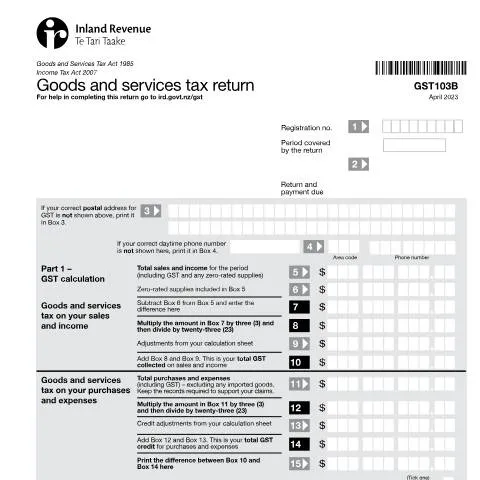
Navigating the GST103B: A Crucial Document for Your Business Tax Responsibilities
In the dynamic landscape of New Zealand's taxation system, the GST103B form stands as a vital instrument for businesses to fulfil their Goods and Services Tax (GST) obligations. This document is not merely an administrative requirement but a key player in the broader financial ecosystem that supports sustainable business operations.
Understanding Who Engages with GST103B
Primarily, the GST103B form is tailored for registered businesses that earn over NZD 60,000 annually from taxable supplies. However, certain nuances come into play depending on the nature of the business. Here are some profiles of potential filers:
- Small Enterprises: Small businesses that meet the revenue threshold must file GST returns regularly, either monthly or bi-monthly.
- Freelancers and Contractors: Those who operate as sole traders are also required to submit this form, ensuring they report their income accurately.
- Companies with Complex Structures: Businesses with multiple divisions or branches must carefully aggregate their sales and income from various sources.
- Non-Resident Entities: Foreign businesses engaged in trade within New Zealand may also need to comply with GST requirements, albeit with specific filings.
Exceptions and Unique Cases
While the general obligation to file the GST103B applies widely, there are notable exceptions:
- Exempt Supplies: Businesses dealing exclusively in exempt supplies, like some financial services, may not need to file.
- Threshold Adjustments: If a business's revenue fluctuates below the NZD 60,000 threshold in a given year, they may be eligible for deregistration from GST.
The Ripple Effects of Filing: Rights and Obligations
Submitting the GST103B is more than just a regulatory box to tick; it opens avenues for both rights and obligations:
- Claiming Input Tax Credits: By filing accurately, businesses can claim back GST on eligible purchases, thus reducing their overall tax burden.
- Penalties for Non-Compliance: Failing to file on time can lead to significant penalties and interest, further exacerbating a business's financial health.
Consequences of Inaccuracies
Even minor inaccuracies can have serious repercussions. A miscalculation in GST payable may lead to tax audit flags, potential fines, or even legal action for persistent non-compliance.
Decoding the Filing Process: A Step-by-Step Journey
Filing the GST103B involves several key steps, each of which must be approached with precision:
- Gather Financial Records: Compile all financial data, including total sales and any zero-rated supplies.
- Calculate GST: Utilize the form sections meticulously to calculate your GST collected and paid.
- Fill out the GST103B Form: Enter the required information clearly in the designated boxes, ensuring accuracy.
- Review and Submit: Before submission, double-check all figures and then file the form either online via myIR or via traditional postal methods.
Submission Channels and Their Nuances
The choice of submission channel impacts the ease and convenience of GST filing:
- Online Submission: Filing through myIR is encouraged for its efficiency and the immediate acknowledgment it provides.
- Paper Submission: This traditional method may be used, but it can lead to delays, especially if postal services are slow.
- In-Person Filing: Businesses may opt to submit their forms directly at an IRD office, although this is less common in the digital age.
| Submission Method | Advantages | Disadvantages |
|---|---|---|
| Online (myIR) | Fast processing, immediate confirmation | Requires a digital setup |
| Paper | Familiarity for some users | Longer processing times |
| In-Person | Direct interaction for complex queries | Limited office hours, potential queues |
Distinguishing GST103B from Related Forms
The GST103B form is often confused with other tax forms, such as the income tax return. It is essential to delineate these distinctions:
- GST103B: Specifically for reporting GST obligations and collecting input tax credits.
- Income Tax Return: Reports overall income, expenses, and tax liability, not limited to GST-related finances.
Understanding the Interplay with Other Documents
Entities engaging with both GST and income tax must ensure meticulous record-keeping to avoid overlaps or omissions. Each form caters to different aspects of taxation.
Pitfalls to Avoid When Completing GST103B
While the GST103B form is straightforward, certain sections may trip up even the most diligent business owners. Here’s a breakdown of common sections with potential pitfalls:
Key Sections and Their Common Errors
- Total Sales and Income (Box 5): Ensure that all sources of income are included; overlooking zero-rated supplies can skew your figures.
- Goods and Services Tax on Sales (Box 7): This crucial calculation must be precise, as errors here affect your overall GST payable or refundable.
- Adjustments (Box 9): Missing adjustments can lead to significant discrepancies; always keep track of your calculation sheets.
Special Considerations for Unique Situations
Some businesses may encounter scenarios that require special attention while filing the GST103B:
- Foreign Businesses: Non-resident businesses must understand the local GST implications and may require additional documentation.
- Complex Financial Structures: Organizations with multiple branches may find the aggregate reporting challenging, necessitating careful data management.
- Urgent Filings: In cases of urgency due to penalties or disputes, businesses should prioritize online filing to ensure timeliness.
Documentation for Non-Standard Cases
Documentation requirements may vary, particularly for foreign entities or those with diverse operations. Consulting the IRD or a tax advisor may provide clarity in these complex situations.
Deciding the Value of GST103B for Your Financial Health
Engaging with the GST103B and understanding its implications can greatly impact a business's financial stability, presenting opportunities for tax credits and refunds.
For those navigating the New Zealand tax system, taking the time to familiarize oneself with the GST103B can lead to significant benefits. Completing it accurately not only ensures compliance but also maximizes potential financial gains.
Understanding the Relationship Between GST and Provisional Tax
The Goods and Services Tax (GST) and provisional tax are two vital components of New Zealand's taxation system that influence how businesses operate financially. Understanding the relationship between these two forms of taxation can help business owners better navigate their fiscal responsibilities.
GST is a consumption tax levied on most goods and services sold in New Zealand, currently set at 15%. Every registered business must charge GST on taxable supplies and can claim back GST on their business purchases. This mechanism is crucial for managing cash flow, as businesses effectively act as intermediaries for the government, collecting tax from customers and passing it on to the IRD (Inland Revenue Department).
Provisional tax, on the other hand, is a way for the IRD to collect income tax from businesses throughout the year rather than in one lump sum after the end of the fiscal year, which runs from 1 July to 30 June. Businesses that expect to owe more than NZD 5,000 in tax for the year must pay provisional tax. The payments are based on the business’s estimated income, making it essential to keep accurate financial records to forecast tax liabilities effectively.
One of the key intersections between GST and provisional tax arises in a business's cash flow management strategy. For example, if a business underestimates its income and consequently its provisional tax liability, it may find itself in a precarious position if its GST collection from customers does not align with its provisional tax obligations. Therefore, understanding both taxes and their implications on cash flow is critical for effective financial planning.
Additionally, businesses should note that it is possible to offset excess GST credits against provisional tax liabilities, providing a cash flow relief mechanism. This practice allows businesses to manage their finances more effectively, ensuring that they do not overextend their financial resources. However, careful documentation and timely submission of GST returns are crucial to leveraging this benefit.
Common Pitfalls and How to Avoid Them
Navigating GST and provisional tax returns can be challenging, especially for small business owners who may not have a background in finance. Awareness of common pitfalls can significantly reduce mistakes and ensure compliance with New Zealand tax laws.
One common mistake is failing to register for GST on time. If your business's turnover exceeds NZD 60,000 in any 12-month period, you are legally required to register. Failing to do so could result in penalties and interest charges. It is advisable to regularly monitor your turnover and seek advice if you are nearing the threshold.
Another frequent oversight is not keeping detailed and accurate financial records. The IRD requires businesses to maintain suitable records for at least seven years, which must be easily accessible if requested. Neglecting this responsibility can lead to difficulties should the IRD require verification of your GST or provisional tax calculations.
Additionally, many businesses miscalculate their provisional tax obligations. It’s crucial to base your provisional tax payments on realistic income estimates. Underestimating can result in a tax shortfall and possibly penalties, while overestimating ties up cash unnecessarily. A common strategy is to use the "uplift" method, which calculates provisional tax based on the previous year's tax liability, adjusted for expected changes.
Lastly, timing can be a significant factor. Businesses often fail to submit GST returns on time, leading to late penalties. Understanding the filing deadlines is vital. For instance, if you’re on a bi-monthly filing schedule, your GST returns are due on the last working day of the month following the end of the two-month period. Keeping a calendar of important tax deadlines can be an effective way to avoid these pitfalls.
GST for Non-Residents and International Transactions
The landscape of GST in New Zealand becomes more complex when considering non-residents and international transactions. For businesses engaging in cross-border trade, understanding GST implications is crucial, not only for compliance but also for strategic business planning.
In general, non-residents are not required to register for GST unless they are making taxable supplies in New Zealand. This includes selling goods or services that are physically delivered or performed within the country. However, if a non-resident sells low-value goods (under NZD 1,000) to New Zealand consumers, they must register for GST and charge GST on those sales.
For businesses exporting goods or services, sales to overseas customers are typically zero-rated for GST. This means that while you charge 0% GST on the sale, you're still entitled to claim back GST on purchases related to that sale. However, to maintain this zero-rating status, businesses must meet specific documentation requirements, including proof of export and invoices that clearly indicate zero-rated GST status.
In contrast, when purchasing services from overseas suppliers, New Zealand businesses may need to self-assess GST on those services if the supplier is not registered for GST in New Zealand. This is often referred to as the "reverse charge" mechanism. Businesses must account for this GST in their GST returns, even if they do not pay the GST upfront to the supplier.
Additionally, New Zealand's provisional tax obligations may also apply to non-residents who earn income from New Zealand sources. The IRD has specific guidelines for calculating and remitting provisional tax for non-resident entities, which can differ from standard practices. Consulting with tax professionals is advisable for non-residents to ensure compliance with local tax laws while maximizing any potential tax benefits.