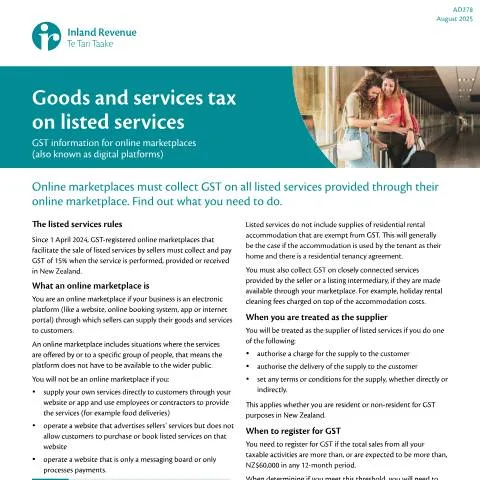
Navigating the GST Landscape for Online Marketplaces in New Zealand
In the rapidly evolving sharing economy, the implementation of Goods and Services Tax (GST) for services rendered through online marketplaces marks a significant change. The AD278 document outlines these regulations, providing essential guidelines for marketplace operators who facilitate transactions between service providers and customers. Understanding this framework is crucial for businesses to remain compliant and effectively manage their tax obligations.
Unpacking the Role of AD278 within the GST Framework
The AD278 document serves as a guideline for online marketplaces regarding their responsibilities to collect GST on listed services. Effective from 1 April 2024, this regulation mandates that GST-registered online marketplaces must collect a rate of 15% on all listed services provided or received within New Zealand. This includes but is not limited to ride-sharing, food delivery, and visitor accommodation services.
The primary function of AD278 is to clarify the obligations of online marketplaces, ensuring they understand their status as suppliers of listed services. This is important as the GST implications can significantly affect the financial health of a business and its compliance with New Zealand tax regulations.
Understanding Listed Services and Their Exclusions
Listed services encompass a variety of offerings, including:
- Ride-sharing and ride-hailing services.
- Food and beverage delivery services.
- Short-stay and visitor accommodation.
However, it is essential to note the exceptions. For instance, supplies of residential rental accommodation are generally exempt from GST, provided that the accommodation is used as a primary residence by the tenant. This distinction is crucial as it affects how GST is applied to various transactions within the marketplace.
Who is Required to Register for GST?
The requirement to register for GST hinges on the total sales generated from taxable activities. Specifically, if a business anticipates sales exceeding NZ$60,000 within a 12-month period, it must register for GST. This threshold encompasses all sales facilitated through the marketplace, including remote services and any fees charged to customers.
For non-resident marketplaces, a fair and reasonable method for currency conversion to New Zealand dollars is permitted to determine whether the GST registration threshold has been met.
Step-by-Step Registration and Compliance Process
- Determine Eligibility: Assess whether your total sales surpass the NZ$60,000 threshold.
- Register for GST: New Zealand residents can register online via myIR, while non-residents follow a separate GST registration process.
- Choose Filing Frequency: Depending on your sales volume, you will select your GST filing frequency, either monthly or quarterly.
- Collect GST: Charge the regular 15% GST on all eligible services provided through your marketplace.
- File Returns: Regularly file GST returns through the myIR system to ensure compliance.
Getting it Right: Filling Out the AD278 Form
Completing the AD278 form requires careful attention to detail. Operators must provide accurate information to avoid potential pitfalls that could complicate their tax obligations. Here’s a breakdown of the critical sections and common areas of confusion:
Key Sections of the AD278 Form
| Section | Description | Common Pitfalls |
|---|---|---|
| Marketplace Identification | Details about the operator and the nature of the marketplace. | Incorrect business type choice can lead to misclassification. |
| Sales Information | Total sales figures and GST liability calculations. | Underreporting sales volume can trigger audits. |
| GST Collection Method | How GST will be collected from users. | Not clarifying collection responsibilities can lead to compliance issues. |
| Signatory Details | Signature of a responsible party affirming the accuracy of information. | Unsigned forms will be considered invalid. |
Understanding What Makes AD278 Distinct
While other tax forms might cover different aspects of GST or tax obligations, the AD278 focuses specifically on the nuances of online marketplace operations. It delineates responsibilities that are particularly relevant for digital platforms, setting it apart from general GST documentation.
Online marketplace operators need to recognize that liability under GST arises when they act as intermediaries facilitating transactions. This contrasts with direct sellers or service providers, who may have different reporting and compliance requirements. Thus, clarity on these differences is vital for maintaining compliance and avoiding any penalties.
What Happens After Submission of the AD278 Form?
Once the AD278 form is submitted, the marketplace operator enters a crucial phase of compliance and monitoring. Here’s what follows:
- Processing by the IRD: The Inland Revenue Department (IRD) will review your submission for completeness and accuracy.
- Confirmation of Registration: If approved, you will receive confirmation of your GST registration, which is vital for your operations.
- Ongoing Compliance: You are now required to maintain accurate records of all transactions and file GST returns regularly, depending on your chosen frequency.
- Adherence to Payment Deadlines: Ensure to remit the collected GST to the IRD by the specified due dates to avoid penalties.
Addressing Issues: What to Do in Case of Errors or Missing Information
Errors in the submission of the AD278 form can lead to complications in your tax status and may necessitate corrective action. Here’s how to manage issues effectively:
- Identify the Issue: Review your submission and identify any inaccuracies or missing information.
- Contact the IRD: Reach out to the IRD as soon as possible for guidance on how to rectify the issue.
- Submit Corrections: File amended returns or additional documentation as directed by the IRD.
- Monitor Compliance: After corrections are made, ensure ongoing compliance and maintain updated records to prevent future issues.
The Importance of Proactive Compliance
Understanding the implications of GST as it pertains to listed services through online marketplaces isn't just about adhering to regulations—it's also about fostering trust with consumers and ensuring the sustainability of your business operations. By proactively managing GST obligations and staying informed about changes in the tax landscape, online marketplace operators can mitigate risks and enhance their service offerings while remaining compliant with New Zealand law.
The introduction of GST regulations on listed services signifies a maturation of the sharing economy in New Zealand, establishing frameworks that benefit both providers and consumers. By thoroughly understanding and engaging with the requirements set out in the AD278 document, marketplace operators can effectively navigate the complexities of taxation in this dynamic sector.