Understanding the FATCA Status of New Zealand Trusts: A Critical Examination
Navigating the complexities of tax compliance regulations can be daunting, particularly for trusts in New Zealand operating under international frameworks like FATCA (Foreign Account Tax Compliance Act). The IR1086 form, titled FATCA status of NZ trusts that are not U.S. persons (2017), plays an essential role in establishing these trusts' tax status. Understanding when and how to complete this form is vital for ensuring compliance and avoiding potential penalties.
Who Should Be Concerned About the IR1086 Form?
The IR1086 form is particularly relevant for trustees of New Zealand trusts that are classified as Non-Financial Foreign Entities (NFFEs) under FATCA. This situation typically arises when:
- The trust is a New Zealand resident not classified as a U.S. person.
- The trust does not fall under the definitions of a financial institution as outlined by the Intergovernmental Agreement (IGA) between New Zealand and the USA.
Trustees must assess their trust's activities and legal structure to determine its FATCA status accurately. This process requires a nuanced understanding of both domestic and international regulations.
The Step-by-Step Process of Completing the IR1086 Form
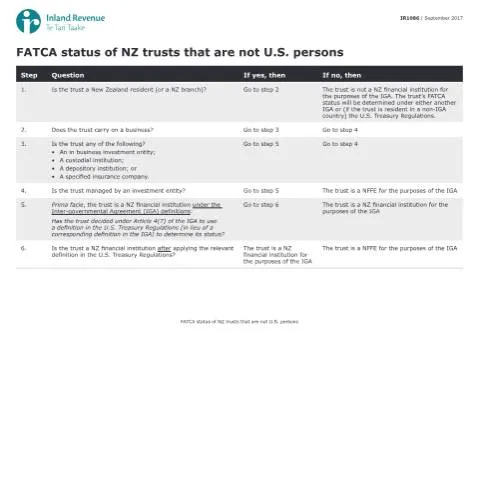
Completing the IR1086 form involves answering a series of questions that guide the determination of the trust’s FATCA status. Here's a breakdown of the steps:
- Is the trust a New Zealand resident?
If yes, proceed to the next question. If no, the trust is not classified as a financial institution under FATCA and will be governed by either another IGA or the U.S. Treasury Regulations.
- Does the trust carry on a business?
If yes, continue to the subsequent question. If no, go to the next relevant section.
- Is the trust classified under specific financial categories?
If yes, it may be deemed a New Zealand financial institution. If no, proceed to the next question.
- Is the trust managed by an investment entity?
If yes, the trust’s status must be further assessed. If no, it may be classified as a Non-Financial Foreign Entity.
- Does the trust elect to use U.S. Treasury Regulations to determine its financial institution status?
If yes, continue evaluating the trust’s classification. If no, it remains classified under NZ definitions.
- Finally, is the trust a financial institution according to U.S. Treasury Regulations?
If yes, the trust is a New Zealand financial institution for FATCA purposes. If no, it remains classified as an NFFE.
Exploring the Channels for Submitting the IR1086 Form
The IR1086 form can be submitted through various channels, depending on the preference of the trustee and the nature of the trust.
- Online Submission: Utilizing the online services provided by the Inland Revenue Department (IRD) is often the fastest and most efficient method. Trustees can complete the form via their RealMe digital ID, ensuring a secure submission.
- Paper Forms: For those who prefer traditional methods, paper forms can be completed and mailed directly to the IRD. This method may involve longer processing times.
- In-Person Submission: Although less common, trustees have the option to submit their forms at an IRD office. It is advisable to schedule an appointment ahead of time to avoid long waits.
Each channel has its pros and cons, and trustees should choose the one that best suits their needs and capabilities.
Special Considerations for Unique Situations
Trustees may encounter unique situations that complicate the submission of the IR1086 form. Understanding these nuances is critical for ensuring compliance:
- Foreign Trusts: If a trust operates across borders, the trustee must evaluate its obligations under both New Zealand law and the laws of the trust's resident country. This may necessitate filing under different jurisdictions.
- Minors and Incapacitated Individuals: In cases where a minor or an incapacitated individual is the trust beneficiary, a guardian or legal representative must fill out the IR1086 on their behalf.
- Complex Structures: Trusts with multiple layers or involving partnerships may require additional documentation or legal consultation to ensure accuracy in the submission.
Dealing with Errors or Missing Information on the IR1086
In the event of a mistake or if required information is missing from the IR1086 form, trustees should act promptly:
- Rectifying Errors: Trustees can correct any errors by submitting a revised IR1086 form. It is crucial to indicate that the new submission is a correction and to cite the original submission.
- Addressing Missing Information: If additional information is requested by the IRD, trustees should respond as quickly as possible, providing the necessary details to avoid potential penalties.
Failure to address these issues may lead to delays in processing and could significantly affect the trust’s compliance status.
Timelines and Important Dates for the IR1086 Submission
Understanding the timeline for submission and the consequences of delays is essential for compliance:
- Submission Period: The IR1086 form should be submitted as soon as the trust is established or when there are changes to its status. Regular reviews are advisable to maintain compliance.
- Consequences of Late Submission: Late submissions can lead to penalties and increased scrutiny from tax authorities, emphasizing the need for timely reporting.
Profiling Trusts and Their Circumstances Under FATCA
Diverse scenarios exist concerning trusts and their applicability under FATCA. Understanding these profiles is crucial for compliance:
| Trust Type | FATCA Classification | Remark |
|---|---|---|
| Simple Trust | NFFE | Basic structure, typically with no business operations. |
| Complex Trust | May be a Financial Institution | Dependent on operations; requires further assessment. |
| Charitable Trust | NFFE | Generally exempt from FATCA unless generating significant income. |
| Foreign Trust | Dependent on jurisdiction | Must comply with multiple tax regimes. |
Each trust type has unique obligations and would have to navigate FATCA rules accordingly, necessitating a careful examination of their status.
Final Thoughts on the Importance of the IR1086 Form
Completing the IR1086 form is not just a regulatory requirement; it represents the trust’s commitment to complying with international taxation standards. Given the implications for tax compliance and potential penalties, understanding the particulars of this form is essential for trustees. As compliance complexities continue to evolve, proactive management of tax obligations will ultimately serve to protect the interests of the trust and its beneficiaries.